Secret Service drone port revelation could undercut Trump’s claim ballroom is needed ‘to protect the White House’
Por Collin Binkley — – World RSS Feed
Secret Service drone port revelation could undercut Trump’s claim ballroom is needed ‘to protect the White House’
Trump started talking about the drone port in May, weeks after a federal judge halted ballroom construction but allowed work on security components to continue
Collin Binkley Wednesday 23 September 2026 19:40 BST
- Bookmark
Bookmark popover
Removed from bookmarks
Close popover

Become an Independent member to bookmark this article
Want to bookmark your favourite articles and stories to read or reference later? Start your Independent Membership today.
Already a member?
Log in
Your support helps us to tell the story
Read more Support Now
From reproductive rights to climate change to Big Tech, The Independent is on the ground when the story is developing. Whether it’s investigating the financials of Elon Musk’s pro-Trump PAC or producing our latest documentary, ‘The A Word’, which shines a light on the American women fighting for reproductive rights, we know how important it is to parse out the facts from the messaging.
At such a critical moment in US history, we need reporters on the ground. Your donation allows us to keep sending journalists to speak to both sides of the story.
The Independent is trusted by Americans across the entire political spectrum. And unlike many other quality news outlets, we choose not to lock Americans out of our reporting and analysis with paywalls. We believe quality journalism should be available to everyone, paid for by those who can afford it.
Your support makes all the difference. Read more
President Donald Trump says a drone port, complete with armed unmanned aerial vehicles and gun-toting troops, is needed atop the new White House ballroom to safeguard the 18-acre complex and Washington, D.C. – but the Secret Service is already operating one right next door.
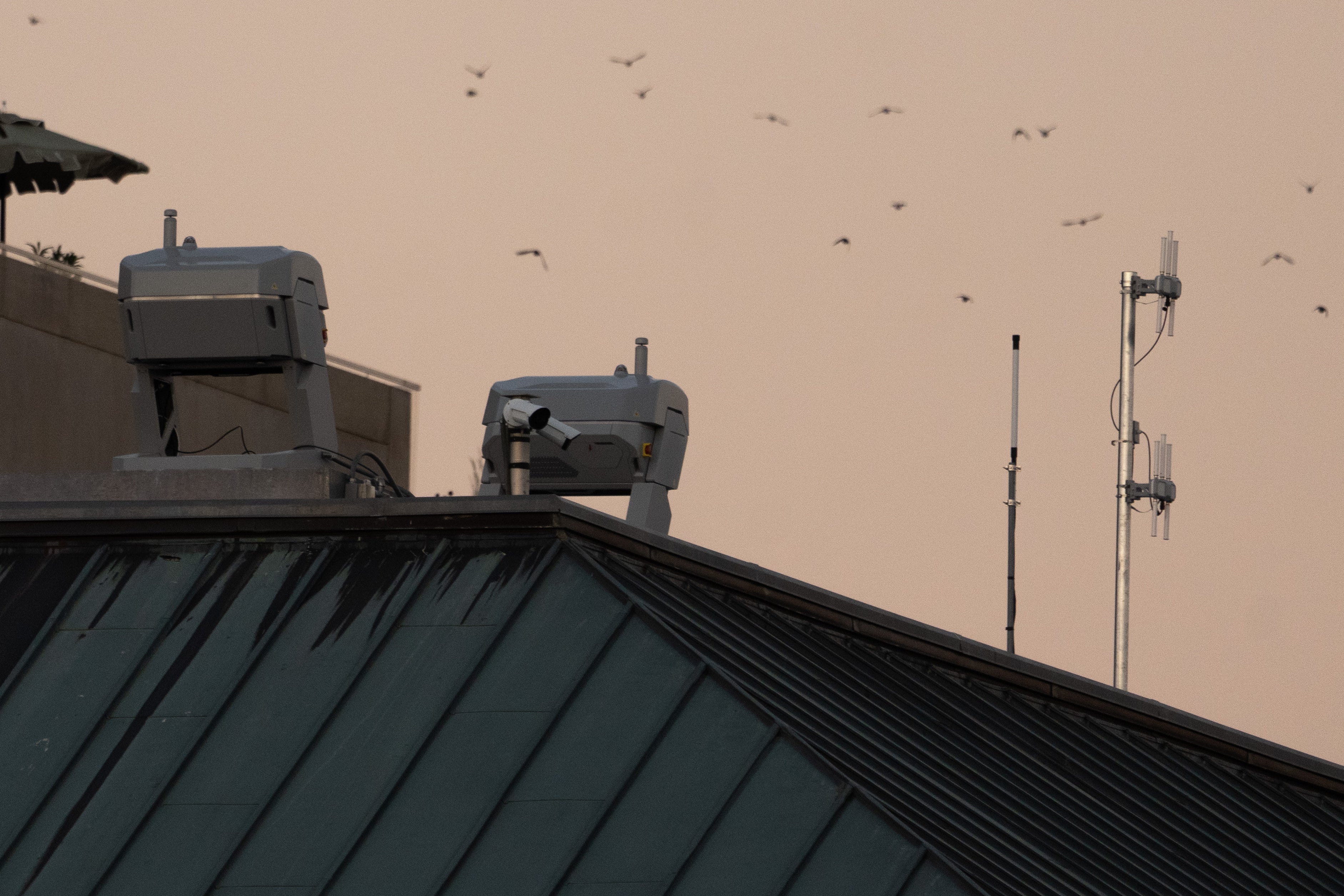
A few hundred feet away, small UAVs equipped with camera systems and sensory technology remain on standby to monitor potential risks from above until called into action by law enforcement personnel.
Utilizing a framework referred to as “drone as first responder,” the Secret Service launches fast, unarmed airborne cameras from outdoor docks. Hundreds of law enforcement entities throughout the United States employ similar systems, frequently utilizing artificial intelligence programs to navigate around hazards or monitor moving subjects.
Previously undisclosed, the operation of these monitoring drones atop a Treasury Department facility neighboring the White House property may challenge legal arguments put forth by Trump that building the ballroom is essential “to protect the White House and surrounding region from aerial attacks.”
This national security rationale served as a foundational defense for the ballroom development, an argument Trump is now employing to defend constructing a large archway near the entrance of Arlington National Cemetery.
 open image in gallery
The Secret Service’s active setup is considerably subtle compared to the aggressive plan pitched by Trump, which depicts lines of advanced combat UAVs resembling those deployed in military operations—a concept characterized as unrealistic by aviation specialists.
“To be honest, if a drone was so close to the White House that it needed interdiction, it’s already gotten too far,” stated Matt Sloane, who co-founded SkyfireAI, a developer of drone software for emergency services.
Constructing an operation similar to the neighboring Secret Service system would prove more practical for the White House, according to Sloane: “The drone takes off and does some type of perimeter sweep or whatever, and then puts itself back in the box.”
Representatives for the White House offered no statement. The Secret Service declined to discuss details regarding its drone activity, though it clarified that its current docking units are independent of Trump’s proposed ballroom drone station.
The details of Trump’s ballroom drone port remain murky
Security of the president and the White House complex is generally the domain of the Secret Service, which works in close concert with the White House Military Office and other military elements when needed.
Trump has said the drone port came at the request of U.S. military officials. Speaking to reporters in May, he said the building’s plans were expanded to meet the request: “They wanted more drone capacity,” he said. On social media, he boasted that the drone port might end up being the “most sophisticated” in the world.
What Trump is ultimately aiming to build, and how far it goes beyond what has already been installed, remains unclear. Beyond Trump’s AI images, some of which he filed in his appeal to the U.S. Supreme Court to lift lower courts’ blocks on the construction, the White House has not disclosed what kinds of drones will be used or for what tactical purpose.
The Secret Service is using smaller surveillance drones that are a fraction of the size of the attack drones depicted in Trump’s AI images. The U.S. Air Force bought similar drones from Skydio in April to protect bases across the Middle East. The company also supplied drones to help protect World Cup matches this year.
 open image in gallery
The Secret Service has been building out its drone- and counter-drone programs for years. But work has accelerated since the 2024 attempted assassination of Trump at a campaign rally in Butler, Pennsylvania, when the agency failed both to take action against a drone used by the shooter to scout out the attack and to fly one of its own to provide overwatch of the event.
In the weeks that followed, tethered and untethered surveillance drones became commonplace at campaign rallies and large events at the White House complex.
In an online video released by the agency highlighting their deployment, the Secret Service said the Skydio drones are used to provide “real-time situational awareness” and “aerial overwatch.”
“It allows you to see the threat before it becomes an issue, and to task assets accordingly,” Dustin Talbott, of the Secret Service’s Aviation and Airspace Security Division, said in the video. “We no longer wait for the threat to reveal itself. We find it first.”
Skydio did not provide comment for this story.
Trump’s drone port vision would face logistical hurdles
Trump has made it a priority to build a stronger drone presence around the White House, responding to an increase in political violence and the evolution of drone warfare.
Paul Eckloff, a former supervisor of the Secret Service’s presidential protection division, said the Russia-Ukraine war has highlighted the risks posed by drones, even off-the-shelf models that can cause massive damage. Drones now represent one of the largest emerging threats the White House must defend against, he said.
During Trump’s first term, conversations about drones often centered on their use in places like Iraq and Syria, said Javed Ali, who served on the National Security Council during that time and now teaches national security at the University of Michigan. Since then, it has become a matter of domestic security, he said.
Yet there would be major logistical hurdles involved in putting a busy drone port on top of the White House, he said. “There’s a whole host of questions, like who is responsible for overseeing it, and how would there be any de-confliction with commercial airspace?” he said.
Complexities around federal oversight were laid bare this year when the U.S. military used a laser to shoot down a drone near El Paso, Texas, only to find it belonged to Customs and Border Protection. The mishap briefly led the FAA to close nearby airspace.
 open image in gallery
A drone hub at the White House would navigate crowded and complex airspace around Washington, not far from Reagan Washington National Airport and flight paths shared by other military aircraft.
Opponents say the White House is becoming a fortress
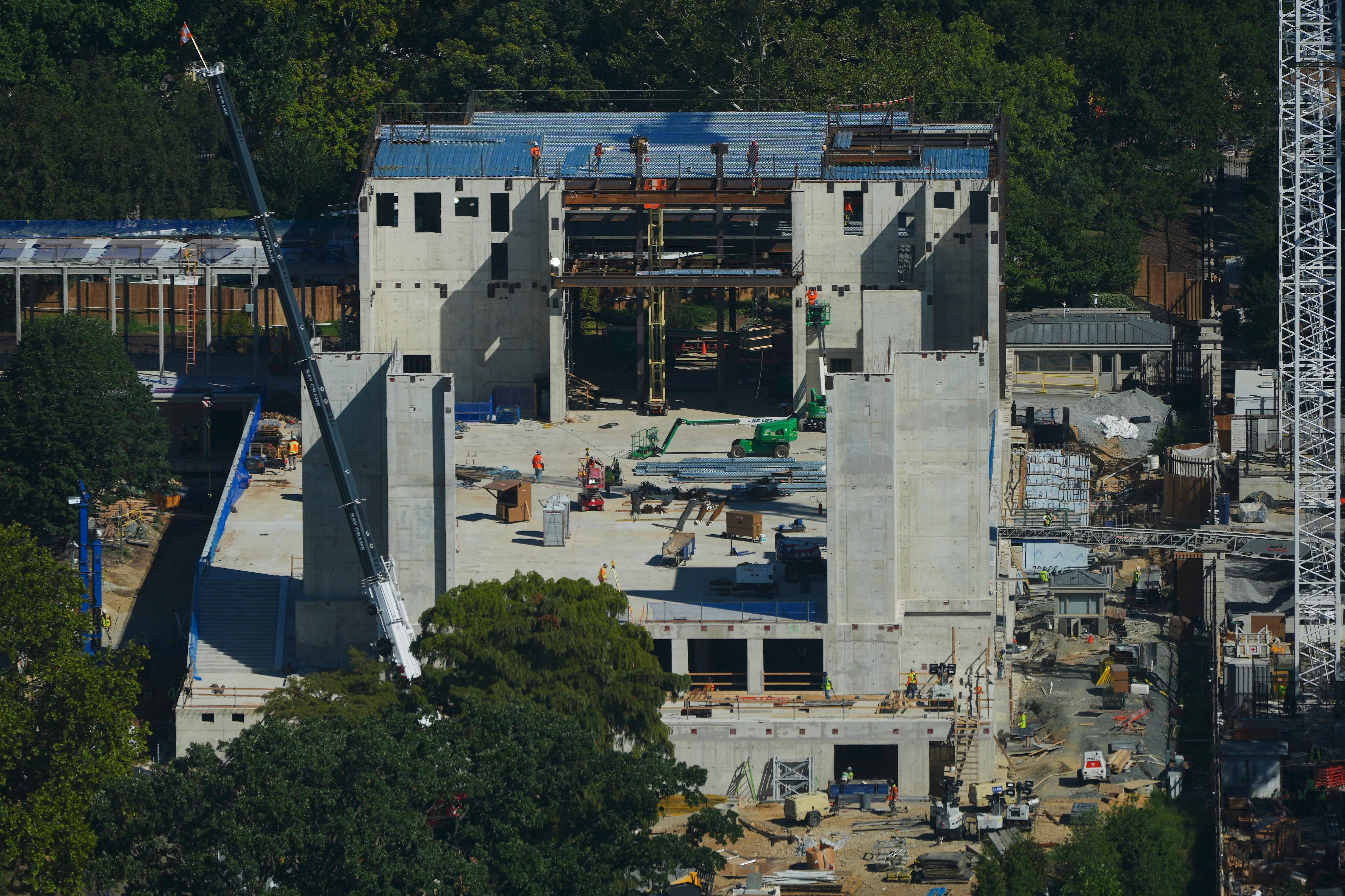
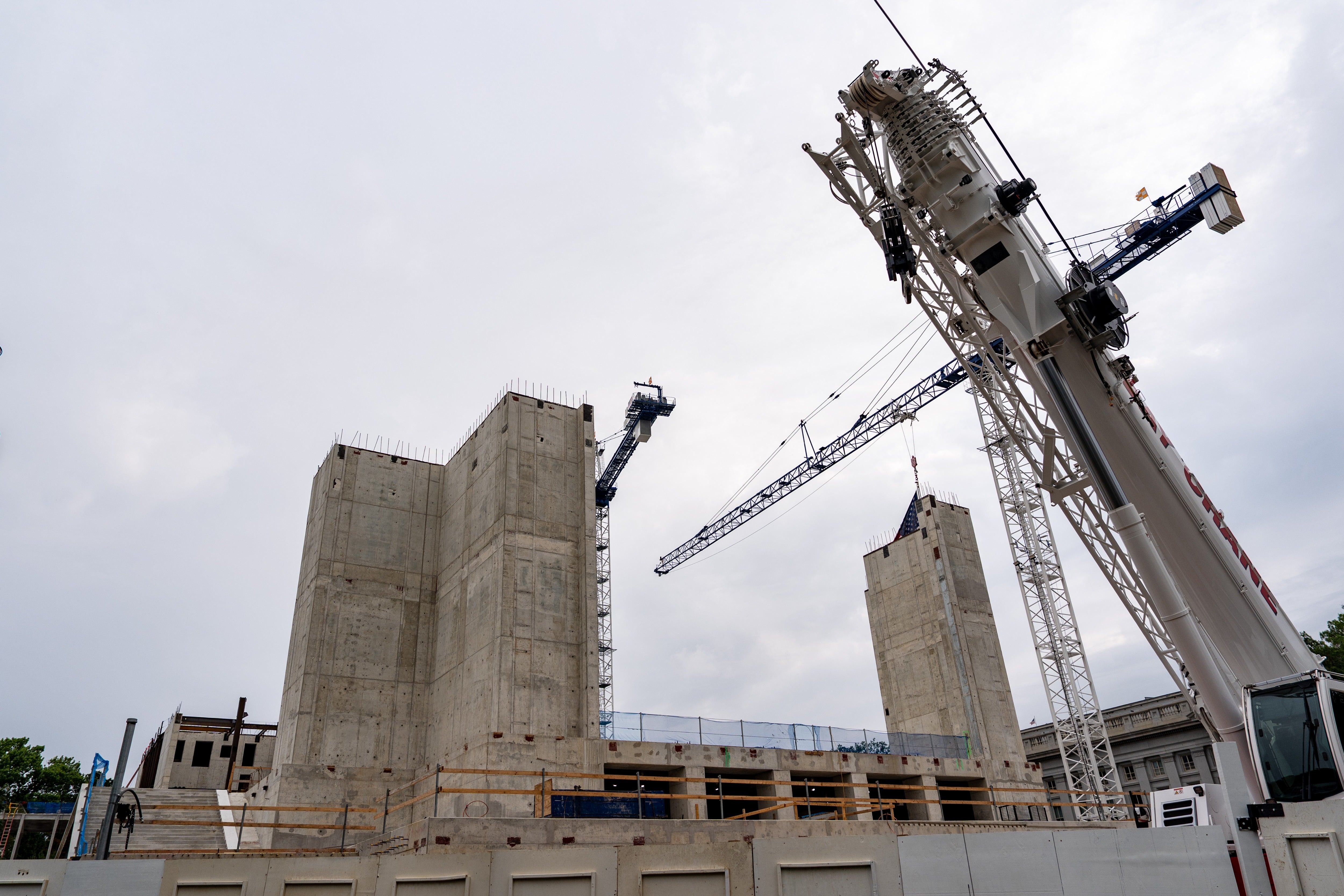
Trump started talking about the drone port in May, weeks after a federal judge halted ballroom construction but allowed work on security components to continue. Trump later went on to refer to the ballroom as a “military complex,” leaning on that security role as a legal justification.
The Supreme Court in August cleared Trump to continue construction as the legal challenge moves ahead.
Opponents say the president is going too far in his hardening of the White House, turning it into something closer to a fortress. Edward Lengel, a former chief historian for the White House Historical Association, said Trump has militarized the White House at a scale that’s at odds with its legacy as “the people’s house.”
“It turns it into a big giant porcupine that has its spines pointing out against the people and against the world,” Lengel said.
Trump has argued that the White House was in “very bad condition” when he returned to office, saying it had become vulnerable to modern threats.
At times, he has expressed concerns about his own safety and the risks posed by drones and other air threats. Speaking at a Rose Garden dinner for law enforcement officials in May, Trump quickly glanced up from the lectern as a low bird flew overhead.
“I thought that was a drone,” Trump said, bringing laughs from the crowd. “They make them in all different sizes nowadays — they can be very destructive, as you’ve probably heard.”
More about
Secret ServiceDonald TrumpWhite HouseSecurity
Most popular
Popular videos
Bulletin
Read next
Fonte: – World RSS Feed