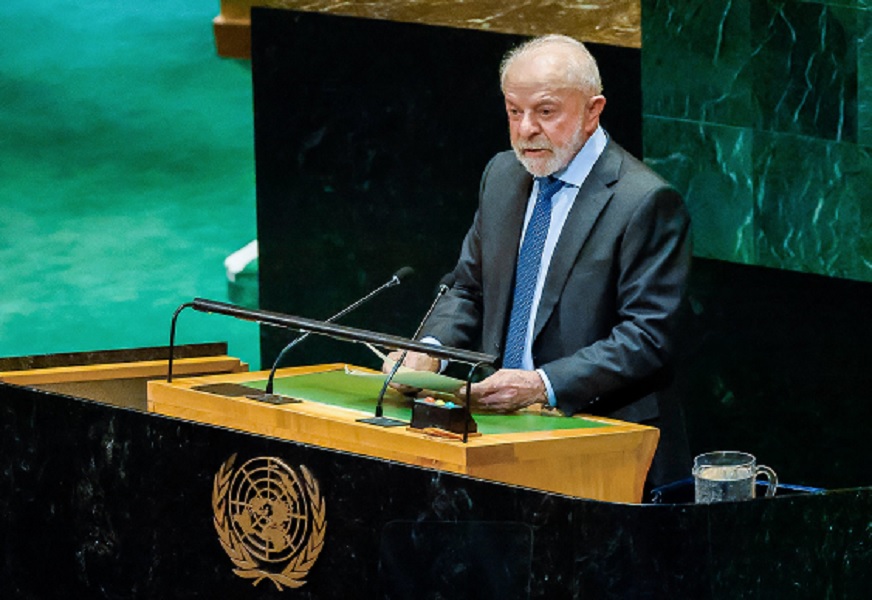
The United Nations looks broken. Is it?
Por Caitlin Dewey — Vox – All

This story appeared in Today, Explained, a daily newsletter that helps you understand the most compelling news and stories of the day. Subscribe here.
It’s time for yet another United Nations General Assembly meeting in Manhattan — just one year after President Donald Trump appeared at it and asked, bluntly: “What is the purpose of the United Nations?”
Every year around this time, roughly 130 leaders from around the world convene at the UN to deliver speeches, hold diplomatic meetings, and debate issues like AI, climate change, and the wars in Ukraine, Gaza, and Iran. Trump is scheduled to speak this week, as are Ukrainian President Volodymyr Zelenskyy, Iranian President Masoud Pezeshkian, and Israeli Prime Minister Benjamin Netanyahu (…despite New York’s chilly reception).
Even more important than those big public speeches, however, are the one-on-one talks between foreign leaders. Trump has a packed meeting schedule on Monday and Tuesday, featuring the likes of Zelenskyy, New York City Mayor Zohran Mamdani, and new British Prime Minister Andy Burnham.
In Trump’s famously bizarre speech last year, he attacked several US allies, called climate change a “con,” and suggested the UN itself was irrelevant. Increasingly — as we’ll get into below — that’s an accusation echoed by many UN critics.
Go a little deeper
This week’s meeting comes at a moment of crisis — or at the very least, inflection — for the United Nations.
The UN faces a severe budgetary shortfall this year, caused largely by Trump’s refusal to pay America’s full dues. At the same time, the UN has battled searing criticism of its inability to end conflicts in places like Ukraine, Iran, and Gaza.
Under the organization’s founding charter, any of the five permanent members of its Security Council — the body responsible for maintaining international security — can block important resolutions unilaterally. In 2022, Russia controversially used that power to torpedo a resolution condemning its attempted annexation of parts of Ukraine. Three years later, the US similarly vetoed a demand for a permanent ceasefire in Gaza and an increase in unrestricted humanitarian aid.
Critics point to impasses like these as evidence the UN no longer works; even UN Secretary-General António Guterres has said the Security Council needs reform. But it would be a mistake to conclude the UN is somehow irrelevant or newly ineffectual.
For one thing, Security Council gridlock isn’t a recent development — it’s the historical norm. (Check out all the Cold War-era vetoes in the chart above.) The UN is also far more than its Security Council — it’s a sprawling humanitarian apparatus that provides food, cash aid, medical care, and other assistance to millions around the world.
In Gaza last year alone, for instance, the UN says it provided clean water to 1.6 million people, operated dozens of makeshift schools for Palestinian children, and distributed almost $55 million of humanitarian cash assistance.
Those efforts probably won’t make headlines this week. But they help answer Trump’s 2025 question.
One link for later
➨ Put yourself first for once. A striking new poll finds that healthcare challenges prevent a sizable plurality of women from having the careers, social relationships, and family lives they want. The problem is overwhelmingly structural, of course. But in an exclusive interview with Vox, the philanthropist Melinda French Gates warns that women are also “often taught to put themselves last,” especially when they’re caregivers.
Before you go…
- Did you know…that crows can solve puzzles as well as 5-year-olds? In one study, they were observed bending a piece of wire to fish a treat out of a tube.
- Today’s trivia: Which classic Broadway star — the most successful of her generation — debuted the songs “I Got Rhythm,” “I Get a Kick Out of You,” and “There’s No Business Like Show Business”? (You can find this and other brain puzzles in Vox’s daily crossword. Look for the answer in tomorrow’s edition.)
- Yesterday’s trivia: Last week we asked you for the US Supreme Court justice who succeeded John Paul Stevens. That would be Elena Kagan, an Obama nominee who was confirmed to the court in 2010.
Fonte: Vox – All