Yale’s Protest Tradition Is Back
Por Zachary Clifton — The Nation » Article
/
/
October 7, 2026
Yale’s Protest Tradition Is Back
For the first time in 50 years, Yale students gathered around an iconic sculpture to protest their university and their government.
Share
Copy Link
Facebook
X (Twitter)
Bluesky
Pocket
Email
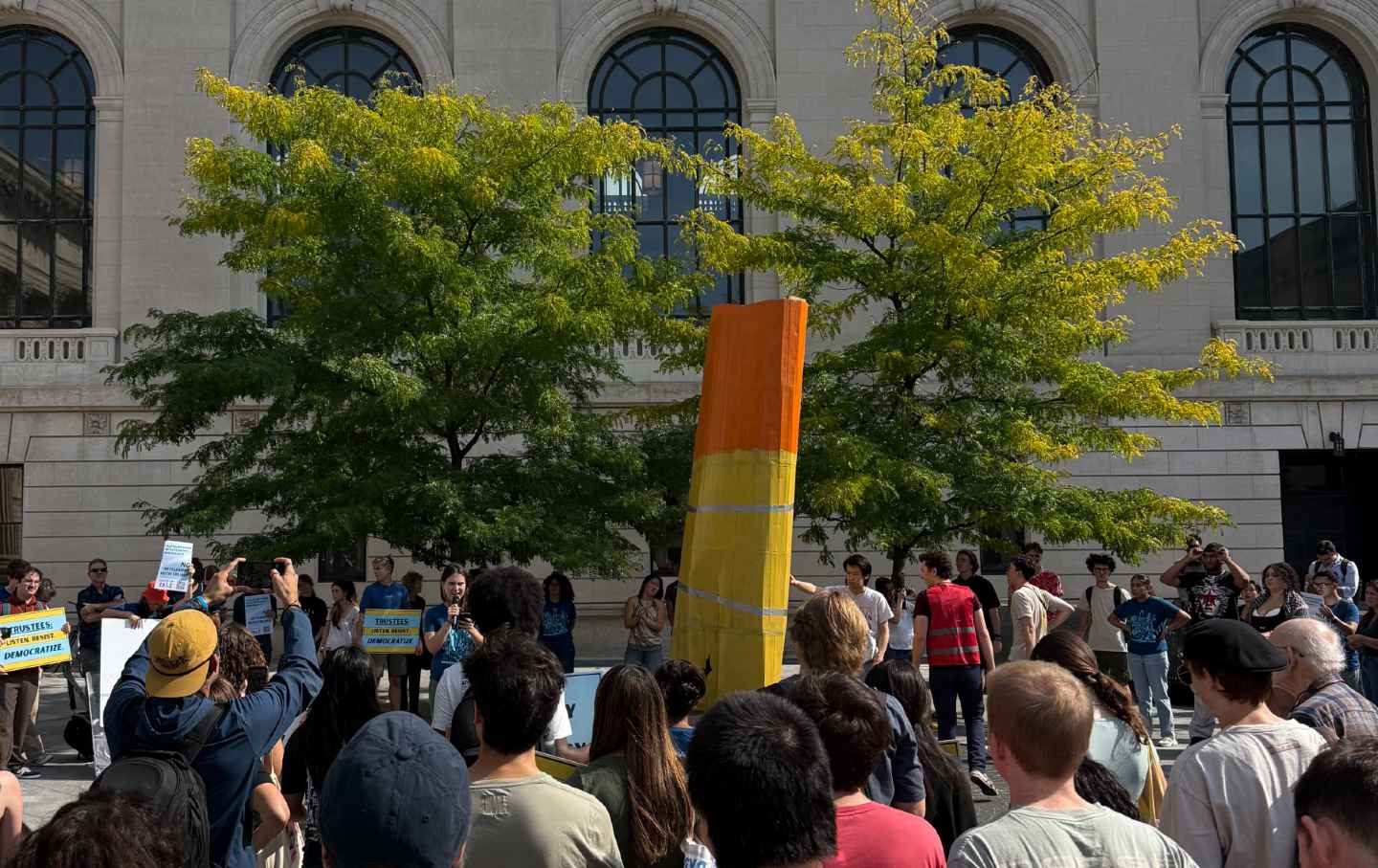
A crowd gathered around a 12-foot cardboard version of Claes Oldenburg’s lipstick sculpture to protest their university and government.
(Zachary Clifton)
StudentNation is a program of the Nation Fund for Independent Journalism and is made possible through generous funding from the Puffin Foundation . StudentNation focuses on first-person accounts from student activists, organizers, and journalists and has helped launch the careers of contributors to The New York Times , Vox , Business Insider , Teen Vogue , the Guardian , and more. If you’re a student and you have an article idea, please send pitches and questions to [email protected].
By 1969, the Vietnam War had killed tens of thousands of young American men. President Richard Nixon had begun a secret bombing campaign in Cambodia. Across the United States, millions of protesters, many of them students, joined the largest anti-war marches in American history. In New Haven, Connecticut, Yale students were among the loudest, most impassioned demonstrators.
That spring, Claes Oldenburg, who had graduated from Yale nearly two decades earlier, installed a sculpture on Beinecke Plaza, the center of campus. It was called Lipstick (Ascending) on Caterpillar Tracks: a giant tube of lipstick rising from the treads of a tank. Students for a Democratic Society used it as a podium for their speakers during anti-war rallies, positioning it outside Woodbridge Hall, where university presidents historically had their office and where trustees met. The art historian Mya Dosch has called the tube “phallic and bullet-like,” a beauty product that evokes the danger and threat of a weapon.
The sculpture, and the protests that it featured in, were about young people versus large institutions: the university and the federal government.
Last Friday, the Lipstick appeared on Beinecke Plaza for the first time in more than 50 years. Yale College students had built a cardboard version, about half the size of the original, and placed it near where its predecessor once stood. (Oldenburg’s sculpture was moved to the Yale University Art Gallery’s sculpture garden.)
Hundreds marched to Beinecke Plaza to protest, two generations later, their university and their nation’s government. Specifically, they gathered for the second protest of Democratize Yale, a coalition of students, staff, faculty, and alumni that formed following the university’s settlement negotiations with the federal government about Yale’s alleged racial discrimination in their admissions process. The coalition’s demands include shared governance; free speech and assembly; academic freedom; and that the university exit negotiations with the Department of Justice, which they see as a strategy to appease Trump.
Senator Richard Blumenthal, Representative Rosa DeLauro, and New Haven Mayor Justin Elicker stood in the crowd, signaling solidarity with the demonstrators’ civil disobedience against the university. Blumenthal could be seen chanting with the students who now study at his alma mater. Members of the Yale chapter of the American Association of University Professors were also there, speaking and joining rallying cries.
Current Issue

The crowd gathered around the twelve-foot cardboard version of Oldenburg’s sculpture for an unregistered protest, deliberately violating Yale’s campus free-expression policies. The sculpture also violated a rule barring outdoor artwork without administrative approval. Sam Callaway and Stuart Wrede, two architects who built the original with Oldenburg, sent the organizers a statement calling the ban censorious. “What is Yale afraid of?” they asked.
Organizers passed chalk through the crowd and asked everyone to write down what they would do with the university if they ran it. Soon the granite was covered in messages and peace signs. Someone had written “Make love not war,” a slogan reminiscent of the original Lipstick’s era. Someone else had written “Fuck fascism.” A junior speaking on behalf of Students Unite Now, a group that organizes Yale students on labor and economic justice issues, led the crowd in a chant at an hour when Yale’s policies do not permit chanting on Beinecke Plaza: “Pre-compliance is a scam. Don’t concede to Trump’s demands.”
A week earlier, the trustees of the Yale Corporation were on campus for their first meeting of the academic year. They sat in the back seats of black town cars driving down College Street, then up Prospect Street, toward Science Hill, where, according to Yale junior John Robert Walker, they convene “in secret…far from central campus.” The trustees have been criticized for their corporate affiliations, their clandestine structure, and their lack of accountability to students, faculty, and alumni.
But, on the morning of September 26, students had arrived first. Hours ahead of the trustees, they dropped banners from prominent places around campus, like the Humanities Quadrangle and Phelps Hall, home of the Classics Department. One sign hung just below the university’s crest on the face of Sheffield-Sterling-Strathcona Hall. With the insignia’s Latin motto, the building now read:
LUX ET
VERITAS
FIGHT BACK
DON’T SETTLE
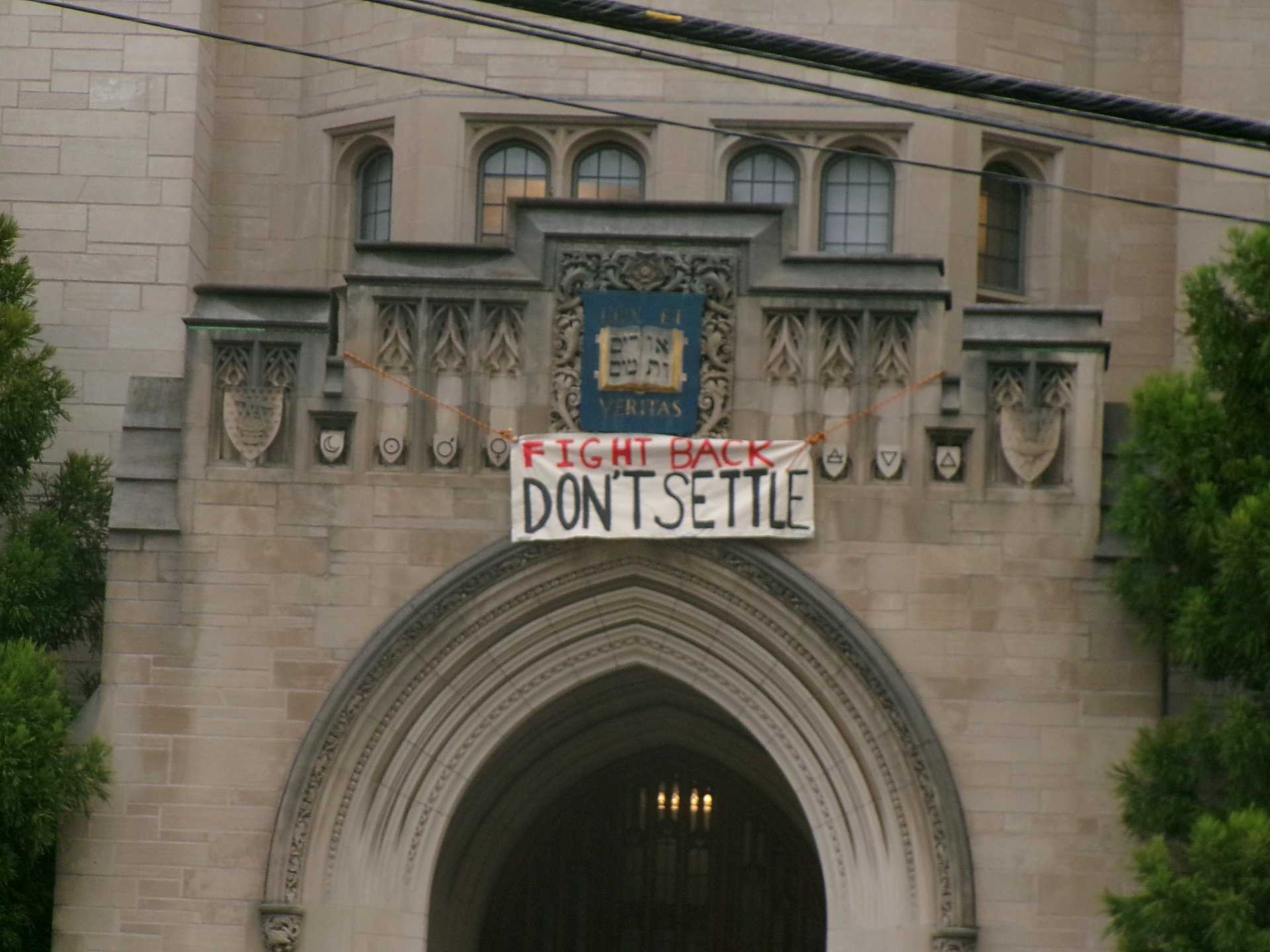
Other banners simply read “Shared governance now” and “Trustees, you can’t hide.” All of them violated Yale policy, which forbids hanging banners on building facades and requires anyone who puts up a poster to print their name and the date on it.
But students did not start out by breaking the rules. For years, they tried to express discontent through the university’s own channels.
In 2023, almost 90 percent of students who voted in a Yale College Council referendum said the trustees should be democratically elected. The Endowment Justice Coalition had campaigned to turn out the vote. The Corporation responded with a letter acknowledging that it had received the results. Students also asked the university’s Advisory Committee on Investor Responsibility, three times, to divest from weapons manufacturers. Three years later, Yale has acted on neither demand.
Popular
“swipe left below to view more authors” Swipe →
-
How Mexico Proved Mainstream Economics Wrong
How Mexico Proved Mainstream Economics Wrong
-
Adjuncting Until the End of Time
Adjuncting Until the End of Time
-
The Tragedy of William O. Douglas
The Tragedy of William O. Douglas
/
-
Of Debt and Deficits and the Dollar System
Of Debt and Deficits and the Dollar System
“Yale thinks our demands go away on four-year cycles,” said Diego Suchenski Loustaunau, a member of the Endowment Justice Coalition. But the banners and the cardboard sculpture showed they had not gone anywhere.
This fall, the groups that had carried those demands for years, including the Endowment Justice Coalition, joined the Yale College Council, the Yale College Democrats, the Black Student Alliance at Yale, MEChA de Yale, and the alumni group Stand Up for Yale. On September 1, they held their first event as a coalition, a teach-in on Cross Campus. Their newest demand, that Yale walk away from the negotiating table, is the one that turned scattered campaigns into a movement.
In May, the Justice Department accused Yale’s medical school of illegally favoring Black and Hispanic applicants. In July, Yale President Maurie McInnis confirmed that separate investigations into Yale College and Yale Law School were also pending, and that Yale was negotiating with the government. She has offered few details since.
Muneer Ahmad, a professor at Yale Law School and co-general counsel of the university’s AAUP chapter, told the crowd that Yale had made one offer, seen it rejected, and made another, “essentially bargaining against itself.”
Sher Tremonte, a law firm the chapter hired over the summer, called the department’s findings “cherry-picked” and “statistically weak.” The government, Ahmad said, has not proven anything before a judge.
Faculty members have their own reasons to worry. Amy Kapczynski, also a professor at the law school, pointed to an AAUP survey of almost 200 faculty members. Since January 2025, nearly half of those who responded have stepped back from public engagement, and about a third have avoided controversial topics in their lectures. The chapter has asked Yale to put protections for academic freedom in writing. Yale agrees with the principle, Kapczynski said, “but they won’t write it down.”
For decades now, Yale has made peace with Oldenburg’s sculpture. A permanent version, made of steel, aluminum, and fiberglass, was given to the Yale University Art Gallery in 1974. After nearly 50 years in the Morse College courtyard, it moved this year to the gallery’s sculpture garden. “Yale now celebrates the Lipstick’s history,” said Katherine Profeta, cofounder of the alumni group Stand Up for Yale, “but the University’s current ‘free expression’ policies would never allow this structure to be built today.”
Zachary Clifton is a writer and student at Yale University. He has written for Salon, Oxford American, Yale Daily News, National Civic League, and more.
Fonte: The Nation » Article