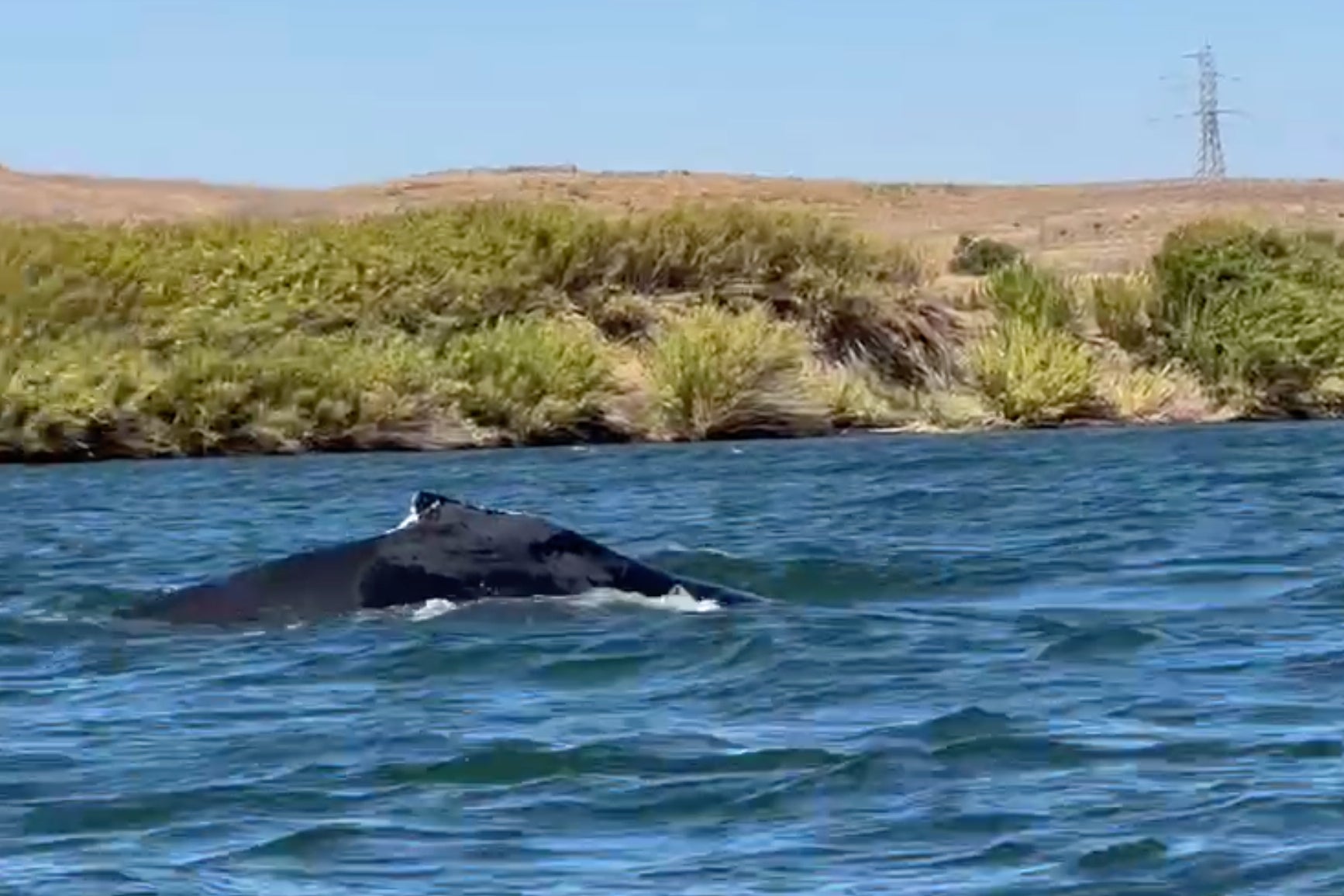
Humpback whale spotted in California river, traveling 60 miles from Pacific Ocean
Por Terry Chea and Patrick Whittle — – World RSS Feed
Humpback whale spotted in California river, traveling 60 miles from Pacific Ocean
The animal seemed in good shape despite being far from home
Terry Chea & Patrick Whittle Saturday 19 September 2026 16:43 BST
- Bookmark
Bookmark popover
Removed from bookmarks
Close popover


Your support helps us to tell the story
Read more Support Now
From reproductive rights to climate change to Big Tech, The Independent is on the ground when the story is developing. Whether it’s investigating the financials of Elon Musk’s pro-Trump PAC or producing our latest documentary, ‘The A Word’, which shines a light on the American women fighting for reproductive rights, we know how important it is to parse out the facts from the messaging.
At such a critical moment in US history, we need reporters on the ground. Your donation allows us to keep sending journalists to speak to both sides of the story.
The Independent is trusted by Americans across the entire political spectrum. And unlike many other quality news outlets, we choose not to lock Americans out of our reporting and analysis with paywalls. We believe quality journalism should be available to everyone, paid for by those who can afford it.
Your support makes all the difference. Read more
When Denny Glover went fishing with buddies on the Sacramento River, he was hoping for a solid catch, but he certainly was not expecting to encounter a fully grown humpback whale.
Glover spotted the whale surfacing on Wednesday while fishing for salmon and striped bass from a 21-foot (6.4-meter) boat, which is less than half the size of the animal.
He recorded video footage as the whale broke the surface in California‘s largest river, roughly 60 miles (97 kilometers) away from its typical Pacific Ocean environment.
“One of the guys on the boat, he said, ‘I see a whale.’ He saw the spout,” Glover said.
“At first we didn’t believe it. We thought he had mistaken a dolphin or a porpoise. Then we saw the spout again, and there’s no mistaking a whale spout.”
This unusual inland journey has attracted widespread attention from marine scientists who want to determine its health condition and understand how it ended up so far from the open sea.
The whale entered San Francisco Bay earlier in the week and has been moving east into the Sacramento-San Joaquin Delta, California’s largest river delta, the Marine Mammal Center said in a statement.
The center, based in Sausalito, confirmed its cetacean team is preparing to evaluate and monitor the creature.
Members of the public should refrain from interacting with the whale or attempting to change its course, warned Kathi George, the center’s director of cetacean conservation biology.
“While it’s unknown whether this whale is just passing through or if there is an underlying, unknown ailment, the best thing people can do is experience this adult whale’s presence from a respectful distance,” George said.
Researchers recognize the whale via a photo identification catalog and have documented the individual 15 times across the past 24 years, according to the center.
Before this week, its most recent documented sighting took place in Baja California in February. Scientists have not established whether the whale is male or female.
Neither the California Department of Fish and Wildlife nor the National Oceanic and Atmospheric Administration provided comment regarding this week’s sighting.
The creature is not the first whale to travel so deep inland. Back in 1985, a humpback nicknamed Humphrey spent several weeks around Rio Vista before finding its way back to the ocean, The Marine Mammal Center said. A mother-calf pair known as Delta and Dawn also spent nearly three weeks in the Sacramento River Delta in 2007 before departing. Those whales eventually navigated back to sea, the center said.
Humpback whales count among the largest creatures on Earth, capable of weighing up to 80,000 pounds (35,287 kilograms). They are renowned for their elaborate underwater songs and dramatic lunges at the surface of the water, a behavior called breaching.
Witnessing the whale so far upriver was an incredible thrill, Glover noted, adding that the animal appeared to be in good health despite being far from home.
“It came up and went down in fairly regular intervals,” he said. “It was moving along at a fair clip. It wasn’t acting erratically other than that it was upstream in a freshwater river.”
More about
CaliforniaSan Francisco BayHumpback whale
Most popular
Popular videos
Bulletin
Read next
Fonte: – World RSS Feed