CIA Report Warns Israel Could Head Toward Civil War, Total Collapse
Por Aída Chávez — Drop Site News
As a reader-funded independent news outlet, we operate free from the influence of governments, advertisers, and corporate backers. This is essential to our mission: to report on what matters most, beholden only to the truth. In that spirit, we made a commitment to ensure that our journalism is free for everyone, not locked behind a paywall. But that means we rely on the voluntary support of our community of readers. Please consider making a tax-deductible donation to support our work today.
This article is being co-published with Capital & Empire.
Israel is at risk of civil war or state collapse, a classified CIA assessment warns, as years of genocide in Gaza and war in Lebanon and Iran deepen political, economic, and social fractures within the country.
The August report, titled “Fracture From Within,” was compiled by experts in the CIA’s Red Cell, according to two U.S. sources who described the contents of the report to Drop Site News. The Red Cell, which is the unit responsible for providing “alternative analysis” within the agency, produced the assessment through a combination of open source information and U.S. intelligence. The CIA did not respond to a request for comment.
CIA experts pointed to a volatile mix of pressures converging ahead of Israel’s elections on October 27: economic crisis and soaring military spending; heavily armed veterans returning from prolonged combat, many carrying serious psychological trauma; growing fury over ultra-Orthodox men who are exempt from military service; escalating settler violence in the occupied West Bank; and Israeli Prime Minister Benjamin Netanyahu fighting to hold onto power and igniting a constitutional crisis.
The CIA’s “red teams” are tasked with developing analysis and ideas that challenge prevailing assumptions and expose groupthink or blind spots that can take hold within the intelligence apparatus. “The writers of this are Israel experts,” a source in the intelligence community noted, “this isn’t a fantastical what if—with the upcoming election and the fissures in Israel we should take seriously their conclusion that Israel is one spark away from real internal conflict.”
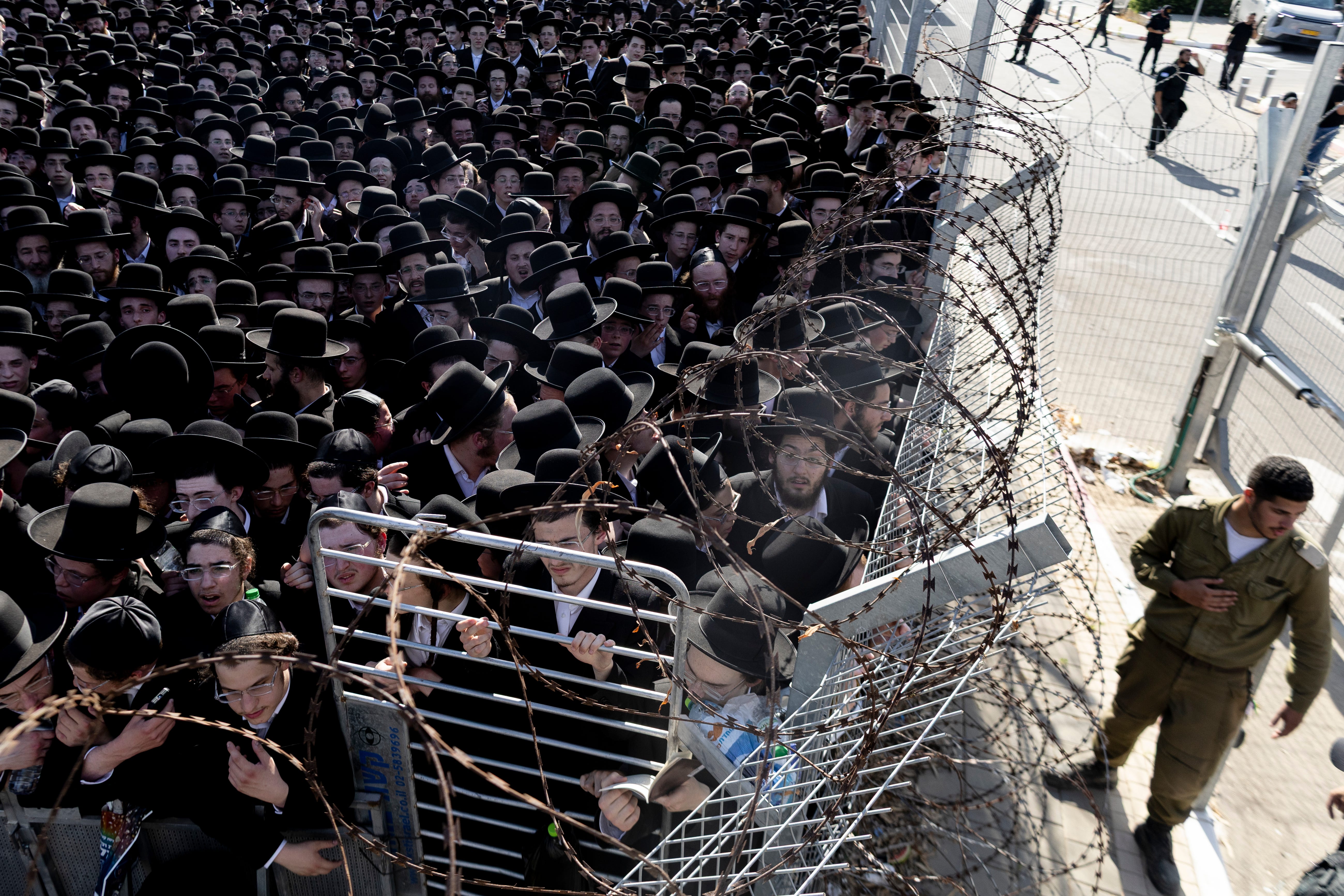
One of the deepest fractures in Israeli politics has emerged not over opposition to the country’s war crimes—but over who is expected to fight and who is exempt. Ultra-Orthodox men have historically received broad exemptions from military service while continuing to receive state benefits, an arrangement that has become increasingly contentious amid repeated reserve mobilizations. Their collective refusal to serve is not rooted in opposition to Israel’s wars, as ultra-Orthodox leaders argue that military service threatens religious life and their obligation to Torah study. But after years in which reservists have been repeatedly called away from their jobs and families, the exemption has become a potent source of resentment in Israeli society. Households have also been absorbing the costs of Israel’s belligerent policies. Food prices have reached record highs, with the cost of food—including fresh fruit and vegetables—rising 9.5 percent over the past two years, deepening an already severe cost-of-living crisis after years of war.
Yet much of the opposition to Netanyahu is not opposition to Israel’s brutality against Palestinians, but anger over how he has managed it. The major anti-Netanyahu Zionist parties are themselves divided over leadership and coalition strategy, while a central line of attack against Netanyahu has been his responsibility for the October 7 security failure. Recent polling has shown both the Netanyahu and anti-Netanyahu blocs struggling to reach the 61 seats required to govern.
The sources warned that the combination of political fracture and a growing population of heavily armed, traumatized veterans has historical precedents. “Famously the Freikorps of Germany were PTSD-addled veterans with weapons and bloodthirst,” he said. “I’m not saying Israel post Gaza is Germany post-WWI but there are certainly aspects of this that ring similar to me.”
Israel is also confronting growing isolation abroad, including an erosion of support in the United States that Israeli officials themselves have privately treated as a long-term threat. The August report pointed to Israel increasingly becoming a pariah state as a factor that could lead to state breakdown.
According to another CIA assessment Capital & Empire reported in July, Israeli officials believe the American political consensus underpinning the alliance is breaking down and that continued reliance on billions of dollars in direct U.S. military aid may eventually become politically untenable. Their response has been to seek deeper integration into the American military, intelligence, and defense establishment—ties that would be harder for future governments to unwind. By this spring, 60% of Americans viewed Israel unfavorably, up from 53% a year earlier, according to a Pew Research Center survey.
That deterioration of support is increasingly visible inside the U.S. national security establishment, as well. “The intelligence community, like America, like the military, like everywhere, is growing frustrated with the real and political capital that’s spent on propping up Israel,” the source said. “As we’re moving forward with further integrating our military-industrial capacity with them, there’s deep frustration that we’re doing this for a country that dragged us into a war we’re losing, a country that spies on us.”
The CIA report also tried to game out how these pressures could interact if Israel’s internal crisis deepened—how a single spark could turn political fracture into open civil conflict, and what would follow from there. Among the scenarios raised were foreign technology and artificial-intelligence companies pulling investment or personnel from Israel, further eroding an already strained economy, regional governments reconsidering the political and strategic value of deeper normalizing relations with Israel, and Hamas or Hezbollah exploiting a period of domestic weakness. The report specifically used the term “civil conflict,” according to the sources.
For decades, Israel’s power depended not only on weapons and American backing, but on the projection that its military dominance, intelligence superiority, and internal cohesion made the state effectively unbreakable. But as the assessment warned, beneath that projection of overwhelming force, Israel is accumulating economic, political, and social contradictions that military might alone may not be able to contain.
Fonte: Drop Site News