Chinese Development Is the Betrayal Washington Cannot Forgive
Por Jake Werner — The Nation » Article
/
September 23, 2026
Chinese Development Is the Betrayal Washington Cannot Forgive
The prospects for Xi Jinping’s visit are dim because American leaders are blaming China for the failures of globalization.
Share
Copy Link
Facebook
X (Twitter)
Bluesky
Pocket
Email
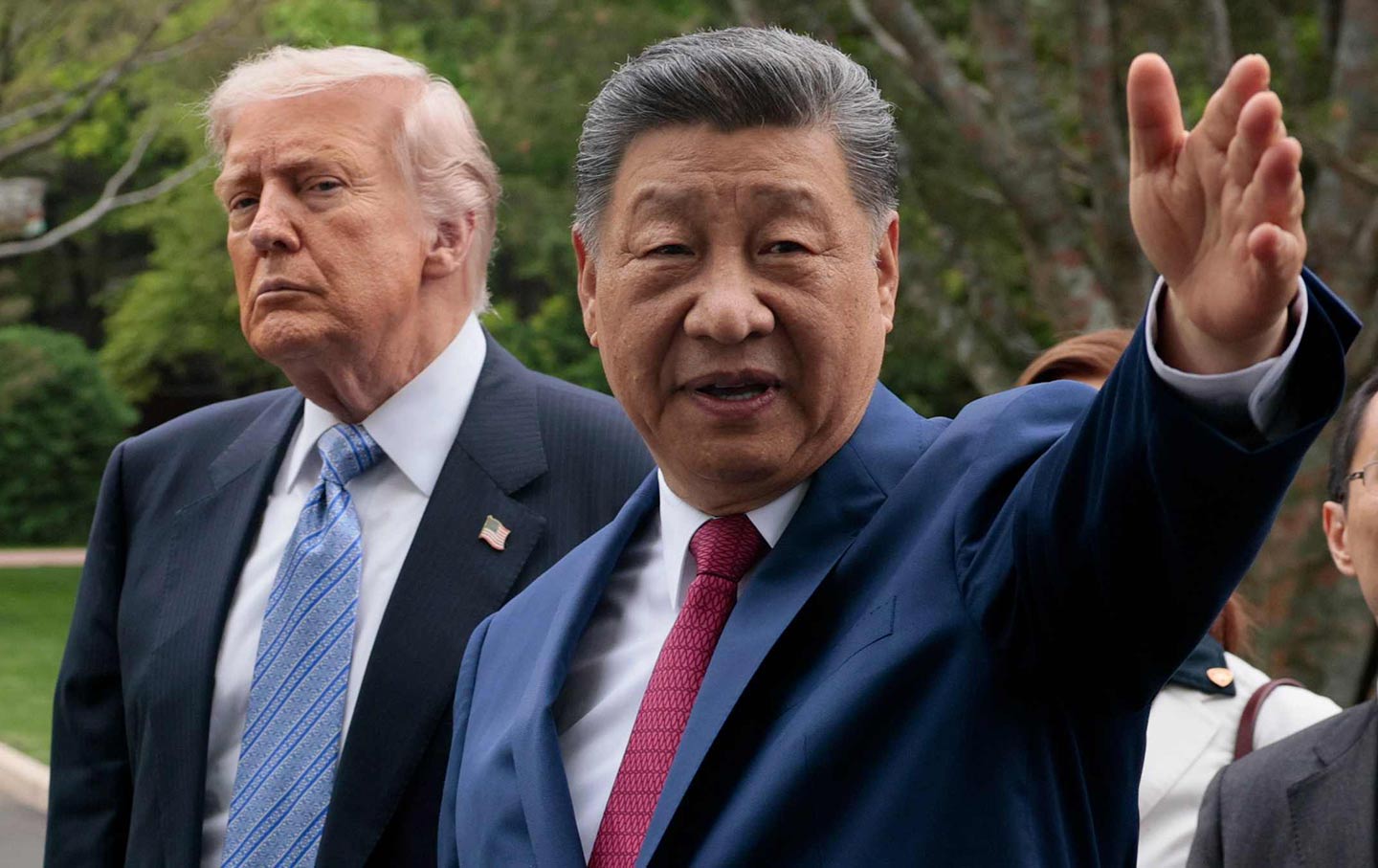
As Xi Jinping arrives in Washington for his third meeting with Donald Trump in less than a year, few expect progress in the badly deteriorated United States–China economic relationship. For nearly a decade, official US opinion has dismissed the possibility of significant new agreements with China.
Yet the irreconcilable economic philosophies and uneven capacities that once prevented a US-China accord have dissolved. A different obstacle has risen in their place, blinding policymakers to new possibilities: Most American leaders see the recent history of trade as a morality tale, with China as the treacherous villain.
In this story, the United States is said to have naïvely offered China prosperity through integration into free-market globalization. China cunningly exploited these good intentions, piling one nonmarket practice on another to rig the system. Today, it seeks control over the technologies of the future and—many suspect—world domination.
This story constructs an external enemy as a shortcut to overcoming US social divisions at home and damaged alliances abroad. It also allows US leaders to ignore how free-market globalization entrenched the chasm of wealth and opportunity separating the rich countries from the underdeveloped world. An honest reckoning with the past would force a reevaluation of China’s behavior, revealing paths away from mutually ruinous economic warfare.
Current Issue

Economic historians and heterodox economists have long understood that economic development requires robust state intervention. Though policies vary and cannot achieve development on their own, protecting infant industries and applying subsidies or preferences to force industries up the value chain are practices shared across successful cases of development.
The state’s role, however, was suppressed from historical memory under the free-market triumphalism of the 1990s. Instead, former Soviet bloc and Third World countries were thrown into cutthroat competition for foreign investment, forced to offer their workers and resources to multinational corporations at favorable prices while harshly limiting the role of the state.
They were told to emulate the export-led growth of Japan, South Korea, and Taiwan. But crucial conditions of the East Asian success—few low-cost competitors, weak controls on intellectual property, US tolerance for allies’ industrial policy during the Cold War—were no longer available.
China overcame these disadvantages because it was the only developing country so large and dynamic that foreign investors would make concessions to gain access. Featuring a highly disciplined and repressed labor force, entrepreneurial local governments competing to support investment, and a capable planning apparatus, China won technology transfer and domestic sourcing from foreign firms that otherwise would have refused. While other poor countries gained little from foreign investment, China achieved rapid growth and steady development.
The incapacity of the US system to offer an honest path to development and China’s quiet subversion of the system to achieve development bred bitter resentments on both sides. The Americans blamed China’s forced technology transfer, state subsidies, and localization requirements for limiting US exports and encouraging offshoring of US manufacturing.
On the Chinese side, anger built over US pressure to conform to an orthodoxy that Chinese leaders believed would end in the middle-income trap. Condescension from the West was particularly grating when privileged countries happily pocketed huge profits exploiting Chinese labor and resources but refused to accept China’s emergence as a competitor.
Both sides had a point. But rather than recognizing that the only solution would be reforming the global system, these animosities led each to blame the other when globalization itself fell into economic crisis in 2008 and political crisis in 2016.
In the years since, dramatic changes made the old conflicts irrelevant. American leaders gave up free-market dogma and now embrace industrial policy and managed trade. Chinese companies are no longer vulnerable to foreign competition but can often stand on their own without state protection.
That means forms of trade reciprocity are possible today that would have sabotaged China’s development path 20 years ago. Just as the United States in the 1960s and 1970s shifted from tolerating European and Japanese protectionism to negotiating reciprocal opening, a US-China discussion on opening markets, harmonizing regulations, and securing labor rights is now possible.
Popular
“swipe left below to view more authors” Swipe →
-
The GOP’s Incredible Shrinking Senate Map
The GOP’s Incredible Shrinking Senate Map
-
How to Arrest Benjamin Netanyahu
How to Arrest Benjamin Netanyahu
-
As Morale Sags, More Military Service Members Are Having a Crisis of Conscience
As Morale Sags, More Military Service Members Are Having a Crisis of Conscience
-
Trump Wants to Keep Journalists Out of the White House. He Should Get His Wish.
Trump Wants to Keep Journalists Out of the White House. He Should Get His Wish.
The two countries should also discuss how China could accommodate development techniques that once worked in the opposite direction. The US could welcome Chinese investment that advances its industrial policy goals, placing conditions on technology transfer, union neutrality and wage/benefits standards, and supply chain localization.
As important as fixing the bilateral relationship is global reform to expand development. The key measures would be stronger labor and environmental standards worldwide to end the practice of pitting workers and communities against each other, coupled with policies allowing developing countries to sustain higher standards without pricing themselves out of the global economy. These include a strong system of global public goods, significantly increased development investment and space for industrial policy, looser intellectual property restrictions, and democratizing global governance.
These reforms would initiate a benevolent cycle of egalitarian growth expanding productivity and consumer demand. That in turn would absorb overproduction and create space for the powers to grow together. A coordinated multilateral expansion of wages and public goods is also the best way to convince China to undertake internal rebalancing.
China’s official rhetoric on global governance, economic development, and domestic consumption are broadly compatible with this agenda. Yet US policymakers, feeding off past resentments, peremptorily dismiss such possibilities because a very different, weaker China resisted a different set of demands some 20 years ago. Intransigence born of refusal to see how free-market globalization looked to those it subordinated is leading the world into disastrous new economic wars.
Become a Sustaining Donor This September
Between the reemergence of right-wing red-baiting and Donald Trump’s use of the chilling National Security Presidential Memorandum–7 to criminalize left political organizing, we’re seeing McCarthyism reborn before our eyes.
This assault on democracy cannot be ignored or wished away. Resisting it requires bravery in the face of threats and repression, a steadfast commitment to the truth, and the unwavering belief that we can—and will—overcome this darkness.
We must have an independent media that sets the record straight, unearths corruption and abuses of power, and advances a politics of justice and dignity for all if we’re to win this fight.
That’s why I’m writing to you today. This September, The Nation needs to add 100 monthly donors to sustain our progressive journalism. Your contribution makes the next investigative report, the next truth-speaking column, and the next pathbreaking essay all possible.
I hope you’ll support our work with a recurring donation today. If you donate $10 or more a month, we’ll send you a brand new “Hands Off the Free Press!” sticker to recognise your commitment to our cause. Please, donate today.
Onward,
Katrina vanden Heuvel
Editor and Publisher, The Nation
Jake Werner is a historian of modern China and director of the East Asia Program at the Quincy Institute for Responsible Statecraft.
Fonte: The Nation » Article