US approves visas for Iranian leaders to attend UN meeting despite war stalemate
Por Matthew Lee — – World RSS Feed
US approves visas for Iranian leaders to attend UN meeting despite war stalemate
The decision on the Iranian visas was announced a day after the State Department denied visas to Palestinian President Mahmoud Abbas and his delegation
Matthew Lee Thursday 17 September 2026 20:19 BST
- Bookmark
Bookmark popover
Removed from bookmarks
Close popover
Your support helps us to tell the story
Read more Support Now
From reproductive rights to climate change to Big Tech, The Independent is on the ground when the story is developing. Whether it’s investigating the financials of Elon Musk’s pro-Trump PAC or producing our latest documentary, ‘The A Word’, which shines a light on the American women fighting for reproductive rights, we know how important it is to parse out the facts from the messaging.
At such a critical moment in US history, we need reporters on the ground. Your donation allows us to keep sending journalists to speak to both sides of the story.
The Independent is trusted by Americans across the entire political spectrum. And unlike many other quality news outlets, we choose not to lock Americans out of our reporting and analysis with paywalls. We believe quality journalism should be available to everyone, paid for by those who can afford it.
Your support makes all the difference. Read more
The Trump administration has granted entry visas to key Iranian figures, including the country’s president and foreign minister, enabling them to attend next week’s UN General Assembly high-level sessions in New York despite an ongoing conflict between the two nations.
On Thursday, the State Department confirmed that visas had been issued for Iran’s core delegation and essential support staff. According to US officials speaking on condition of anonymity due to visa privacy laws, the main delegation features President Masoud Pezeshkian and Foreign Minister Abbas Araghchi.
The decision comes amidst an extraordinary backdrop of a military stalemate lasting over six months, with no immediate indications of progress toward reopening the Strait of Hormuz or resuming diplomatic talks regarding Iran’s nuclear program.
Concurrently, Iranian-backed Houthi rebels in Yemen have heightened strikes on Saudi infrastructure and shipping in the Red Sea, compounding maritime disruptions that have driven up global oil prices.
Washington continues to designate Iran as the world’s leading state sponsor of terrorism, maintaining severe economic sanctions alongside a recent initiative designed to sever the nation’s critical financial lifelines.
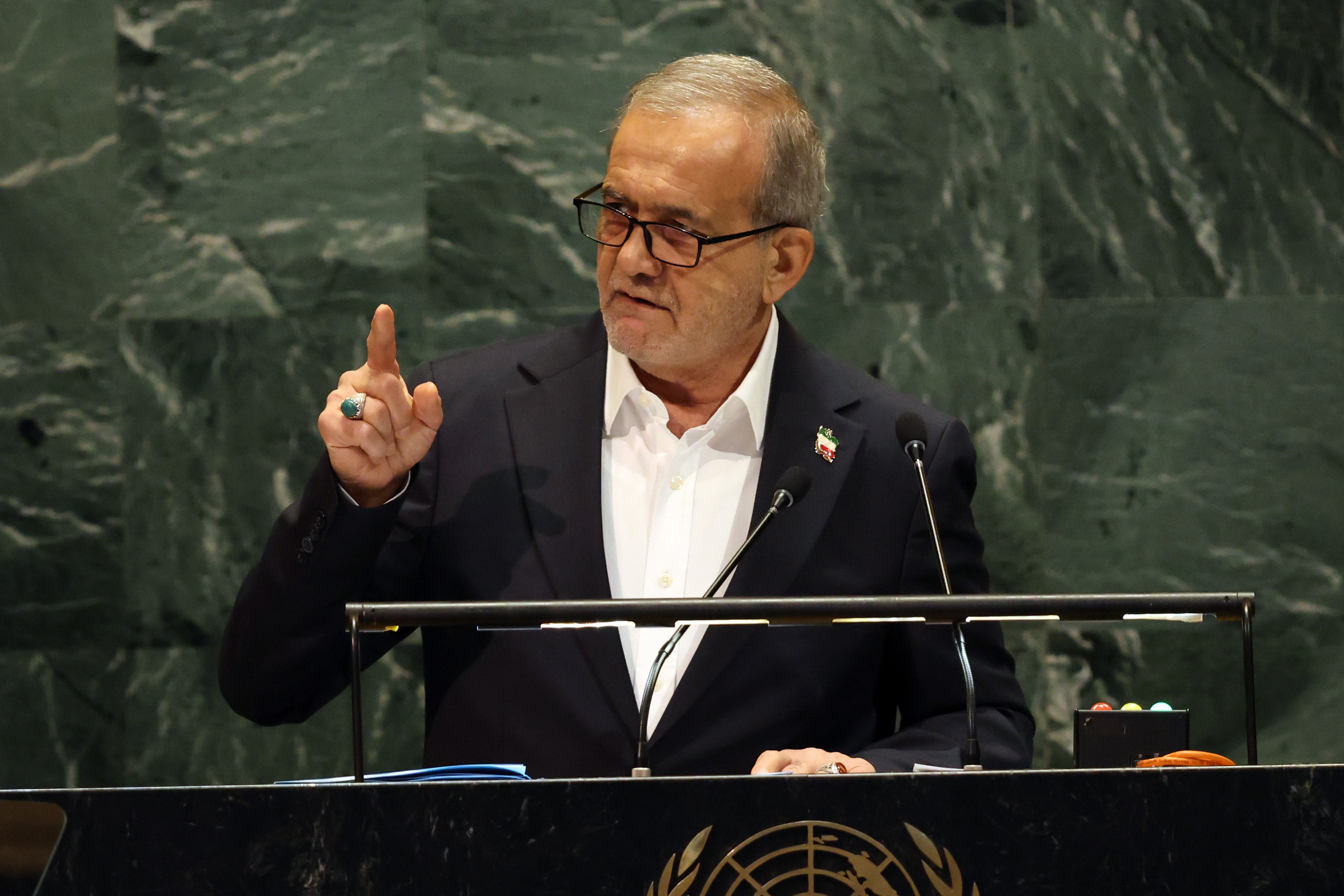
As the host nation for the United Nations headquarters, the US is generally limited in what it can do to prevent foreign leaders from coming to the General Assembly. Even so, Washington has previously denied visa applications or discouraged attendance from leaders involved in direct military conflicts with the United States.
Ahead of last year’s UN meetings—held prior to the outbreak of the war with Iran on Feb. 28, yet following US and Israeli air strikes on Iranian nuclear facilities in June 2025—the State Department similarly granted a limited number of visas for Iranian diplomats while imposing rigid restrictions on the delegation’s movements.
Those constraints tightly regulated how far Iranian officials could travel in New York City from their UN mission and explicitly barred them from shopping at wholesale membership stores, such as Costco and Sam’s Club.
The decision on the Iranian visas follows just a day after the State Department denied visas to Palestinian President Mahmoud Abbas and his delegation to come to the General Assembly.
“Consistent with our host country obligations, the core delegation from the Iranian regime will be able to attend UN General Assembly High Level week,” the State Department said. “The delegation will be under travel restrictions and will face prohibitions on the purchase of luxury and other goods per our policy. The delegation is smaller than last year.”
The department accused the Palestinian Authority—which administers parts of the Israeli-occupied West Bank—of seeking to “internationalize” the Israel-Hamas war in Gaza by bringing cases to the International Court of Justice and the International Criminal Court, as well as continuing to pay stipends to prisoners jailed in Israel for attacks on Israelis.
The Palestinian Authority condemned the decision and called Israel’s actions “the real threat to the two-state solution and prospects for peace.” It affirmed its commitment to long-stalled negotiations while defending its efforts to gain recognition through international bodies and courts.
“Punitive measures and restrictions imposed on Palestinian officials do not contribute to advancing peace or combating violence,” the authority’s foreign ministry said in a statement. “Rather, they weaken the Palestinian partner committed to a political solution and encourage forces working to undermine the two-state solution and impose the reality of occupation, settlement and annexation by force.”
While the US does not recognize the Palestinian Authority as the government of a full UN member state, the UN General Assembly and various affiliated agencies do.
More about
UNIranUSState DepartmentNew York
Most popular
Popular videos
Bulletin
Read next
Fonte: – World RSS Feed