Associated Press journalists who witnessed Sept. 11 remember what they saw, 25 years later
Por Joseph Frederick,David R. Martin and Leah Willingham — – World RSS Feed
Associated Press journalists who witnessed Sept. 11 remember what they saw, 25 years later
Twenty-five years after the Sept. 11 attacks, current and former Associated Press journalists who witnessed them recall the day
Joseph Frederick , David R. Martin & Leah Willingham Thursday 10 September 2026 05:01 BST
- Bookmark
Bookmark popover
Removed from bookmarks
Close popover
Associated Press journalists who witnessed Sept. 11 remember what they saw, 25 years later
Show all 4 

Your support helps us to tell the story
Read more Support Now
From reproductive rights to climate change to Big Tech, The Independent is on the ground when the story is developing. Whether it’s investigating the financials of Elon Musk’s pro-Trump PAC or producing our latest documentary, ‘The A Word’, which shines a light on the American women fighting for reproductive rights, we know how important it is to parse out the facts from the messaging.
At such a critical moment in US history, we need reporters on the ground. Your donation allows us to keep sending journalists to speak to both sides of the story.
The Independent is trusted by Americans across the entire political spectrum. And unlike many other quality news outlets, we choose not to lock Americans out of our reporting and analysis with paywalls. We believe quality journalism should be available to everyone, paid for by those who can afford it.
Your support makes all the difference. Read more
Karen Matthews was getting her 3-year-old daughter ready for preschool in her Manhattan apartment on Sept. 11, 2001, when she heard a loud boom, unlike anything she’d ever heard before.
Holding her child, she went outside. Around her, people stared up at a gash in the north tower of the World Trade Center, smoke billowing from the building just blocks from her home.
“What did you see? What did you see?” people were asking one another. Matthews, an Associated Press reporter, began asking the same question, fumbling to get out her notebook and record what people had witnessed, all with her daughter still in her arms.
Matthews had planned to drop her daughter at school before working later to cover New York’s primary election. Instead, she and other AP journalists found themselves documenting the Sept. 11 attacks as they lived through them.
Twenty-five years later, they remember what they saw.
At first, no one knew what was happening
On her way outside, Matthews passed a woman in her building’s lobby with tears streaming down her face. Some people assumed a small plane had accidentally struck the tower.
Then she saw a “big fireball” erupt from the south tower as a second hijacked jet struck.
“‘I want to go to school, I want to go to school,’” her daughter started crying.
“That’s when we all knew that we were under attack,” Matthews said.
Matthews started toward the preschool anyway, until she saw teachers grabbing children and running north, many of them crying. She took her daughter upstairs, intent on getting her to a safe place, and put on Barney.
Then she heard two more impossibly loud roars — one tower collapsing, then the other. Nearly 3,000 people died in the World Trade Center, at the Pentagon, and on the four jets hijacked by al-Qaida militants.
Twenty-five years later, Matthews, now retired, still divides her life into before Sept. 11 and after.
“I’m not a really fearful person,” she said. “But you lose a sense of security when something like that happens.”
“I do think it helped to be part of telling the story of what happened,” Matthews said.
The camera becomes a wall
Lower Manhattan’s streets were filled with smoke and debris when Richard Drew got off the subway at Chambers Street and saw the burning twin towers.
His assignment that day had originally been to cover the opening day of Fashion Week — a whirlwind of glamour, models and runway shows.
He began taking pictures. Gray ash and soot covered his clothes, face and cameras.
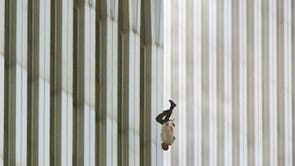
An emergency medical worker pointed up and said, “Look at that.” People were plummeting from the burning towers.
“I don’t know whether they were jumping or they got forced out by the fire,” Drew said.
Drew photographed them. One image became known as “The Falling Man.” It shows a lone man falling headfirst, his body nearly aligned with the vertical lines of the towers. The photograph appeared in some newspapers the next day, but was rejected by other publications that worried readers would find it too upsetting.
Drew still thinks about the photograph — and the unidentified man in it— at least once a week.
“When I’m in a situation like September 11th, I go into professional photographer mode and I concentrate on whatever’s happening in front of me,” said Drew, who also photographed the 1968 assassination of Robert F. Kennedy.
He said his wife calls his camera a wall — a filter between the photographer and the reality they’re capturing.
“I guess I’m in denial about whether those things really affected me,” he said.
The wheelchairs stayed empty
Dust from the pulverized towers was falling “like a snowstorm” when AP reporter Larry Neumeister made it to a hospital near ground zero that afternoon.
Doctors and nurses gathered outside. Lines of wheelchairs and gurneys waited at the entrance. Staff were preparing for a constant stream of injured survivors — potentially thousands, Neumeister said.
Then the hours passed.
“It became clear nobody else was being brought in,” Neumeister said.
Around midnight, Neumeister walked by the World Trade Center site. A doctor told him: “You either walked away from the site or ran away from the World Trade Center buildings when they fell, or you were gone. There was no in-between.”
Her training took over
Sept. 11 was supposed to be Amy Sancetta’s day off.
Then based in Ohio, the AP photographer had traveled to New York to cover U.S. Open tennis. But the tournament was over and she had the day to herself. Then her editor called: A small plane had hit one of the towers. She needed to go downtown.
As she gathered her gear, Sancetta realized she didn’t know where the twin towers were. She got into a cab and told the driver to get her as close as he could.
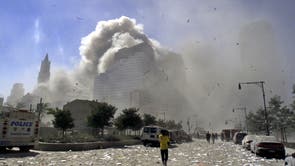
About a block and a half away, Sancetta was photographing the south tower when it began to collapse.
“The weirdest thing that went through my head at the time was, it was kind of muscle memory, like shooting a basketball game,” she said.
When the cloud of debris came toward her, Sancetta ran into a parking garage. In a stairwell, she found a woman crying who had escaped from the towers and wanted to call her son. Sancetta hugged her and reached for her flip phone. Her hand was shaking. There was no signal. Sancetta took the son’s number and promised to call him.
When she emerged onto the street, everything was white, “like covered with snow, but not snow.” The screaming and pounding footsteps had given way to crying and whimpering. Loose-leaf office paper floated through the sky “like birds.”
“I wish I’d shot that,” Sancetta said. “I didn’t, but I can see it — I see it right now.”
Twenty-five years later, Sancetta held up a newspaper from Sept. 12 showing the burning towers she had photographed.
“NIGHTMARE,” the headline read.
Outside her windows now are woods. But she can still remember the sound of the tower collapsing — “just unearthly.”
“As a journalist, I’m glad I was there,” Sancetta said. “But as a human being, I wish I’d gone home on Monday.”
__
Willingham reported from Boston.
More about
Associated PressNew YorkLower ManhattanWorld Trade CenterPeoplePentagonBostonOhio
Most popular
Popular videos
Bulletin
Read next
Fonte: – World RSS Feed