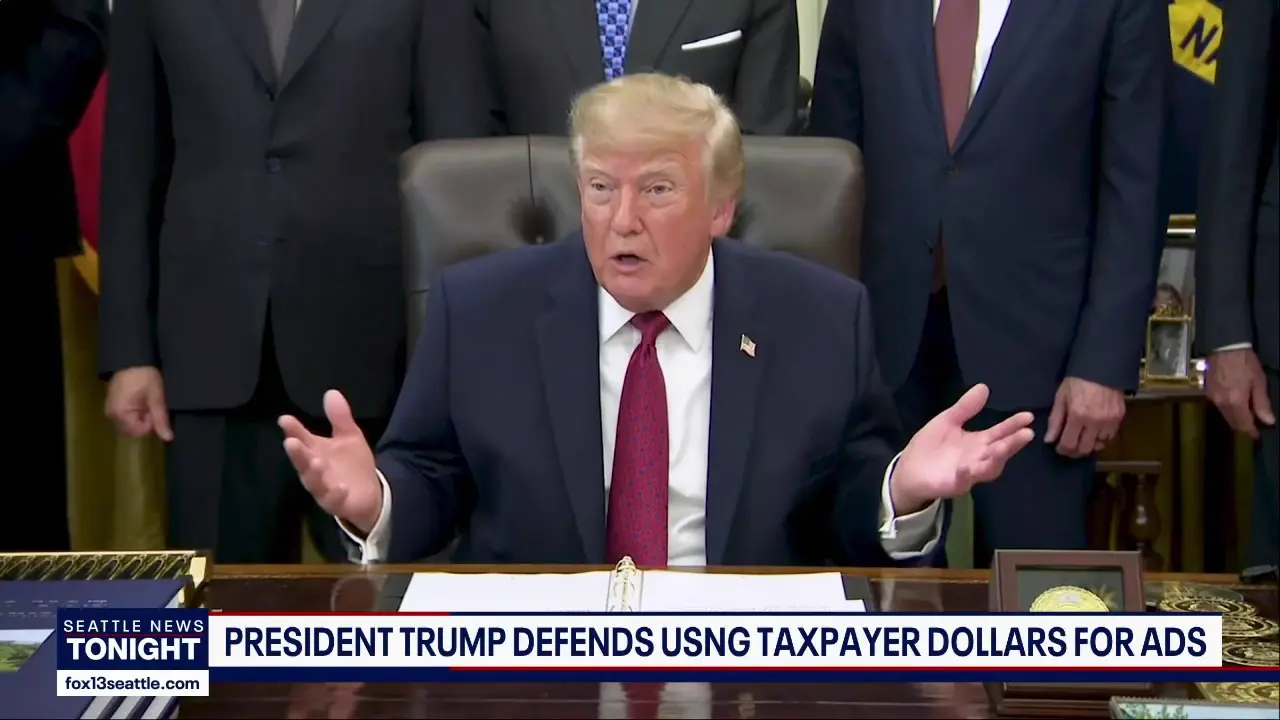
There’s One Middle East War Trump Seems Willing to Avoid
Por Nahal Toosi — POLITICO – TOP Stories

President Donald Trump has done a lot this year to live up to the criticism that he is reckless. But in a faceoff with a heavily armed, religiously driven regime that’s threatening a critical waterway, he’s acting remarkably restrained.
Trump may have no choice: It’s really hard to deal with the Houthis.
As the Yemeni militant group pursues a new offensive against U.S. ally Saudi Arabia, Trump has — for now — resisted entering the fray with American airstrikes. He has made clear he isn’t inclined to abandon a ceasefire the U.S. reached with the Houthis after weeks of clashes last year, despite Saudi requests for more help as the Houthis threaten oil and other commerce in the Red Sea.
Trump has stressed that the Houthis are promising not to fire on U.S. ships.
“The Houthis called us, and they don’t want to fight with us,” Trump said last month.
This is a notably cautious position from a man who has shown a big appetite for political risk this year, whether it’s by launching a war on Iran, abducting Venezuela’s president or imposing an energy blockade in an effort to oust the Cuban regime.
Standard disclaimer here: Trump frequently changes his mind, often for surprising reasons. He could end up striking the Houthis while you read this column.
Still, Trump’s unwillingness so far to break the ceasefire with the Houthis is a potential sign that he has learned some hard lessons about the battlefront, including when to avoid it.
The Houthis wouldn’t mind this being the case. In texts to me, a Houthi official sidestepped questions about the group’s views on Trump but stressed that the ceasefire with the U.S. stands.
“We do not believe there is any reason for the United States to get involved in Yemen again,” the official wrote. I granted the official, and others, anonymity to discuss sensitive issues.
Besides, Trump has other headaches. That includes deciding whether and when to resume bombing the regime in Tehran.
“The war with Iran is unresolved, so I can understand why he’s not keen to open up another front,” Tim Lenderking, a former U.S. special envoy to Yemen who has negotiated with the Houthis, told me.
There are, of course, links between the Iran war and the Saudi-Houthi fight. Iran’s regime supports and arms the Houthis, who control much of Yemen.
Tehran’s leaders and the Houthi hierarchy also share a striking number of characteristics, including leaders who stay in hiding and, some argue, expansionist ideals. Both the Houthis and Iran’s regime follow Shia Islam, though different strands. They both despise the U.S. and Israel. The Houthi official motto is: “God is the greatest, Death to America, Death to Israel, A curse upon the Jews, Victory to Islam.” Amid outside pressure, they each seek to control maritime passages key to global trade: Iran in the Strait of Hormuz and the Houthis in the Bab el-Mandeb Strait.
In many ways, however, the battles are distinct.
The Houthis are more a partner than a proxy for Tehran, current and former U.S. and foreign officials familiar with the group are keen to stress. The Houthis have their own grievances, history and agenda. That agenda includes ending what the Houthis describe as a blockade on Yemen imposed by Saudi Arabia, which backs the official, but weak, Yemeni government.
“We are merely defending ourselves and our country,” the Houthi official told me.
The U.S. continues to support Saudi Arabia through efforts like intelligence-sharing and weapons sales. Washington and Riyadh have a defense agreement, and, in a boilerplate statement, the White House stressed that “if it comes down to it, the United States will always stand with Saudi Arabia and support them.”
But there’s no sign that top Trump aides are urging him to again unleash the U.S. military in the Yemen fight. Last year’s U.S. air campaign against the Houthis, Operation Rough Rider, had limited impact even though Trump claimed the Houthis “capitulated.” U.S. munition shortages, caused in part by the Iran war, have to be considered now.
I’m told that Secretary of State Marco Rubio is particularly attuned to analysts’ warnings about the dangers of jumping back into the Houthi fight.
“Rubio understands the complexity. He has a good grasp of who the players are,” said a U.S. official familiar with the administration’s Middle East policy.
Some U.S. lawmakers and former U.S. officials say it’s worth helping the Saudis by carrying out airstrikes against the Houthis, at least to degrade the Yemeni militia’s capacity. Others familiar with the region warn that even sending in U.S. ground troops may not be enough to stop the group.
The Houthis have evolved into a fearsome military force in recent years. They are manufacturing more of their own weapons, while upgrading arms sent from Iran. They are even reportedly integrating artificial intelligence into their arsenal.
“They’re amazing with these advanced conventional weapons. They would take missiles and figure out how to lighten them so that they would go farther. They did trial and error with guidance systems,” said a Western official who has closely monitored the Yemen conflict. “If nothing further came from Iran, that would hurt the Houthis, but they’d overcome it.”
April Alley, a former U.N. official who has met with the Houthis, said their ambitions are likely to grow in the years ahead.
“A lot of their leadership is really young, and they’ve kind of come up in various wars. They’ve seen themselves throughout this come out of really tight spots and kind of on top, so they’re pushing on open doors,” Alley said.
Former Presidents Barack Obama and Joe Biden also struggled to counter the Houthis without tipping into large-scale conflict. So yes, Trump might have something in common with his Democratic predecessors.
Obama authorized at least one strike, casting it as a response to Houthi attacks aimed at U.S. ships, and his administration supported the Saudis in other ways. Biden authorized a series of strikes as the Houthis stepped up attacks at the height of the Gaza war while claiming to be acting against Israeli interests in the region. But Biden also scaled back U.S. military support for the Saudi war effort and pushed Riyadh to reach a 2022 truce with the Houthis.
Hussain Al-Bukhaiti, a pro-Houthi Yemeni journalist, argued that Saudi Arabia undermined that 2022 truce, especially by refusing to lift the blockade. The Houthis also allege the Saudis in July bombed an airport in Sanaa as an Iranian plane was about to land. The Houthis started striking back, and the truce collapsed.
Al-Bukhaiti blamed the Saudis for the suffering and displacement of numerous Yemeni civilians.
“It’s about Yemeni lives,” Al-Bukhaiti said. “What is silly is that we see that all the international community and the Saudis are crying out loud that the price of oil will increase and the price of shipping is increasing. I mean, what about Yemenis?”
I must interject here: The Houthis are highly repressive rulers and not great at governing. “Horrifying” is how one humanitarian official described life under the Houthis.
When I noted to Al-Bukhaiti that the Houthis struck the Saudis just as the kingdom is struggling to absorb the economic shock of the Iran war, he didn’t disagree that it was a tad opportunistic.
“It is not wrong when you take advantage of the weakness of your enemy, and our enemy is Saudi,” he said.
The Saudi Arabian Embassy in Washington declined to comment. Riyadh, which militarily intervened against the Houthis in 2015, views the militia and its ties to Iran as a next-door security risk that could eventually threaten Saudi territorial integrity.
Reuters reported Friday that the Saudis are planning a new assault on the Houthis in the coming weeks.
Trump likely wants to stay out of the Saudi-Houthi fight for as long as possible. It could get harder, though, if the Houthis grow more emboldened, threatening not just the Bab el-Mandeb Strait but also other parts of the region.
If Trump wants to avoid opening another front, it’s strange that he has devoted little diplomatic muscle to resolving the conflict.
Trump has not filled the role of the U.S. special envoy focused on the Saudi-Houthi fight; Lenderking, who last held that role, helped broker the 2022 truce. There is no one serving as U.S. ambassador to Yemen or Saudi Arabia. Trump’s favored negotiators, like Steve Witkoff and Jared Kushner, have their hands full with the conflicts in Iran, Gaza and Ukraine. It doesn’t help that the Omanis, who often act as mediators, don’t have the best relationship with the U.S. at the moment.
The Houthis have a diplomatic wing that deals with foreigners, often in Oman. Former international officials who have engaged with Houthi negotiators say they can be funny, charming and transactional, at least on a short-term basis.
That’s not to say diplomacy with the Houthis would be easy.
The main Houthi leadership is in Yemen, and the movement’s structure is hierarchical, religiously zealous and almost paranoid about the outside world.
Martin Griffiths, a former U.N. special envoy for Yemen, is the rare foreigner who has dealt directly with the top Houthi boss, Abdul-Malik Aa-Houthi, in Yemen.
But those encounters were through screens in safe houses. (He thought he heard al-Houthi cough in a nearby room once.)
Ultimately, even if U.S. or other negotiators have good relations on the surface with Houthi representatives, the Houthis still keep a distance that makes it challenging to understand their exact motivations, Griffiths said.
“I found that in the search for truths, which is what we’ve all been doing, you and I, for these many years, they were elusive,” he said.
Fonte: POLITICO – TOP Stories