Marking One Year of NSPM-7, Rights Advocates Call On Congress to Rein In FBI’s Spying Capabilities
Por Julia Conley — Common Dreams
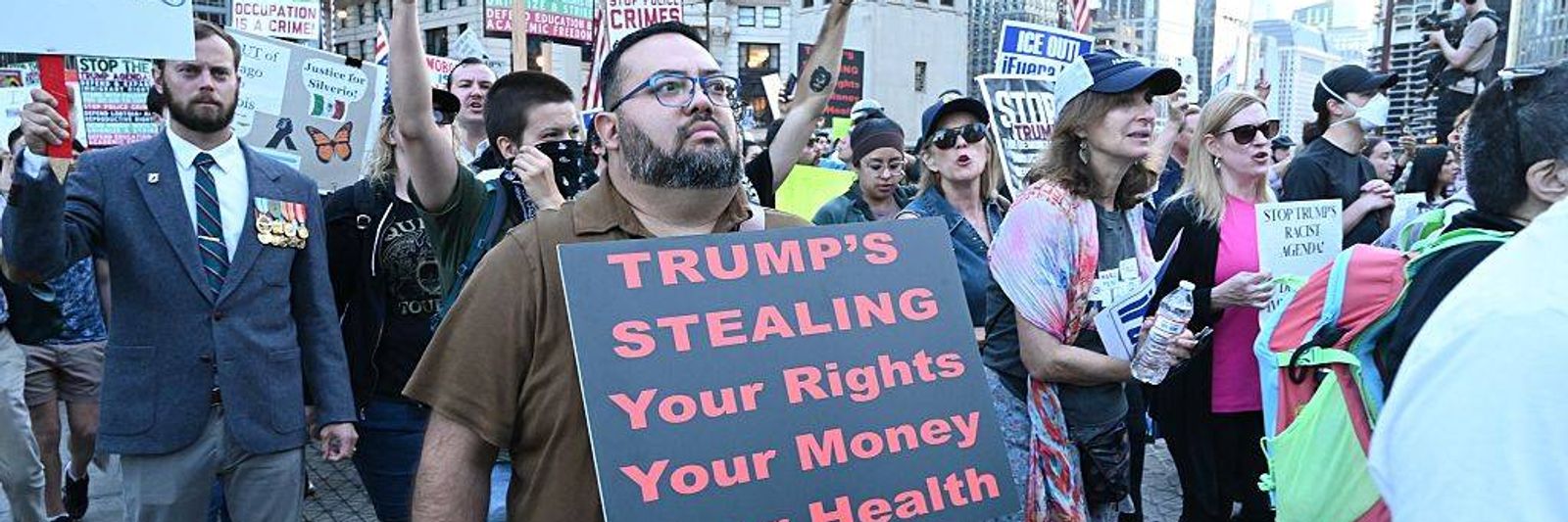
On the first anniversary of President Donald Trump’s signing of one critical national security memo, every member of Congress on Friday received a report on how his administration’s “blatant use of the counterterrorism framework against left-wing domestic speech” has allowed the FBI to “spy on the First Amendment,” attacking one of the bedrock principles of the US Constitution in order to crack down on “speech disfavored by Trump.”
The 19-page report, titled “7Can the FBI Spy on the First Amendment?,” was sent to every congressional office by the advocacy group Defending Rights and Dissent (DRAD), exactly a year after the president signed National Security Presidential Memorandum 7 (NSPM-7) in the wake of the assassination of right-wing activist Charlie Kirk.
Trump and other top White House officials immediately blamed the killing of 31-year-old Turning Point USA co-founder on the “radical left,” and claimed left-wing extremists were behind “the terrorism that we’re seeing in our country today.” Days earlier, the US Department of Justice had removed from its website a report showing that political violence perpetrated by far-right extremists in the US far outpaced that of people on the left.
The memo outlined how the Trump administration planned to crack down on left-wing groups by directing law enforcement agencies to treat political speech “as a precursor to terrorism,” if it came from organizations that demonstrated particular viewpoints—including those critical of capitalism or the US government. Groups that displayed so-called “extremism on migration, race, and gender; and hostility towards those who hold traditional American views on family, religion, and morality” were also named as potential targets.
NSPM-7 called for the FBI’s 200 Joint Terrorism Task Forces (JTTF)—comprised of about 4,000 agents across the country—to investigate groups suspected of left-wing extremism under the memo, with local police officers staffing many of the task forces.
“This extremely broad language leads to individual agents interpreting what these viewpoints mean to them when determining who to target. And thanks to the existence of FBI assessments, designed with the same preventive purpose that NSPM-7 echoes, Task Force officers can investigate groups or individuals without a factual basis to suspect them of criminal wrongdoing or consider them a national security threat,” wrote Chip Gibbons, policy director at DRAD. “At the assessment level, the FBI can even have an informant infiltrate their group. Informants often act as agent provocateurs in sting operations, in which the informant proposes and recruits individuals to participate in a fictitious terror plot concocted by the FBI.”
Under pressure from Trump, Homeland Security Adviser Stephen Miller, and other officials to deliver prosecutions of suspected left-wing extremists, wrote Gibbons, “the agents’ loose guidelines, politicized guidance, and track record of the FBI creates a recipe for disaster.”
“Trump and Miller have made clear they plan to exploit the broad counterterrorism authorities of the executive branch to unleash this machinery of repression upon their domestic political opponents. Unless Congress acts now, they will get away with it.”
A year after NSPM-7 was signed, the memo has already underpinned a crackdown on groups and individuals who oppose Trump’s deeply unpopular deployment of federal immigration agents to carry out his violent mass deportation policy and other aspects of his far-right agenda.
US Attorney Daniel Rosen cited the memo in June when he announced the indictment of 15 organizers who led protests against US Immigration and Customs Enforcement in Minnesota, and those indictments came out of a sprawling investigation into local labor and rights groups that was opened after federal agents fatally shot anti-ICE protester Alex Pretti in Minneapolis in January. Top administration officials also accused Pretti, soon after he had been killed, of being a “domestic terrorist.”
In July, Miller said NSPM-7 would allow the administration to “disrupt, identify, defund, de-bank, arrest, prosecute these political terrorists that are operating within our country,” as Secretary of State Marco Rubio announced that four left-wing groups had been designated as “foreign terrorist organizations.”
And in March, the memo underpinned the conviction of eight people accused of domestic terrorism for wearing all black to a protest at Prairieland Detention Facility in Alvarado, Texas, where one demonstrator shot and wounded a police officer. The protesters were later sentenced to 30-100 years in prison.
“This wouldn’t be a terrorism case if it weren’t for that memo,” a defense lawyer told one news outlet after the conviction.
Gibbons emphasized on Friday that carrying out NSPM-7’s directives “requires no new laws, no new agencies, because well before Trump ever returned to power, the FBI and its enablers have amassed for itself the power to spy on pure political speech.”
As hundreds of thousands of Americans expressed opposition to President George W. Bush’s impending invasion of Iraq in 2003, notes the report, “the FBI issued two controversial intelligence bulletins, one on ‘Tactics Used During Protests and Demonstrations,’ and one on ‘Potential for Criminal Activity at Free Trade Area of the Americas (FTAA) Annual Meeting.'”
“The latter bulletin was prepared in advance of mass protests against the Iraq War,” reads the report. “It went so far as to list ‘tactics by which protestors draw attention,’ which included ‘marches, banners, and forms of passive resistance such as sit-in.’ It urged law enforcement to ‘be alert to these possible indicators of protest activity and report any potentially illegal acts to the nearest FBI Joint Terrorism Task Force.'”
The inspector general of the Department of Justice at the time raised alarm about the bulletins’ potential violation of the First Amendment, but the head of the DOJ’s Office of Legal Counsel (OLC), Jack Goldsmith, dismissed the concern.
“The OLC opinion made clear that the executive branch believes it is not unconstitutional for the FBI to monitor protected speech so long as it claimed it was looking for potential unlawful activity, such as terrorist threats or ‘civil disorder,'” writes Gibbons.
The FBI’s international terrorism program has also pursued “homegrown violent terrorists,” and the agency sought to prove in the 1960s and ’70s that anti-war protests were “the product of Soviet foreign”—providing the National Security Agency with the names of US citizens to be added to a watchlist.
“While the stakes were high before, the actions of the Trump administration, especially those of Stephen Miller, have made it clear they aim to use the counterterrorism bureaucracy to destroy their domestic political opponents,” reads the DRAD report.
Gibbons called on Congress to take several key actions to rein in the FBI as it seeks to carry out the directive outlined in NSPM-7, including:
- Creating a statutory charter for the FBI that outlines what it can investigate and why;
- Imposing on the FBI a definition of “terrorism” that puts the focus on criminal violence against people instead of political ideology;
- Eliminating the FBI’s assessments of individuals based on their political speech and putting the agency “out of the business of suspicionless investigations”; and
- Requiring a warrant for foreign intelligence searches and queries under §702 of the Foreign Intelligence Surveillance Act.
“With NSPM-7, Trump and Miller have made clear they plan to exploit the broad counterterrorism authorities of the executive branch to unleash this machinery of repression upon their domestic political opponents,” said Gibbons. “Unless Congress acts now, they will get away with it.”
Fonte: Common Dreams