Maker of viral squishy toys asks Australia to seize fakes amid child injuries
Por Shahana Yasmin — – World RSS Feed
Maker of viral squishy toys asks Australia to seize fakes amid child injuries
A social media trend encouraging children to microwave squishies has left some with serious burns when the heated toys burst
Shahana Yasmin Friday 25 September 2026 12:43 BST
- Bookmark
- Comments Go to comments
Bookmark popover
Removed from bookmarks
Close popover

Become an Independent member to bookmark this article
Want to bookmark your favourite articles and stories to read or reference later? Start your Independent Membership today.
Already a member?
Log in
Your support helps us to tell the story
Read more Support Now
From reproductive rights to climate change to Big Tech, The Independent is on the ground when the story is developing. Whether it’s investigating the financials of Elon Musk’s pro-Trump PAC or producing our latest documentary, ‘The A Word’, which shines a light on the American women fighting for reproductive rights, we know how important it is to parse out the facts from the messaging.
At such a critical moment in US history, we need reporters on the ground. Your donation allows us to keep sending journalists to speak to both sides of the story.
The Independent is trusted by Americans across the entire political spectrum. And unlike many other quality news outlets, we choose not to lock Americans out of our reporting and analysis with paywalls. We believe quality journalism should be available to everyone, paid for by those who can afford it.
Your support makes all the difference. Read more
The maker of NeeDoh, the squishy toy that has become a viral sensation among children, is asking the Australian Border Force to stop counterfeit versions entering the country as serious injuries fuel concerns over the safety of the toys and what their fakes contain.
Schylling, the US company behind NeeDoh, and its Australian distributor William Valentine have registered the toy’s intellectual property with Australian Border Force’s Notice of Objection scheme, allowing authorities to identify and seize suspected counterfeit goods at the border, according to ABC News.
Valentine also said the company was working with local lawyers to identify sellers of counterfeit products and take legal action.
There has been a surge in demand for NeeDoh in Australia, where genuine products have been selling out and cheaper copies have appeared alongside them. Schylling warned retailers in June that “counterfeit product and websites are coming through thick and fast for NeeDoh”.
Schylling and its Australian distributor William Valentine were taking a “three-pronged approach” to the counterfeit trade, including raids on factories in China and action at the Australian border, according to 7News.
An email sent to retailers said documentation was being lodged with Australian Customs to allow authorities to seize goods brought in by unauthorised importers.
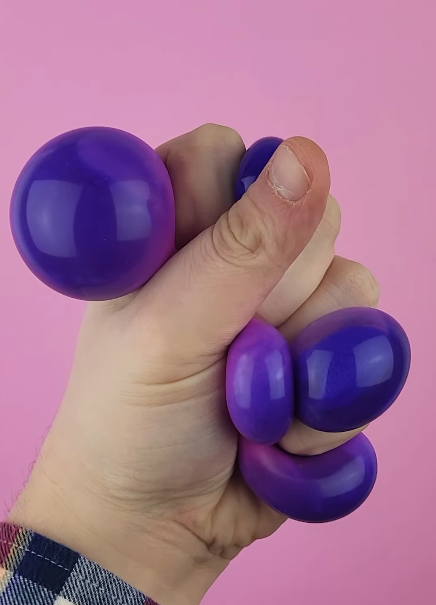
For Schylling, the concern goes beyond fake branding. Benjamin Halls, managing director of William Valentine, said genuine NeeDoh toys go through design, manufacturing, and independent safety checks that counterfeit products may not.
“Counterfeit products don’t just infringe on our intellectual property – they bypass the rigorous design, manufacturing, quality control and independent safety testing that authentic NeeDoh products undergo before reaching consumers,” Halls told ABC News. “That’s why we take the growing issue of counterfeit toys so seriously.”
Concerns over the toys’ safety have been growing in Australia and elsewhere, as children have been ending up in hospital from serious burns and other injuries after following a social media trend encouraging children to put the toys in microwaves to make them softer.
Heating can make the filling extremely hot and sticky, meaning a toy that bursts can cause severe burns.
Sydney Children’s Hospitals Network said 11 children aged between six and 12 had been referred to the Burns and Plastics Treatment Centre at Westmead between January and September after being burned by heated squishy toys. The injuries included mid-to-deep burns to the face, neck, chest, arms and hands, with some children requiring skin grafts and longer-term scar treatment.
Queensland Children’s Hospital paediatric emergency physician Veevek Thankey told ABC News he was aware of at least 13 similar cases since April.
One of those cases involved 10-year-old Gold Coast girl Violet Zerbst, who spent a week in hospital after putting a NeeDoh Nice Cube in the microwave. She told 7NEWS she had seen people online heating the toys to make them softer. When she squeezed hers, the contents burst across her face, lips and mouth. “It literally just exploded,” Violet said.
Her father, Jody Zerbst, told the Gold Coast Bulletin that the filling was “scalding and sticky” and stuck to his daughter’s face. “All the skin had sort of peeled off – it was really gruesome,” he said.
However, not all the recent incidents have involved microwaves. At the Royal Adelaide Show earlier this month, 10-year-old Mason was playing with a squishy toy when it burst across his face. His mother, Amanda, told News.com.au that the contents went into his eyes, nose, and mouth and that he began choking.
She said the toy had no packaging or product information, leaving her worried that it had been a counterfeit. “I’m extremely concerned because if they can’t tell you what the ingredient is, then they shouldn’t be selling them,” Amanda said.
One of the biggest problems plaguing parents is that the fakes are rarely obvious knockoffs. Some have been dressed up as supposed brand collaborations, and counterfeit NeeDohs carrying Coca-Cola and Pepsi branding have appeared on the Australian market.
Schylling said it has never released an official NeeDoh collaboration with either drinks company.
Counterfeit NeeDoh Nice Cubes bearing fake Red Bull, Coca-Cola, and Monster branding have also turned up in UK convenience stores, according to Better Retailing, which examined data from about 13,000 shops.
The Australian Competition and Consumer Commission has warned that squishy toys can contain gels, beads, water, and other materials and may become dangerous if they split, leak or release their contents. Its product safety guidance tells consumers to look for clear information about the toy and its materials, and to avoid products with strong chemical smells, weak seams, loose beads, or leaks.
The ACCC also specifically warns against putting squishies in microwaves or leaving them in hot cars, saying heating can cause them to burst or leak hot contents.
In the US, the Consumer Product Safety Commission said it had stopped 55 shipments of non-compliant squishy toys at ports, preventing more than 355,000 units from entering the country.
In the UK, the Office for Product Safety and Standards rejected an import of counterfeit NeeDoh Splash Balls on 15 September after classifying the toys as presenting a high chemical risk. Officials said there was no evidence that the products had undergone the relevant UK conformity assessment procedures because the supplied Declaration of Conformity did not match the product.
More about
AustraliaABC NewsRed BullConsumer Product Safety CommissionUKUSChina
Join our commenting forum
Join thought-provoking conversations, follow other Independent readers and see their replies
Most popular
Popular videos
Bulletin
Read next
Fonte: – World RSS Feed