‘A Wake-Up Call’: Scientists Behind Study on Climate Feedback Loops Demand Global Action
Por Jessica Corbett — Common Dreams
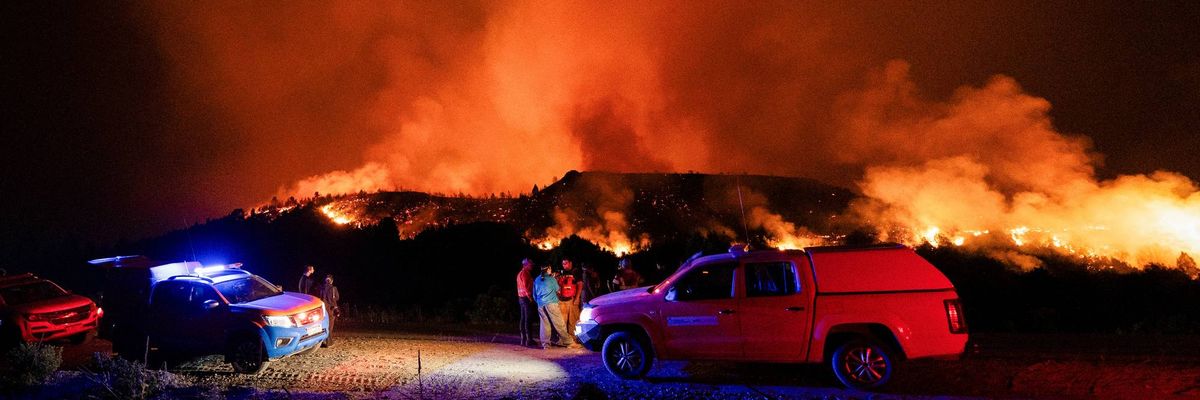
On the heels of the United States setting new summer heat records and United Nations scientists warning that at least a temporary overshoot of the Paris Agreement’s 1.5°C target can no longer be avoided, researchers on Thursday published an alarming new study on climate feedback loops.
For years, experts have feared that humanity’s continued reliance on fossil fuels that heat the Earth could lead to several “positive” feedback loops—or changes to natural systems that amplify global warming. The scientists behind the new paper in the journal Environmental Research focused on carbon dioxide and methane emissions from inland freshwaters, permafrost thaw, wetlands, and wildfires.
“Continued warming from greenhouse gases emitted from human activities threatens to feed further warming as permafrost, wetlands, and wildfires destabilize and respond by releasing carbon dioxide, methane, and nitrous oxide,” said co-author Ben Poulter, warming-induced emissions program director at Spark Climate Solutions, in a statement.
“This study provides a critical look at the magnitude of the temperature response,” he explained, “and a call to action to accelerate the accounting and monitoring of warming-induced emissions to support pathways that phase out fossil emissions to stabilize the planet’s climate.”
Lead author and Spark research scientist Sam Abernethy noted that “what surprised us was the size of the feedback.”
“We found that natural systems could amplify global warming by 20-30%,” he said. In other words, these natural systems could add an estimated 0.2-0.4ºC of warming this century to any temperature rise tied to human activity.
“This hidden multiplier is missing from the models guiding climate policy, so those models are likely underestimating how much warming is coming—and overestimating how much carbon we can still afford to emit,” Abernethy added.
Permafrost is ground that remains fully frozen for at least two consecutive years, and the scientists who study it “have long warned that thawing soils would become a significant emissions source as the planet warms,” said co-author Christina Schädel, senior research scientist at the Woodwell Climate Research Center.
“This paper shows that permafrost thaw accounts for half of the anticipated warming-induced emissions,” she pointed out. “Warming-induced emissions are already in motion, and they scale with every fraction of a degree. Every little bit of warming we can avert today matters for what the climate looks like in the long term.”
Co-author Robert Jackson, a Stanford University professor and chair of the Global Carbon Project, similarly stressed that “the results are a wake-up call, and it’s imperative that they be included in the next generation of climate policies. Failure to do so will make meeting the world’s climate goals less and less likely.”
The paper’s publication came just two months away from the next United Nations Climate Change Conference (COP31) in Türkiye, where firefighters are currently battling deadly blazes that have fueled calls for the country’s government to fight for rapidly phasing out coal, gas, and oil on a global scale.
“This research makes clear that the Earth and climate system doesn’t stand still while we debate policy,” said Brian Buma, a co-author of the new study and senior climate scientist at Environmental Defense Fund.
“Emissions from permafrost, wetlands, and wildfire could meaningfully erode our remaining time to warming thresholds—and they are unaccounted for in most scenarios,” Buma reiterated. “This means rapid fossil fuel emissions reductions are even more urgent than current projections suggest.”
“The good news,” he added, “is that it’s in our hands—lower emissions now limit how severe these feedbacks become.”
Fonte: Common Dreams
