As Americans Face Affordability Crisis, Poll Reaffirms ‘Supporting Medicare for All Is Not Radical’
Por Brett Wilkins — Common Dreams
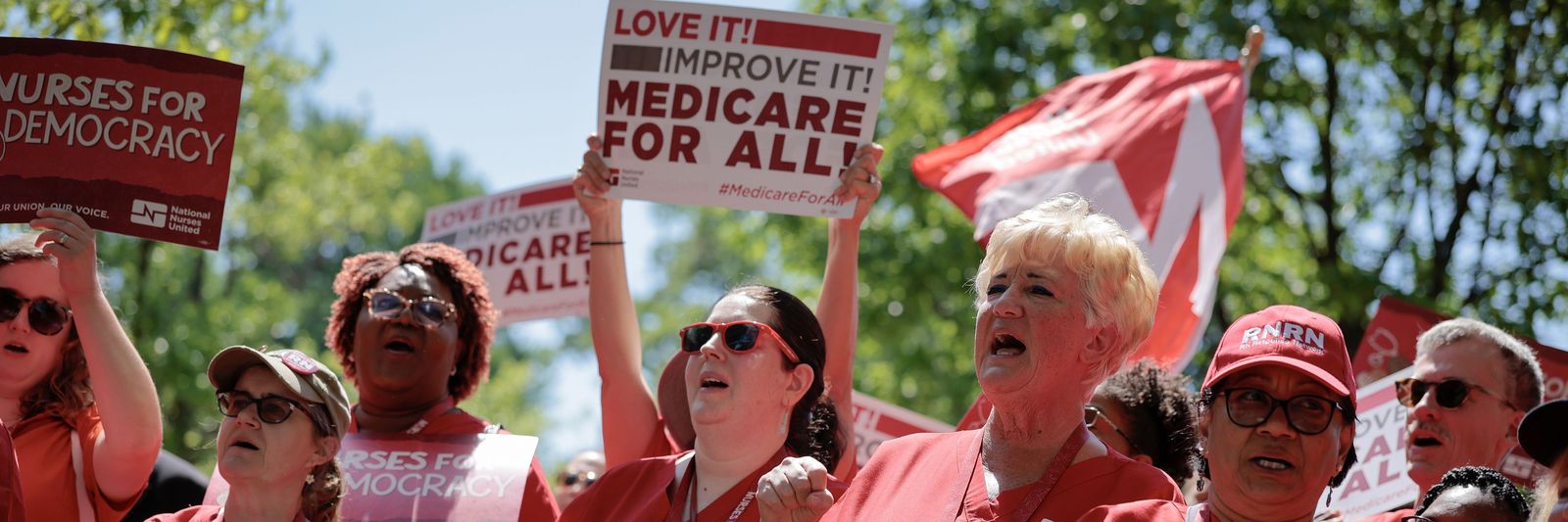
Yet another poll, this one released on Tuesday, shows significant support for Medicare for All as Americans grapple with rising healthcare costs and the Trump administration and congressional Republicans target federal programs upon which tens of millions of people rely.
A plurality—43%—of respondents to the latest Axios-Ipsos American Health Index said they support replacing private health insurance with a government-run Medicare for All system, compared with 24% who oppose the idea. Another 32% were unsure, leaving supporters outnumbering opponents by nearly two to one. Two-thirds of respondents also backed increased federal spending to reduce healthcare costs.
Respondents’ views on Medicare for All are divided along party lines, with a majority of Democrats (62%) and a plurality of independents (47%) supporting the proposal, while a majority of Republicans (52%) oppose it.
Again: Supporting Medicare for All is not Radical — opposing it is. We can’t afford NOT to do it. #MedicareForAllNOW www.axios.com/2026/10/13/a…
[image or embed]
— The Tennessee Holler (@thetnholler.bsky.social) October 13, 2026 at 5:24 AM
The most commonly cited reason people said they oppose Medicare for All is fear that the quality of care would be inferior to that offered by private health insurance (38%), followed by concern that the program would be too expensive for taxpayers (22%), and that the federal government should not be involved in providing healthcare (21%). Supporters were not asked why they favor Medicare for All.
The survey also revealed deepening distrust of political leaders on healthcare issues. Just 20% of respondents said that they trusted President Donald Trump for health-related information, down from 31% in March 2025, while only 25% trusted Health and Human Services Secretary Robert F. Kennedy Jr. The poll also found that 49% would be less likely to support a candidate who received money from pharmaceutical company political action committees.
“Healthcare is one of the significant ways that people experience economic pressure every day,” Mallory Newall, Ipsos senior vice president for US public affairs, told Axios. She noted that while many Americans still “have questions” about Medicare for All, the current level of support for the proposal is “noteworthy—and it is not solely driven by members of the Democratic Party.”
Newall said that even if candidates “don’t call it Medicare for All,” expanding federal healthcare programs so that they cover more people “is a message that can connect with voters” as they prepare to cast their ballots in next month’s midterm elections.
The stakes extend beyond Medicare for All. Republicans’ sweeping 2025 budget law enacted the biggest cuts to Medicaid in the program’s six-decade history, while enhanced Affordable Care Act premium tax credits expired at the beginning of 2026, threatening higher costs for millions of enrollees.
Progressives have cited these and other developments to argue that the private insurance system leaves working-class families vulnerable to corporate profiteers and political attacks.
A separate survey released last week by the health policy research organization KFF found that 66% of Americans favor Medicare for All, the highest level of support since the organization began tracking the issue a decade ago. While 84% of Democrats and 72% of Independents polled backed Medicare for All, 66% of Republican respondents opposed the proposal.
According to a study published in August by researchers at Yale University, shifting to a Medicare for All-type system would save more than 114,000 lives and around $1 trillion annually in the US. Sen. Bernie Sanders (I-Vt.) has cited the study while promoting his Medicare for All Act.
“Do not tell me we cannot afford Medicare for All,” he said at the time of the study’s publication. “What we cannot afford is a broken healthcare system based on greed.”
Fonte: Common Dreams

:quality(85)/740f04a7-73d3-4511-ab80-311f31181139.jpeg)