‘People have a right to seek answers’: Inside India’s unrest over the electoral process
Por RT — RT – Daily news
Protests over a voter-list overhaul that put more than 130 million names at risk have expanded into a broader political confrontation
The administration in the Indian capital, New Delhi, has been on its toes since last week as Indian opposition parties and an informal movement known as Cockroach Janta Party (CJP) are staging protests over the removal of millions of names from voter lists.
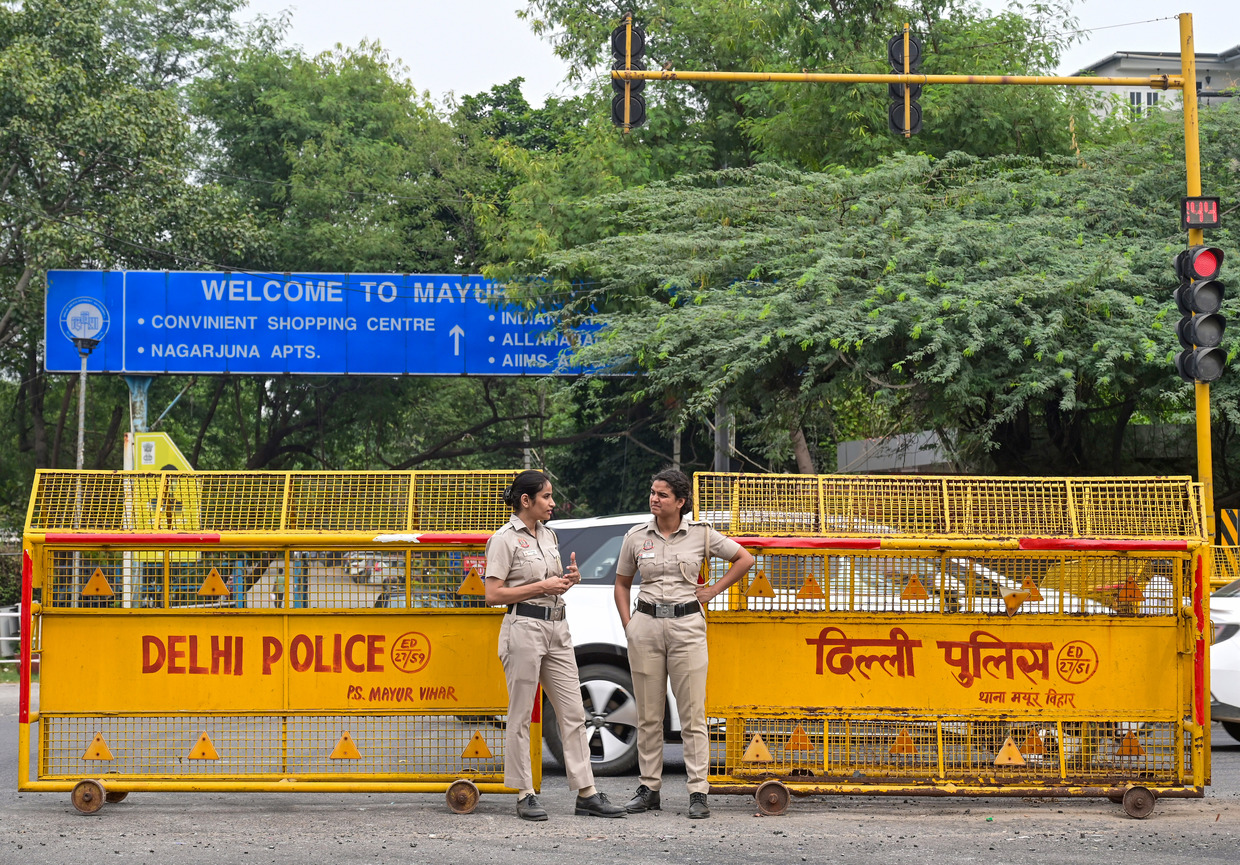
New Delhi became a fortress over the weekend, with barricades made of iron and armed personnel stationed at nearly all major intersections ahead of the protests. Still, people showed up, thousands were detained, and the formal opposition parties took the baton with a massive march towards the Supreme Court on Monday.
The key demand of the protesters is the resignation of Chief Election Commissioner Gyanesh Kumar over allegations that a country-wide revision of the electoral database is helping the ruling Bharatiya Janata Party (BJP) party, led by Prime Minister Narendra Modi, to stay in power and win elections across states. Both the BJP and the Election Commission have rejected the accusations.
READ MORE: ‘Cockroaches’ are back in the streets: Here is why India faces a new wave of protests
CJP back in action
The CJP, a youth movement born out of an online meme, became prominent earlier this year for staging massive protests against irregularities in the examination system that eventually led to the resignation of the country’s education minister.
This time, the protests are challenging the nationwide Special Intensive Revision (SIR) of the electoral rolls done by the Election Commission of India earlier this year. The CJP and formal opposition parties allege that the SIR exercise caused the widespread and irresponsible deletion of people from electoral rolls. Reports say there have been 130 million names deleted from the provisional electoral rolls through the ongoing revision process. The Election Commission says this is necessary to eliminate duplicate names, names of deceased people, and those who have migrated. It also maintained that it operated strictly under constitutional and legal frameworks.
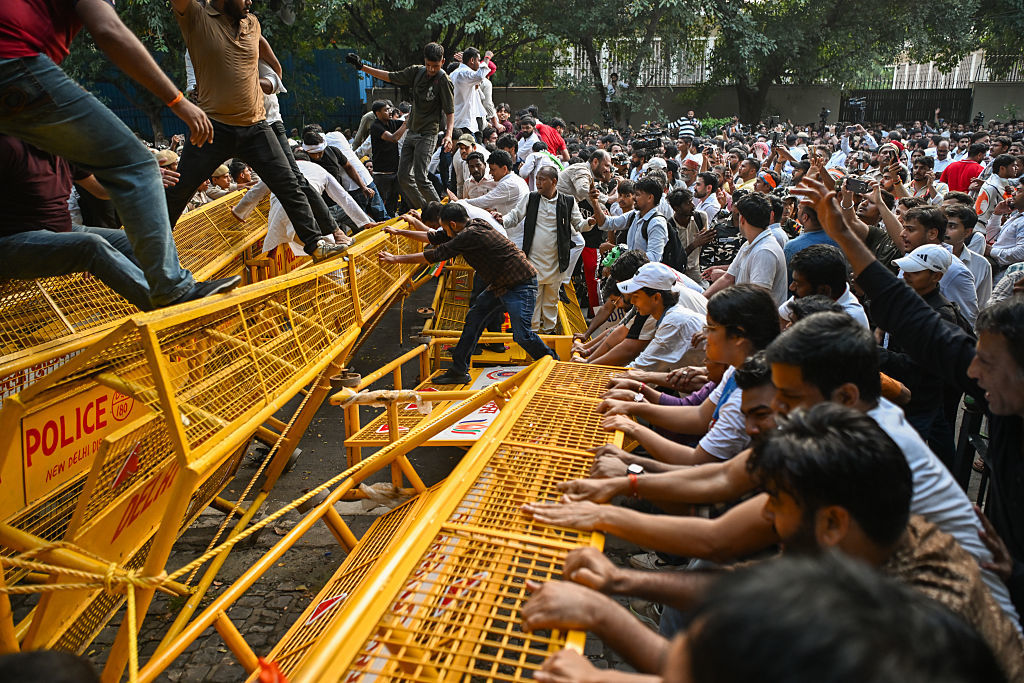
On Saturday, thousands of young activists, students, and opposition leaders gathered around Jantar Mantar and several other prominent locations in the center of the Indian capital. This is despite warnings from the police and the lack of official permission to protest.
© Sunil Ghosh/Hindustan Times via Getty Images
The Delhi Police formally denied permission for the Jantar Mantar protest on Saturday, citing public order and traffic concerns. A 24-hour temporary mobile internet shutdown was enforced across central Delhi and key border points. Entry and exit were restricted or closed across 57 Delhi Metro stations around the central corridor, and over 60 incoming regional trains were canceled or short-terminated.
Over 23,000 police and paramilitary personnel were deployed across central intersections, converting locations like Connaught Place and Janpath into restricted zones.
“We have a right to protest against the Election Commissioner,” Ariba Fahim, 19, a student activist who was detained briefly near INA on Saturday during the demonstration, said.
Shiv Tanakiya, 21, a college student who traveled from Meerut in the neighboring state of Uttar Pradesh a day before the protest, said young people have a right to seek accountability from the government.
“We are the youth of this country wanting to be heard. We live in a democracy. We are not doing this at the behest of any opposition party, but this is a concern for the whole country,” he said.
© Ritesh Shukla/Getty Images
Early Saturday morning, key CJP organizers Abhijeet Dipke, Saurav Das, and Ashutosh Ranka were taken into preventive custody directly from an incoming flight at Delhi Airport. After over 24 hours of preventive detention, all three were freed after a peace bond.
At a press conference shortly after their release on Sunday afternoon, the leaders condemned the government’s response, saying the use of thousands of security personnel and internet shutdowns against peaceful demonstrators exposed the administration’s fear of youth-led accountability.
“Picking up citizens off airplanes and shutting down an entire city just to block a peaceful protest is not governance; it is intimidation,” Das told reporters, reaffirming that the CJP would continue its pan-India campaign for electoral transparency despite the state restrictions.
Prominent YouTuber and influencer Dhruv Rathee, who traveled to Delhi from Germany where he resides, to take part in the protests was detained from his parents’ residence before he could do so. “I was not arrested or detained, I was KIDNAPPED,” Rathee said in a post on X after he returned home.
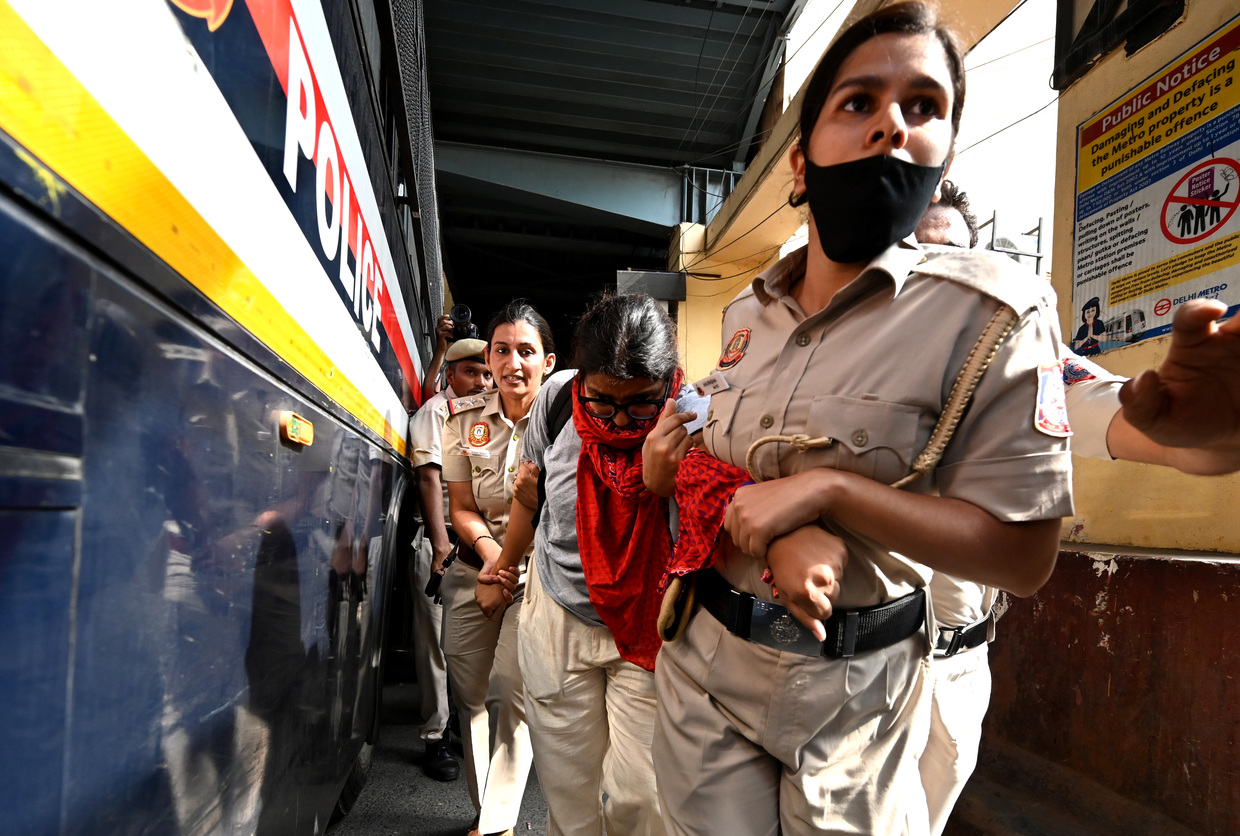
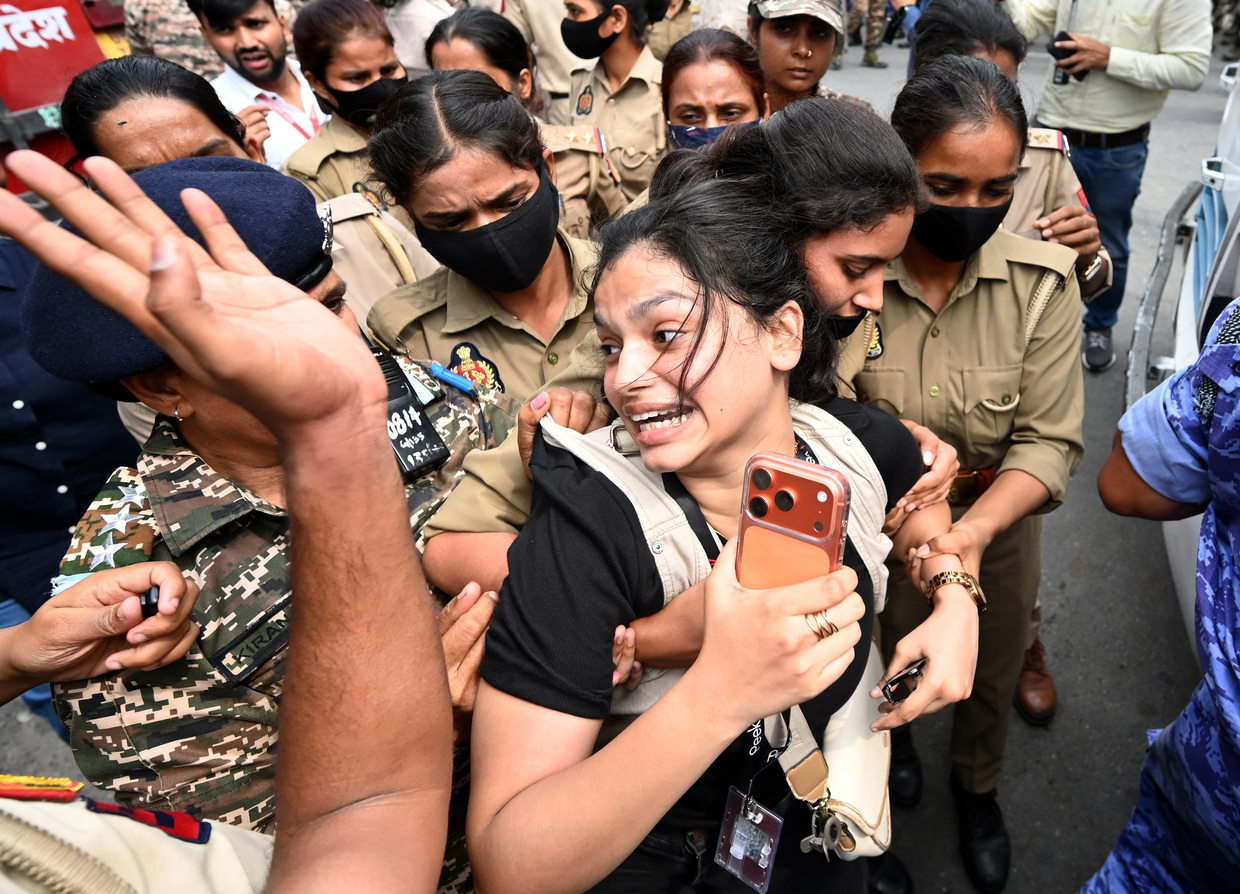
Official police reports indicate that over 7,000 individuals were taken into preventive detention across Delhi and surrounding border checkpoints throughout the day; most of them were freed on Sunday.
“We are educated peaceful protesters exercising our constitutional rights,” Kirti Sahu, 22, a university student who was detained near CP before being loaded onto a police bus, said. “The government caused inconvenience to people by shutting down metro stations, cutting the internet; you are proving our point about highhandedness.”
Another student protester, Rinku Singh, said the key demand is transparency in public institutions.
© Ishant Chauhan/Hindustan Times via Getty Images
The CJP seemed to be prepared for the police crackdown. Just as the detentions started, founder Abhijeet Dipke dropped a pre-recorded video telling protesters to spread out. Prominent student leader Neha Bora, the president of All India Students’ Association, quickly shifted the crowds away from a blocked Jantar Mantar toward Connaught Place, outsmarting police barricades and keeping the protest moving across the city.
“Narendra Modi’s government cannot simply ignore young people. India has a massive youth population with high ambitions, but millions of educated graduates are struggling to find decent jobs, creating deep frustration,” Asim Ahmad, a researcher from Jamia Nagar, Delhi, who was also part of the protest, said.
Nitin Nabin, the president of the ruling BJP, lambasted the CJP protests and said the leaders working at the behest of the opposition cannot see India moving forward.
“PM Modi has the trust of [the 1.4 billion] people of India. We will ensure the Viksit Bharat dream will be taken forward, and any forces, whether they live in this country or outside trying to destabilize India will be strictly dealt with,” Nabin said in a post on X, adding that the opposition is attempting to destabilize the country in collusion with foreign powers.
© Ishant Chauhan/Hindustan Times via Getty Images
Special attention
The Delhi protests were widely covered by international media, drawing immediate attention from the UN High Commissioner for Human Rights (OHCHR). It released a statement on Saturday, expressing concern over “mass detentions” and urging the Indian authorities to “ensure that the right to peaceful assembly is fully respected and fulfilled, and that those detained arbitrarily are released immediately.”
The Ministry of External Affairs issued a firm response, calling the OHCHR’s remarks “an unwarranted interference in the internal affairs of India”
“As in every democracy, Indian citizens exercise this right subject to the maintenance of public order and safety. Our law enforcement authorities act strictly in accordance with the law, and our courts remain available to all for the redressal of any grievances,” New Delhi said. It also noted that OHCHR’s “double standards” in commenting on protests – and the way local authorities respond to it – in various parts of the world.
“Violent responses to protests in our neighborhood have gone uncommented, as indeed have law enforcement actions in its own vicinity. Such double standards only erode the credibility of its standing and contribute to the loss of faith in multilateralism,” New Delhi said.
While images of detentions in India are dramatic, they are hardly comparable to those coming out of France, where student protesters have clashed with fully equipped riot police using tear gas and water cannons.
No official statement came from the OHCHR office regarding the French protests, though the spokesperson for the UN human rights office on Friday said the body is “following with concern incidents related to the student protests and high school blockades in France.”
“We call on everyone to ensure that they remain peaceful and that there is no disproportionate use of force by law enforcement,” the spokesperson said, according to Le Monde.
Opposition springs into action
The official opposition has called for new protest, with Rahul Gandhi, the head of the main opposition Congress party, leading a march to the Supreme Court on Monday. He was joined by other opposition leaders who form the INDIA (Indian National Developmental Inclusive Alliance) bloc.
At a press conference ahead of the march, Gandhi said the opposition’s fight will continue until the Election Commission’s leadership changes, the Constitution is upheld, and the electoral system is overhauled.
INDIA leaders filed a petition in the Supreme Court against the Election Commission, alleging large-scale voter deletions and irregularities in the electoral roll revisions. The plea also raises concerns over restrictions on peaceful demonstrations.
In anticipation of the opposition march, Delhi Police not only barricaded all major access roads with multiple layers of barriers and closed nearby metro stations, but also de-notified Jantar Mantar as a designated protest site – a role it had served for more than three decades.
Under the new arrangement, protests will be permitted only at Ramlila Maidan in central Delhi, Burari Ground in north Delhi, and CBD Ground in east Delhi.
However, in a special hearing on Sunday following the October 10 security lockdown, a Supreme Court bench comprising Justices Joymalya Bagchi and V. Mohana reasserted the constitutional right to peaceful assembly, ordered an immediate halt to all unauthorized preventive detentions, and demanded the full restoration of normal transit and mobile internet services across the capital. The court stressed that while law enforcement can enforce prohibitory orders in specific restricted zones, citizens holding peaceful, unarmed demonstrations cannot be subjected to city-wide blackouts or arbitrary detentions.
Thousands took part in the march on Monday, with drone footage showing massive crowds in the streets of central Delhi leading to the Supreme Court building, which Gandhi and other opposition leaders reached by the evening. Chief Justice of India Surya Kant earlier declined the request of the opposition for a meeting, arguing, according to the media reports, that the meeting would be inappropriate as the issues to be raised are already sub judice before the Supreme Court.
While local protests over the electoral rolls have been seen in other large cities, including Mumbai and Bengaluru, agitation is yet to become nationwide. What is clear, however, is that it is unlikely to die out easily.
“It is the people who choose the government. People have a right to seek answers, but this government is not listening and is using police to stop peaceful demonstrations,” Shiv Tanakiya said. “We are the future of this country, and we must be heard.”
Fonte: RT – Daily news