Corruption in the White House: Does Anybody Care?
Por William W. Taylor III — The Nation » Article
October 5, 2026
Corruption in the White House: Does Anybody Care?
The 2026 midterms and 2028 presidential election should be referendums on whether Trump and his associates can profit from his presidency.
Share
Copy Link
Facebook
X (Twitter)
Bluesky
Pocket
Email
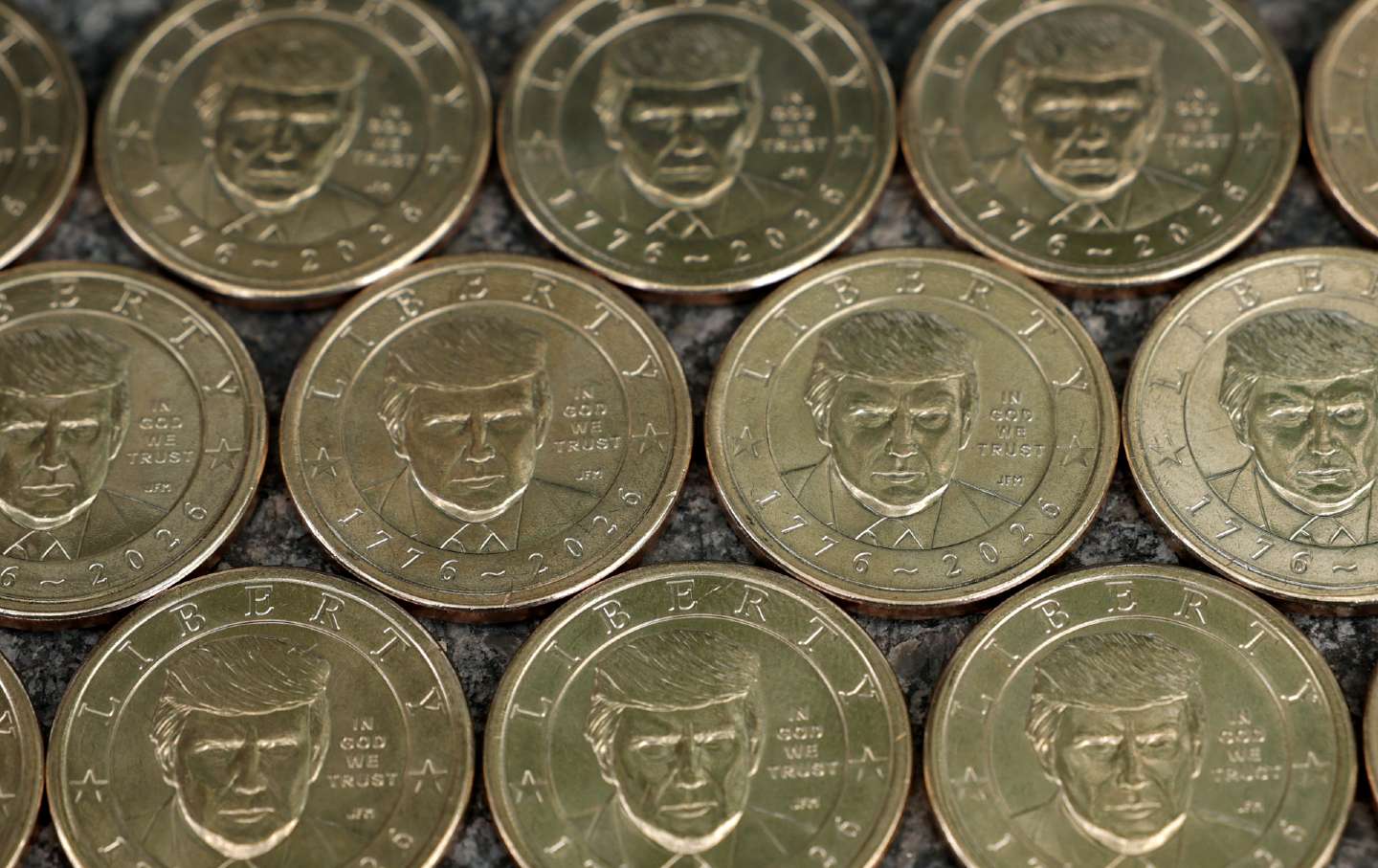
Donald Trump claimed income of over $2 billion in 2025. A substantial part of it came from persons and entities who have a direct interest in what he does as president. When asked why he believed he and his family could buy and sell as if he were not president, he tellingly retorted, “Because I found out that nobody cared.”
It is a frightening thought that nobody cares whether the president uses his office to make money for himself and his family. If nobody cares about the kind of corruption now on display, not only our moral authority in the world but our constitutional democracy is at risk. Elected officials in the United States have a moral and legal duty not to put their own interests above, or in conflict with, the interests of their constituents. If they forsake that duty, we cannot expect they will act only in the best interest of the country, and we cannot expect our noble experiment to continue.
Citizens must care, moreover, because while the president gets richer, they get poorer. The 2026 midterms and the 2028 presidential election should be referendums on a central issue: whether the holder of the highest office in the land, and his relatives and friends, can accumulate fabulous wealth because he holds that office.
Despite his claim to business genius, there is no confusion about how Donald Trump has made money as president and whether it is wrong for him to do it. The rejoinder is that what he has done is not illegal. That may be so for some of his gains: The laws that prevent conflicts of interest for all other federal officials do not apply to the president. The current Supreme Court has defined corruption narrowly, requiring an explicit agreement to give or receive a thing of value in exchange for an official act, and given the president broad immunity. A court will have to determine whether manipulating the stock market, trading on inside information, profiting from pardons, or extorting things of value from foreign governments are protected as part of his “official duties.” But whether it is illegal or not is beside the point: It is morally and ethically wrong. And it must be disqualifying for Trump or any other officeholder.
Current Issue

The framers feared corruption in government because they had seen it and felt it firsthand. Their concern was not just bribery, although bribery was a form of it. They despised the European practice of giving gifts to public officials. They believed gifts, especially valuable ones, caused officials to subordinate their duty to the public to their personal interests. At the end of the Constitutional Convention, Benjamin Franklin warned of the danger from “the bold and the violent, the men of strong passions and indefatigable activity in their selfish pursuits.” And it was Franklin, of course, who had earlier received a gold snuffbox from Louis XVI, a snuffbox that became a symbol of all that was wrong with the lackadaisical European attitude about gifts.
The framers created a government with three separate branches and two emoluments clauses, in Article I, Section 9, and Article II, Section 1, seeking to restrain public officials, including the president, from “selfish pursuits.” The corruption they feared was just the kind we are seeing today: the president’s use of his office to obtain great wealth. They believed the government they were creating would not survive if officeholders could follow their personal greed, and they were right.
Trump’s $2.2 billion in 2025 income is shocking not only for its size but also because it did not occur until he took office in 2025. It far surpasses his income in any prior year of his life. The sheer size and timing of it is powerful evidence that he used the office in his own self-interest.
Trump and his followers deny that he violates any duty to this country by putting $2 billion in his pocket from businesses that profit from his actions. They deny it is wrong to get money from people who want him to do something for them, or at least to curry his favor.
They do not deny—since the major sources are disclosed—where his disclosed riches have come from.
One and a quarter billion dollars came from his interests in the cryptocurrency business, at the same time that the Securities and Exchange Commission, which he controls, announced that it would not regulate cryptocurrency. No small portion came from a $500 million investment in his World Liberty Financial, a cryptocurrency company, by a firm controlled by the government of the United Arab Emirates. The investment was followed close in time by an agreement between his administration and the UAE for the export by the United States to the UAE of hundreds of thousands of computer chips used to power AI. The chip sale provoked concerns over the UAE’s relationship with China and the possibility that China would get chips from the US indirectly when it could not do so directly. The coincidence between the money and the favor is grotesque by any standard.
Trump also collected multiple millions from royalties on sales of his memecoin, $TRUMP, and World Liberty’s sale of its own products. The sales were a sucker’s play. Purchasers of $TRUMP lost money when the coins declined in value, but he and his partners made money on transaction fees when the coins were bought and sold. They were largely unaffected by the drop in value that hit the small investors the hardest. And these businesses are, by his choice, unregulated by any government agency.
His family business has also made millions licensing the Trump name to properties in countries that have important relations with the United States, including Qatar and Saudi Arabia.
Trump also boasts of making billions on stock trades. No small portion of that comes from insider trading—trading on information that is not available to the public. For example, on July 23, he purchased up to $5 million each in Broadcom, Meta, Amazon, Apple, Microsoft, and Nvidia, all of which have substantial interests in artificial intelligence markets. That same day he released his artificial intelligence plan in which he expressed his desire to deregulate the AI industry. Prices for Apple and Broadcom subsequently increased by more than 30 percent.
He thought this scheme was so powerful that he decided to market it. He announced that he would sell an early peek at his Truth Social posts for $100,000 per month. Anyone interested in trading stocks can ante up for inside information that will move the market.
Popular
“swipe left below to view more authors” Swipe →
-
My Rape, the Cornell Case—and Why We Need Better Approaches to Teaching How Consent Works
My Rape, the Cornell Case—and Why We Need Better Approaches to Teaching How Consent Works
-
The People vs. the Supreme Court
The People vs. the Supreme Court
/
-
Garbage and Gravitas
Garbage and Gravitas
/
-
Donald Trump vs. Bernie Sanders—2 Sharply Different Views of America’s Role in the World
Donald Trump vs. Bernie Sanders—2 Sharply Different Views of America’s Role in the World
In pursuit of an unapologetic campaign to benefit the fossil fuel industry, the White House is paying big dollars to owners of wind energy projects to close them. Evan Halper of The New York Times recently reported that the White House’s latest move will funnel vast sums to Australian billionaire Michael Dorrell, who gave about $1 million to Trump’s inaugural. A German company, RWE, got $1.2 billion from the US government to give up its wind leases if it invested in “conventional energy” projects. RWE will invest $900 million in a giant liquefied natural gas project in Louisiana by purchasing a stake in the project owned by Dorrell’s private equity fund.
Political contributions likewise flow in from companies that get generous federal contracts. The New York Times reported on Monday, August 23, that the GEO Group donated $1.4 million to MAGA Inc. within a few days of obtaining two contracts to run detention centers worth $165 million a year. GEO’s good fortune is not isolated. A catalog of similar donations linked to government benefits has been compiled by More Perfect Union, a group admittedly opposed to the administration but whose factual research has not been questioned. And Ruth Marcus has chronicled the going price for pardons in a recent article in The New Yorker, “Trump’s Pardon Economy.”
In perhaps his most dramatic—and crass—escapade, he engineered a “settlement” with the Department of Justice, which he controls, to create a $1.8 billion “anti-weaponization fund” and to prohibit the IRS from auditing the tax returns of him, his family, and their affiliated companies filed before May 19, 2026. Attorney General Blanche says the fund will not be created but the immunity for taxes will go into effect. In essence, Trump granted himself and his family immunity for any taxes they owe but have not paid.
The White House maintains that all decisions are made on their merits, a proposition that does not pass the laugh test.
Nothing in our history comes close to this president’s abuse of his office. His colossal income is from investments in industries that are directly affected by White House policy. These industries benefit when their businesses are deregulated or when, as the UAE tycoon found, restrictions on sales of certain products are lifted. There is no doubt that this president has used the power of his office to benefit himself. And he is getting a lot more than a snuffbox.
Maybe Trump is right. Nobody cares. Or voters have grown rightfully cynical about politicians, as they see companies and billionaires buying elections, the revolving door between public officials and private lobbies, the reality that money talks big-time in today’s politics. Certainly the Republican-controlled Congress does not care. But the reality is that the president and his cronies are doing exactly what the framers thought they were preventing and what our democracy cannot survive. They represent the most basic gluttony and decline of “civic virtue.” They are cleaning up while most Americans are struggling to make ends meet, as the prices of basics—housing, food, gas, energy, healthcare—keep rising.
It may be that the only restraint against Trump’s abuses of his office is the ballot box. The 2026 midterms and the 2028 presidential campaign will tell us whether voters are so offended that they will put him and his cronies out. Trump has said to his followers that, with regard to the midterms, they should “pretend I am running,” and offered $5,000 to every adult citizen if Republicans keep control of Congress.
So American citizens are indeed being asked if they care about corruption. We can only hope that they do. He makes the midterms about him. His opponents should make them about not only his failed policies and his disastrous war but his greed and shameless abuse of his office to make money. To people whose groceries are costing more than ever before, the prospect of his continuing to enrich himself at their expense is, or ought to be, unacceptable. To all of us, the impact of it on the values this country was built upon—not to mention its moral stature—is unspeakable.
William W. Taylor III is a founding partner of Zuckerman Spaeder.
Fonte: The Nation » Article