Hong Kong invests billions to accelerate innovation of impactful solutions as an AI-powered future comes into focus
Por Advertising partner — South China Morning Post – News feed
Advertisement Impactful AISS-approved projects Hong Kong Hong Kong invests billions to accelerate innovation of impactful solutions as an AI-powered future comes into focus
• The HK$3 billion Artificial Intelligence Subsidy Scheme aims to accelerate the transformation of AI R&D projects into impactful practical solutions.
• Over 30 projects have been approved, backed by a total of HK$1.7 billion.
Paid Post: Cyberport 4 -MIN READ 4 -MIN
Advertising partner Published: 12:00am, 2 Oct 2026
[The content of this article has been produced by our advertising partner.]
Artificial intelligence has rapidly evolved from an emerging technology into a cornerstone of Hong Kong's economic transformation strategy. Under the Government's AI+ initiative, further reinforced by the First Five-Year Plan for Economic and Social Development of the HKSAR (2026-2030), the city is stepping up efforts to integrate AI across industries, public services, scientific research, healthcare, finance and smart-city development, with the ambition of becoming a leading innovation hub in the Greater Bay Area and beyond.
At the heart of this strategy is the HK$3 billion Artificial Intelligence Subsidy Scheme (AISS), a three-year programme that supports universities, research institutions, enterprises and government departments in harnessing the immense computing power of Cyberport's Artificial Intelligence Supercomputing Centre, the city's largest AI computing facility and a key piece of digital infrastructure. Hong Kong's total computing capacity has now surpassed 5,000 petaFLOPS.
The scheme marks a strategic shift from supporting AI research alone to accelerating real-world applications capable of generating tangible economic and social benefits. .
Against this backdrop, a new generation of researchers, scientists and innovators is translating cutting-edge breakthroughs into practical solutions.
Since the launch of AISS in 2024, more than 50 applications have been received and over 30 projects approved, spanning local universities, R&D centres, government departments, technology companies and start-ups. Total subsidies granted have exceeded HK$1.7 billion.
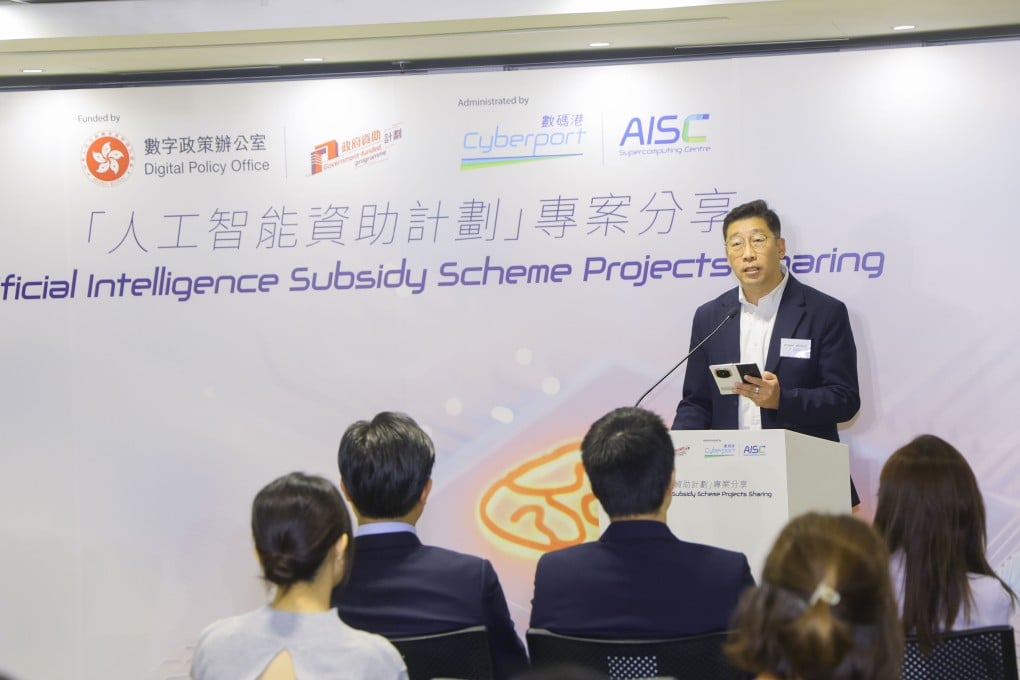
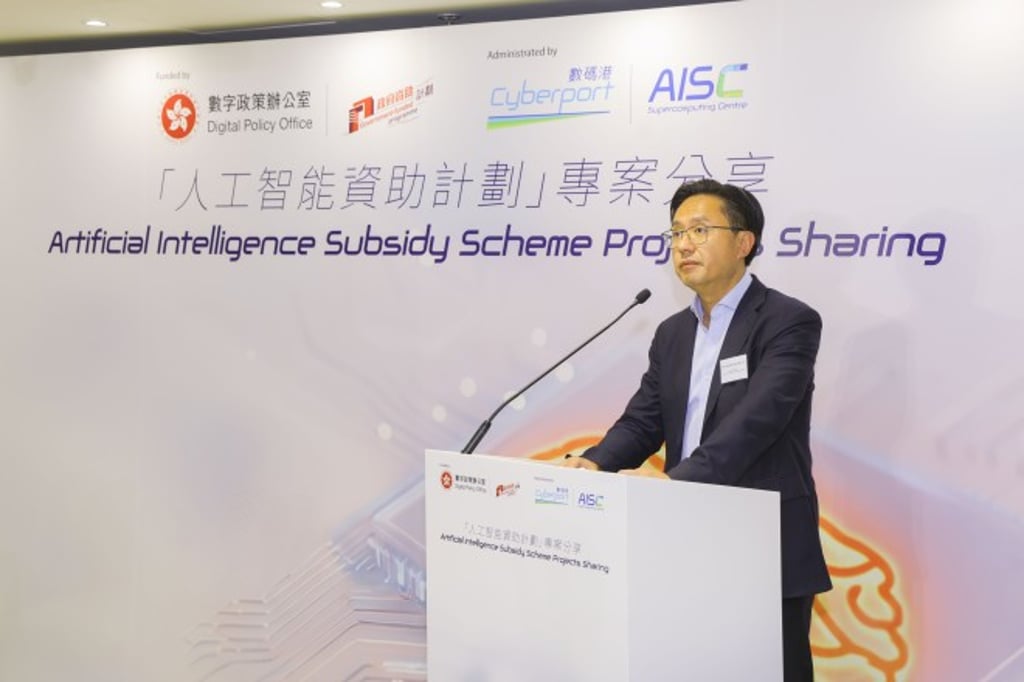
Speaking at a sharing session featuring approved AISS projects, Daniel Cheung, Acting Commissioner for Digital Policy, highlighted the scheme's role in supporting Hong Kong's broader development goals. "The AISS closely aligns with the National 15th Five-Year Plan by advancing ‘industries for AI’ and ‘AI for industries,’ promoting the transformation and upgrading of traditional sectors such as finance and healthcare. Since its launch, the AISS has received enthusiastic responses, with subsidised projects demonstrating immense potential in technological innovation and industrial application," he said.
Echoing this view, Hendrick Sin, Chairperson of the Committee of AISS, said: "The approved projects not only showcase scientific breakthroughs but are steadily being transformed into practical applications that benefit society and industry, enhancing citizens' quality of life and exemplifying the power of collaborative innovation among government, industry, academia and research."
AI for life sciences
One of the highlights of the sharing session was a multimodal large language model for medical diagnosis and surgery developed by the Centre for Artificial Intelligence and Robotics (CAIR) under the Hong Kong Institute of Science & Innovation of the Chinese Academy of Sciences.
Focused on advancing innovation at the intersection of AI and life and health sciences, CAIR has built a comprehensive medical AI ecosystem centred on CARES 3.0, a multimodal medical model equipped with continual learning and trustworthy decision-making capabilities. The platform pioneers a new "copilot" approach to intelligent healthcare.
Among its innovations is EchoCare, an ultrasound foundation model trained on four million ultrasound datasets. Adaptable across a wide range of clinical applications, the model can accurately identify lesions in more than 50 organs. CAIR's technological advances have helped overcome critical technical bottlenecks.
Providing an update on the project's progress, Dr Liu Hongbin, Director of CAIR, said the system has been successfully implemented in leading hospitals in Hong Kong and the Mainland. "Surgical report generation time has been dramatically reduced from 2 hours to 15 minutes. Echocardiogram scanning time has been cut from 16 minutes to 6 minutes, increasing daily throughput per physician from 25 to over 60 cases and shortening patient waiting times from 2-3 weeks to 3-5 days. Furthermore, AI-assisted diagnostic accuracy has exceeded 90 percent, identifying 8 additional high-risk cases per 100 patient cases on average," he said.
.jpg?itok=bb8hqAbI)
Financial innovation
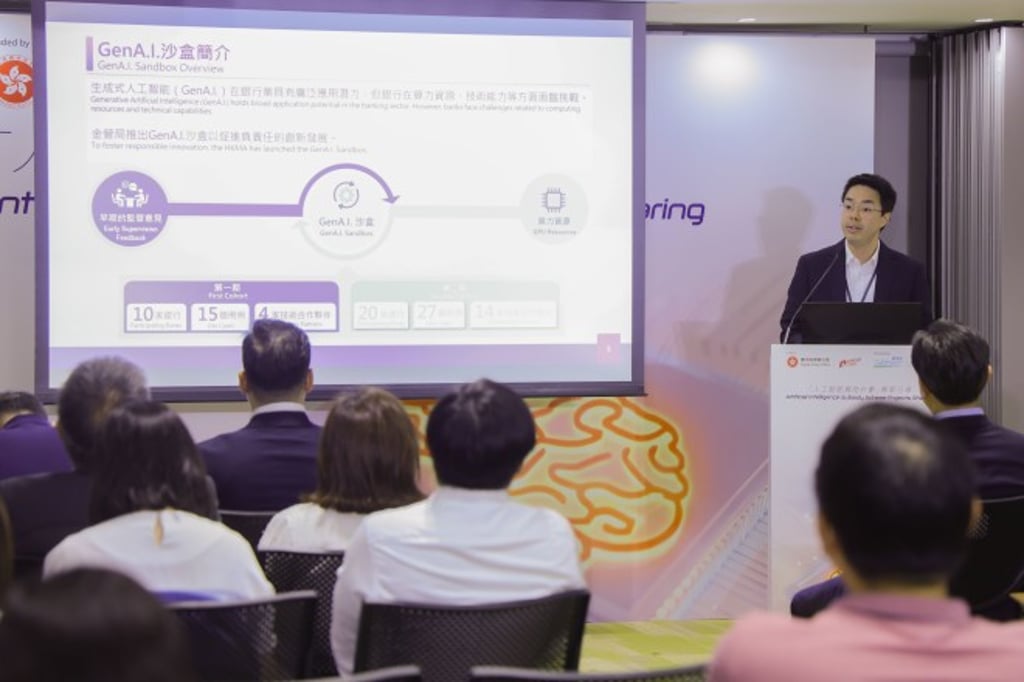
AI is also reshaping Hong Kong's financial sector. The Hong Kong Monetary Authority (HKMA) and Cyberport launched the first and second cohorts of the GenA.I. Sandbox in 2024 and 2025 respectively, focusing on use cases in anti-fraud operations, risk management and customer experience enhancement.
Trial results demonstrated significant operational gains across the banking sector. Participating institutions recorded a 30 to 80 percent reduction in preparation time for suspicious transaction reports, while document processing times were cut from one day to approximately five minutes. The technology also reduced risk assessment report production time by 60 percent, enabled more comprehensive risk analysis workflows, and resulted in more than 70 percent of GenAI-generated credit assessments being regarded as useful references by adopting institutions.
Building on this momentum, the HKMA joined forces with Cyberport, the Securities and Futures Commission, the Insurance Authority and the Mandatory Provident Fund Schemes Authority to launch GenA.I. Sandbox++ in March 2026, with a strong emphasis on exploring Agentic AI applications.
Moving beyond content generation, selected use cases under Sandbox++ are examining how AI systems can responsibly take on greater autonomy across end-to-end processes, including customer onboarding, payments, insurance claims and customer interactions.
Alvin Li, Head (Banking Supervision) of the HKMA, said: "GenA.I. Sandbox++ provides computing resources and supervisory support, enabling financial institutions to test and refine innovative solutions in a safe, controlled environment to enhance operational efficiency, strengthen risk management, and improve customer experience."
Collaborative Generative AI Platform
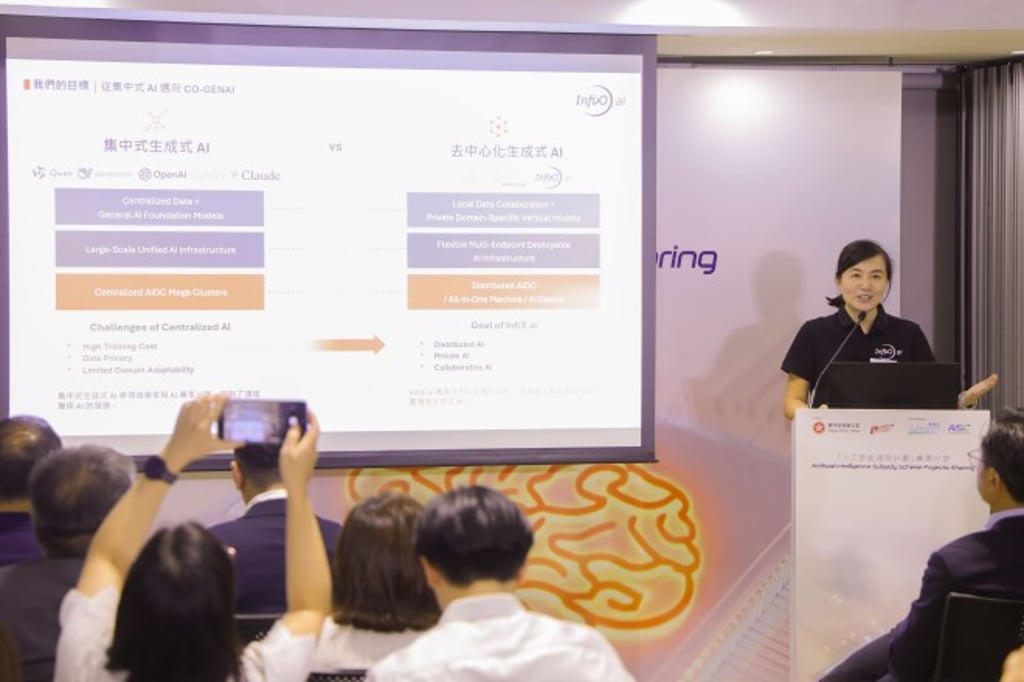
Another project demonstrating the breadth of Hong Kong's AI ambitions comes from InfiX.ai, which has independently developed the Collaborative Generative AI (Co-GenAI) Platform. It enables enterprises, research institutions and industry partners to train domain-specific AI models using their own datasets at significantly lower computing costs. By avoiding the centralisation of proprietary data while safeguarding privacy and intellectual property, Co-GenAI allows specialised intelligence distributed across organisations and devices to be connected and integrated into a continuously evolving collaborative intelligence network.
This approach enables AI technologies to be co-created, co-developed and shared among participating organisations. Supported by high-efficiency computing resources, model engineering, knowledge bases and application workflows, the platform offers capabilities ranging from local deployment and model fine-tuning to evaluation, inference services and multi-model collaboration.
Designed as a scalable, secure and controllable AI infrastructure, the platform has applications across sectors including manufacturing, public administration, finance, healthcare and education, helping drive digital transformation and strengthen the broader AI ecosystem.
Professor Yang Hongxia, Chief Scientist and Founder of InfiX(HK).ai and Chair Professor at The Hong Kong Polytechnic University, said: "The platform helps clients across various industries improve AI application efficiency by 30 to 50 percent, accelerating the translation and deployment of AI technologies."
These three projects illustrate how government support, world-class computing infrastructure and research excellence are converging to address pressing challenges, unlock new opportunities and demonstrate the transformative potential of artificial intelligence for Hong Kong's future.
The city's ambitions are set to grow further with the planned commissioning of the Sandy Ridge Data Facility Cluster in the Northern Metropolis by 2032. Once fully operational, the facility is expected to propel Hong Kong into the ranks of the world's leading centres for computing capacity, strengthening its position as a regional and global AI powerhouse.
Advertisement Select Voice Select Speed 0.8x 0.9x 1.0x 1.1x 1.2x 1.5x 1.75x 00:00 00:00 1x AI-generated voice