Nepal’s flooding disaster set to pile billions onto its national debt
Por Nick Ferris — – World RSS Feed
In Focus Nepal’s flooding disaster set to pile billions onto its national debt
Exclusive: New analysis of climate disasters shared with The Independent shows how they are sending the national debt of countries soaring, as campaigners warn much more must be done to compensate vulnerable countries that have done little to cause the climate crisis. Nick Ferris reports
Sunday 27 September 2026 10:57 BST
- Bookmark
- Comments Go to comments
Bookmark popover
Removed from bookmarks
Close popover

Become an Independent member to bookmark this article
Want to bookmark your favourite articles and stories to read or reference later? Start your Independent Membership today.
Already a member?
Log in
Your support helps us to tell the story
Read more Support Now
From reproductive rights to climate change to Big Tech, The Independent is on the ground when the story is developing. Whether it’s investigating the financials of Elon Musk’s pro-Trump PAC or producing our latest documentary, ‘The A Word’, which shines a light on the American women fighting for reproductive rights, we know how important it is to parse out the facts from the messaging.
At such a critical moment in US history, we need reporters on the ground. Your donation allows us to keep sending journalists to speak to both sides of the story.
The Independent is trusted by Americans across the entire political spectrum. And unlike many other quality news outlets, we choose not to lock Americans out of our reporting and analysis with paywalls. We believe quality journalism should be available to everyone, paid for by those who can afford it.
Your support makes all the difference. Read more
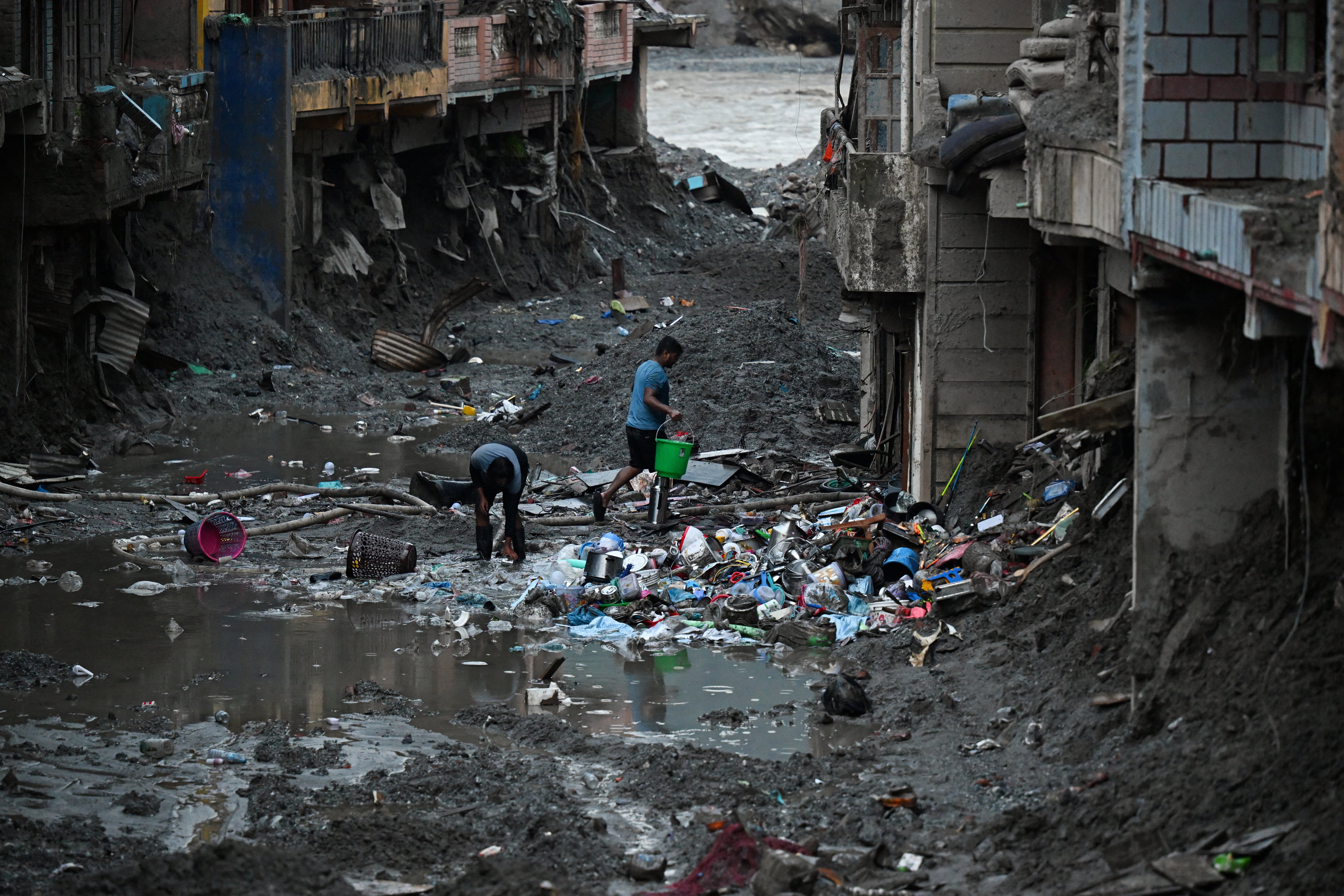
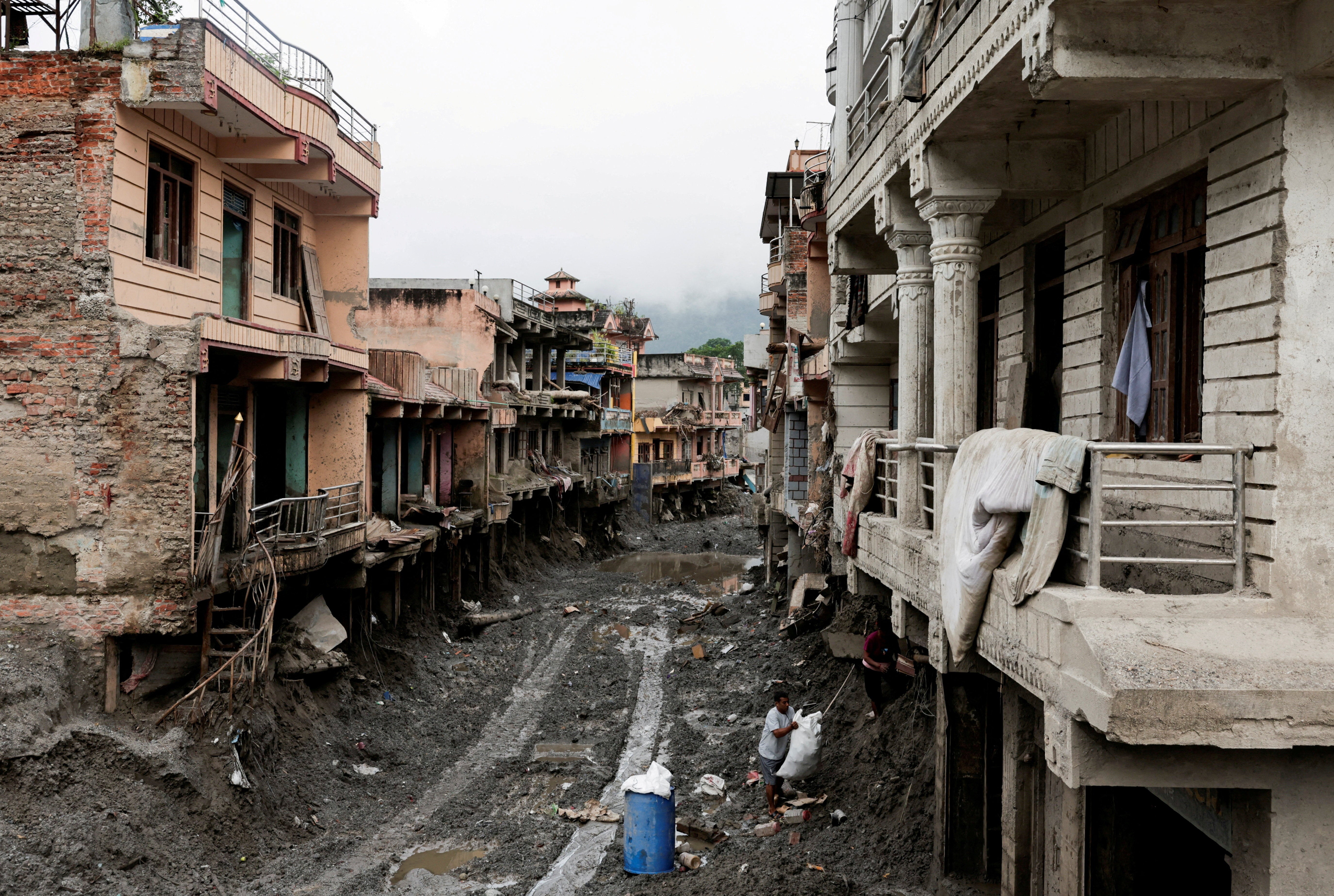
A month on from Nepal’s devastating floods, the disaster looks set to pile billions of pounds onto the country’s national debt burden – as experts warn it could become the latest country to face a huge debt bill from a climate crisis it has done little to cause.
On 26 August, more than 100 million cubic metres of rock and glacier broke away from Langtang Lirung mountain on Nepal’s northern border, triggering a 188km/h debris flood that buried villages, changed the course of rivers, and killed more than 1,400 people.
Scientists have since said that the event was made significantly more likely due to climate change, while the finance minister has warned that the final death toll could exclude that of a devastating 2015 earthquake.
A subsequent rapid assessment of damage from the Nepali government has put the cost of recovery and reconstruction at $4.8 billion (£3.6bn) – equivalent to 11 per cent of the country’s GDP – and government figures have called for grant-based compensation as a matter of ‘climate justice’, given the fact that Nepal contributes to an estimated 0.1 per cent of greenhouse gas emissions each year.
 open image in gallery
But the Fund for responding to Loss and Damage, established at the UN climate summit COP27 in Egypt in 2022, has so far secured just $822m in pledges, of which only $456m had actually been paid in by May, limiting the scale of support available to countries hit by disasters.
The fact that applications for withdrawals are limited to only $20m per country means the government will likely be forced to foot the bill with public debt, according to experts.
“The loss and damage fund was created to support countries facing unprecedented climate disasters such as this, but it has nowhere near enough money,” says Ritu Bharadwaj, director of climate resilience at the International Institute for Environment and Development (IIED).
“Even if – by a stroke of luck – they received the $20m they can apply for, that is less than half of a percent of the $4.8bn in damages.
Bharadwaj continues: “Right now, there is still media attention. But once that goes, Nepal will be left to fend for itself – and that will mean borrowing huge amounts of money at an expensive rate, leaving the country at the mercy of creditors who can essentially use debt to control the country in an almost colonial manner.”
 open image in gallery
Bharadwaj’s comments come as campaigners have for many months now warned that decisive global action must be taken to address soaring debt levels in developing countries. Low-income nations now spend an average of 18 per cent of government revenue servicing external debt, which these days is often held by private financial institutions, and countries are also paying billions more to cover debts than they are receiving as aid to fight climate crisis.
Nepal’s own national debt has risen sharply over the past seven years, from Rs 1.43 trillion in 2019/20 to nearly Rs 3 trillion (£7bn to £15bn). The Asian Development Bank has also warned that the August floods will likely weigh on Nepal’s GDP this year.
If – as many fear – Nepal’s debt is sent soaring by the costs of recovering from the flooding disaster, it will be just the latest developing country to suffer in such a way from a climate disaster they bear little responsibility towards.
New analyses from Debt Justice, shared exclusively with The Independent, show how this pattern has already played out elsewhere.
In Mozambique, Cyclone Freddy caused an estimated $1.5bn in damage in 2023. By 2025, the country’s public debt had climbed to 91.4 per cent of GDP, $1.4bn higher than the IMF had predicted before the cyclone struck, which is a gap roughly equivalent to the disaster’s cost.
Mozambique’s debt was declared unsustainable by the IMF this February, after the country slipped into debt-service arrears estimated at 1.3 per cent of GDP in 2025.
A similar story played out after Pakistan‘s 2010 floods, which caused an estimated $43bn in losses.
The IMF had forecast the country’s fiscal deficit would shrink steadily in the years that followed; instead it more than doubled, driving Pakistan to borrow an estimated $20bn-$40bn more than it otherwise would have. Debt Justice calculates that, once interest payments are factored in, the floods added $36bn to $71bn to the country’s debt burden over the following decade.
“Mozambique and Pakistan’s debt levels were much higher than originally predicted after the climate disasters,” says Tess Woolfenden, policy advisor at Debt Justice. “While not all increases can be put down to the disaster, the increase, alongside a well-known lack of grant-based climate finance, indicates the harmful impact these disasters have contributed to increases in government debt.”
She continues: “Rich countries that have built their wealth on climate-wrecking emissions cannot ignore the billions of dollars of damage now facing Nepal. They must urgently pay what they owe, as grants, not loans.”
The pattern is also extremely evident among the world’s 39 small-island developing states, which are now regularly being thrown into chaos by climate disasters, such as Hurricane Melissa in Jamaica last year.
More than 40 per cent of these countries are currently classified as highly indebted or in “debt distress” – and analysis from IIED’s Bharadwaj finds that the mean external debt of island states increased from 55 per cent during a period of low disaster intensity (2007-09) to 59 per cent during a period of high disaster intensity (2020-21).
The nature of the escalating climate crisis means that climate disasters are now often hitting before a country has had time to recover from a previous such event.
“If you look back just one year, Nepal faced a similar big flooding event, and some of the roads were still being rebuilt when this latest flood occurred,” says Bharadwaj. “For countries like Nepal there is no recourse, as they are battered by the weather and the global financial system.”
NGOs who are either helping to fund the humanitarian response, or actively developing programmes to assist, share similar views that wealthy nations must urgently step up support for Nepal in the wake of its latest disaster.
“A country suffering a natural disaster should have an immediate, interest-free suspension of all debt payments across all external creditors as an act of solidarity and a recognition of the long-term impacts suffered,” says Neil Thorns, director of advocacy at CAFOD.
“Recovery should not leave countries like Nepal taking on any additional unaffordable or inappropriate debt to pay for disasters they did little to cause,” agrees Shruti Agarwal, senior climate finance advisor at Save the Children. “It is critical that climate finance remains affordable for lower-income countries and is grounded in the principles of climate justice.”
As well as calling for more grant-based support, campaigners argue that rich countries can do much more to assist developing countries struggling under excessive debt burdens.
This could include reforming the existing G20 debt relief process – known as the Common Framework – to compel creditors to better engage with the process, or via UK legislation that capitalises on the fact that some 90 per cent of developing country debt eligible for debt relief is legally domiciled in the UK, as a result of the strength of the City of London.
“Rich countries need to urgently agree on a mechanism to cancel unjust debts, including to private lenders,” says Tess Woolfenden from Debt Justice. “The UK should use its Presidency of the G20 next year to radically reform the current debt relief mechanism.”
This article has been produced as part of The Independent’s Rethinking Global Aid project
More about
Rethinking Global AidMozambiquePakistanNepal
Join our commenting forum
Join thought-provoking conversations, follow other Independent readers and see their replies
Most popular
Popular videos
Bulletin
Read next
Fonte: – World RSS Feed