Some states are taking a tougher stance as Medicaid work requirements kick in
Por Geoff Mulvihill — – World RSS Feed
Some states are taking a tougher stance as Medicaid work requirements kick in
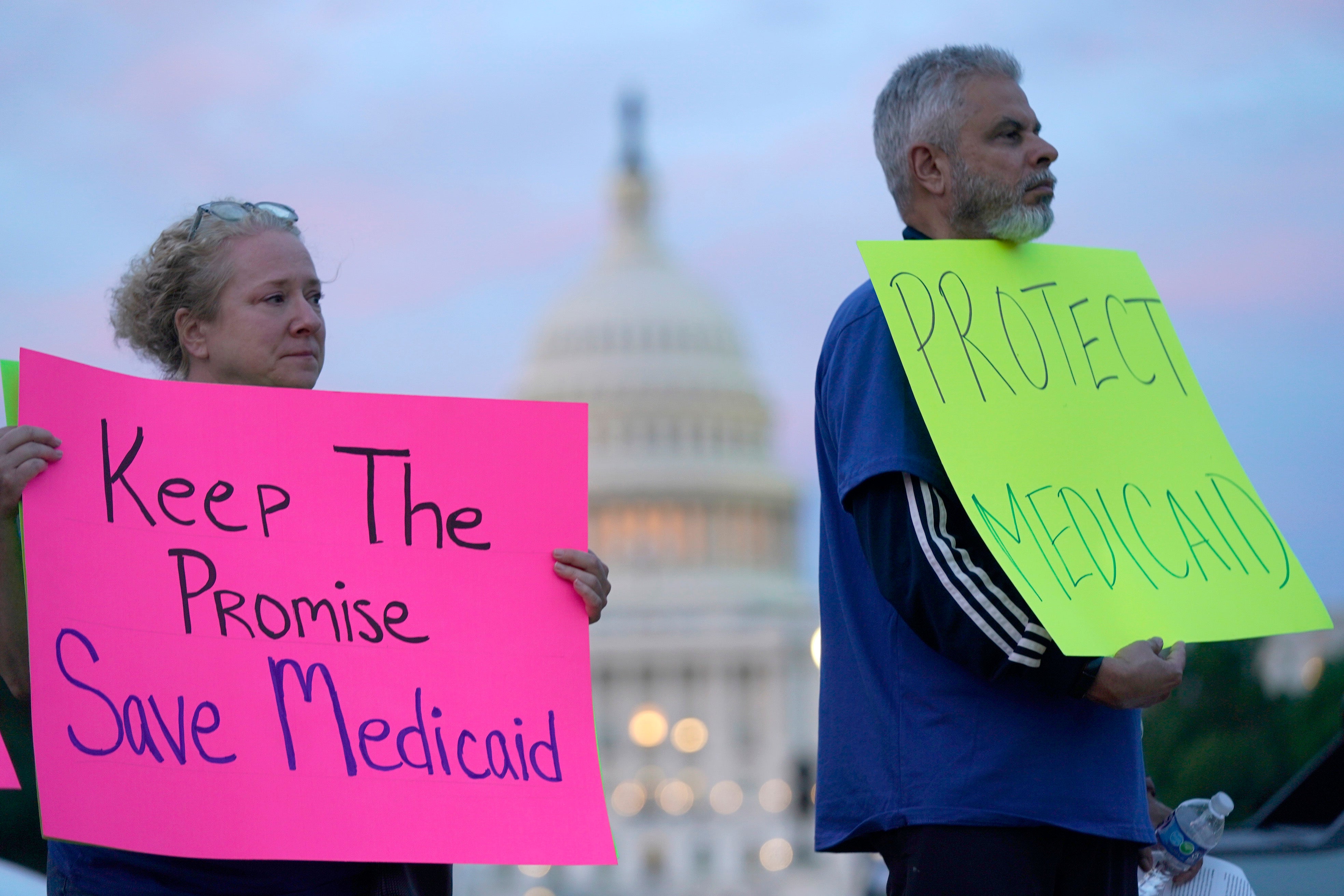
The Medicaid changes are projected to save the federal government $887 billion over the next decade and result in 7.5 million fewer people with health insurance
Geoff Mulvihill Saturday 26 September 2026 17:11 BST
- Bookmark
Bookmark popover
Removed from bookmarks
Close popover
 open image in gallery
Become an Independent member to bookmark this article
Want to bookmark your favourite articles and stories to read or reference later? Start your Independent Membership today.
Already a member?
Log in
Your support helps us to tell the story
Read more Support Now
From reproductive rights to climate change to Big Tech, The Independent is on the ground when the story is developing. Whether it’s investigating the financials of Elon Musk’s pro-Trump PAC or producing our latest documentary, ‘The A Word’, which shines a light on the American women fighting for reproductive rights, we know how important it is to parse out the facts from the messaging.
At such a critical moment in US history, we need reporters on the ground. Your donation allows us to keep sending journalists to speak to both sides of the story.
The Independent is trusted by Americans across the entire political spectrum. And unlike many other quality news outlets, we choose not to lock Americans out of our reporting and analysis with paywalls. We believe quality journalism should be available to everyone, paid for by those who can afford it.
Your support makes all the difference. Read more
Starting this January, new work mandates for select Medicaid recipients will take effect nationwide under President Donald Trump‘s major 2025 tax and policy legislation, with a group of Republican-governed states adopting measures far stricter than federally required.
Central to the dispute is the process by which individuals demonstrate they are medically unfit for employment. Although federal guidelines permit states to accept a participant’s self-attestation for the initial 12 months, a minimum of six states are insisting on immediate medical proof, a standard that additional states are striving to adopt.
Health advocates caution that these stringent demands could hinder lower-income individuals seeking coverage through the joint state-federal program.
“Someone may not be able to work, but they can’t see a doctor because they can’t afford it. So they’re now applying for Medicaid,” said Jennifer Tolbert, director of state health policy and data at the research organization KFF. “But Medicaid is saying you need documentation from a provider.”
 open image in gallery
Even as a number of conservative states pursue a harsher implementation of the federal law, Democratic officials across 25 states have filed lawsuits arguing the new regulations are unreasonably restrictive.
Some say documentary evidence is necessary to avoid fraud
The Medicaid changes are projected to save the federal government $887 billion over the next decade and result in 7.5 million fewer people with health insurance, according to the Congressional Budget Office’s 2025 estimate.
The conservative Foundation for Government Accountability has been pushing states not to make it too easy for people to avoid work requirements, saying able-bodied adults are pushing enrollment and costs higher.
Jonathan Ingram, vice president of research and policy at the group, has been encouraging states not to take a beneficiary’s word for it, a process known as self-attestation.
“Self-attestation is fraud-by-design,” he said via email. “It is a policy developed by bureaucrats to maximize enrollment at the expense of program integrity.”
Self-attestation comes under penalty of perjury, so people who lie can be subject to criminal charges — though such charges are rare.
Arkansas, Idaho, Indiana, New Hampshire, North Carolina and Ohio all have laws or policies that bar self-attestation to qualify for the work requirement exception starting next year.
Republican Missouri state Rep. Darin Chappell said he worked with the Foundation for Government Accountability to craft a proposed amendment that would have enshrined Medicaid work requirements in the state constitution. It would have required “documentary evidence” of work or reasons for exemptions, specifically prohibiting self-attestation.
The amendment passed the Missouri House but died without a vote in the Senate. Chappell plans to try again next year.
“If someone has a debilitating physical ailment — or mental ailment for that matter — something that prohibits them from working, that’s totally legitimate,” he said. “But we’re not taking anybody’s word for it. I don’t mean to shock you none, but people do tend to lie about such things.”
Most nondisabled beneficiaries under 65 already work
The new mandate applies to up to 20 million lower-income adults without children at home who are enrolled in Medicaid through an optional expansion in 40 states and the District of Columbia. The requirement does not apply in the 10 states, mostly in the South, that did not expand Medicaid.
Beneficiaries will have to work or volunteer at least 80 hours each month or be in school at least half-time to qualify, with exceptions for situations including medical frailty.
The law had said medically frail people include those who have substance use disorders, disabilities or serious medical conditions. But the Centers for Medicare and Medicaid Services published a rule in June that went further and was stricter than states and providers expected, saying someone’s condition must “significantly impair” their ability to work, volunteer or attend school as required for an exemption.
 open image in gallery
Currently states generally decide once a year whether Medicaid recipients still qualify for benefits. The new law will require it to happen twice for most enrollees.
States will be allowed to accept self-attestation just once each time a person enrolls starting in 2028. After that, documentation would be required at least every 12 months to verify that they still have the condition and that it still prevents them from being able to work.
The government expects states to rely increasingly on third-party data — on things such as workers’ compensation claims or prescription information — to help make determinations. For conditions that do not show up in the databases, states can require a doctor’s certification, a disability award letter or other proof.
While states have been ramping up the use of this information, the work requirements are still a big change, and many will first have to spend millions of dollars improving their computer systems.
States are already struggling in some cases to make changes to the Supplemental Nutrition Assistance food program, or SNAP, that are required under Trump’s law, including an expanded work requirement.
In Arizona, for example, enrollment plummeted by 55% from April 2025 to April 2026 — the biggest drop in the country — with more than 400,000 fewer people getting benefits now. Last month, the state said that was largely due to difficulties in putting in place new federal requirements that resulted in higher call volumes and additional verification.
Patient advocates worry aid will be denied to qualified people
Ingram said some of the concerns about ending self-attestation are overblown and people can get diagnoses to support their inability to work at many places, including charitable clinics and federally qualified health centers. He also noted that Medicaid allows retroactive coverage for doctor visits that happen before enrollment.
Patient advocates say it’s not that simple.
“The added paperwork, the hoops you have to jump through lead to coverage loss,” said Nate Crippes, a lawyer at the Disability Law Center in Utah, where a law allows self-attestation to qualify for the work requirement exception on a provisional basis.
An added challenge is that most people in the Medicaid expansion group in his state have a mental health or substance use disorder diagnosis — or both.
“We’re choosing to make people with health conditions jump through a bunch of hurdles,” said Camille Richoux, health policy director at Arkansas Advocates for Children and Families.
It can be tricky if states decide to rely partly on patient diagnosis codes to determine whether recipients are able to work.
Lucy Dagneau, senior director of the state and local campaigns team at the American Cancer Society Cancer Action Network, said the codes do not indicate the severity of a condition. For example, some patients with a specific cancer can continue working, she said, but others who are in more advanced stages cannot.
“Our fear is by that banning self-attestation, unfortunately, the state lawmakers who pass those laws are going to have a hand in more people losing coverage in their state than would have,” she said.
More about
Most popular
Popular videos
Bulletin
Read next
Fonte: – World RSS Feed