Las Vegas betting on artificial turf in parks due to water shortage, but residents call it a bust
Por Isabel Keane — – World RSS Feed
Las Vegas betting on artificial turf in parks due to water shortage, but residents call it a bust
Activists argue the city’s plan to remove grass kills existing trees and causing environmental harm
Isabel Keane in New York Saturday 26 September 2026 15:18 BST
- Bookmark
- Comments Go to comments
Bookmark popover
Removed from bookmarks
Close popover



Become an Independent member to bookmark this article
Want to bookmark your favourite articles and stories to read or reference later? Start your Independent Membership today.
Already a member?
Log in
Your support helps us to tell the story
Read more Support Now
From reproductive rights to climate change to Big Tech, The Independent is on the ground when the story is developing. Whether it’s investigating the financials of Elon Musk’s pro-Trump PAC or producing our latest documentary, ‘The A Word’, which shines a light on the American women fighting for reproductive rights, we know how important it is to parse out the facts from the messaging.
At such a critical moment in US history, we need reporters on the ground. Your donation allows us to keep sending journalists to speak to both sides of the story.
The Independent is trusted by Americans across the entire political spectrum. And unlike many other quality news outlets, we choose not to lock Americans out of our reporting and analysis with paywalls. We believe quality journalism should be available to everyone, paid for by those who can afford it.
Your support makes all the difference. Read more
Las Vegas locals are fired up over a plan officials say would save the drought-stricken city 82 million gallons of water a year — but get rid of grass in parks and replace the green space in at least one with artificial turf.
Officials approved a $4 million rebate last week for the city to remove grass in some parks through a cash-for-grass incentive program that would help the Colorado River Basin’s diminishing water supply.
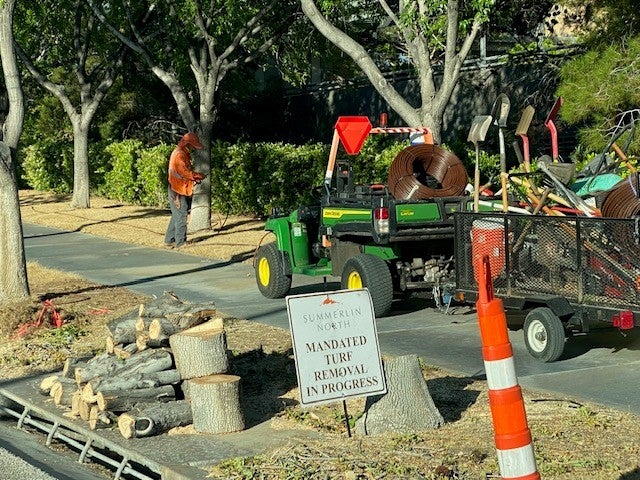
While city officials say the grass being removed is non-functional and will be replaced with drought-resistant plants, some community members fiercely oppose the plan. The critics argue that ripping up grass can kill existing trees, and that clearing too much grass — which helps lower temperatures — will make the sweltering Nevada desert even hotter.
Laura McSwain, a lifelong Las Vegas resident, founded the neighborhood group, the Water Fairness Coalition, to advocate against what she described as destructive water policies from the city and its water provider, Southern Nevada Water Authority.
“They’re creating policies that are adding heat to our environment — it’s being done on the backs of taxpayers — all while they’re saying that this is all about conservation. Well, it’s not. When you exacerbate the temperatures, more water is needed,” McSwain told The Independent.
 open image in gallery
Las Vegas residents already have to abide by strict water use regulations and a hefty price tag on the limited water they have. A law going into effect in January will take measures further and make it illegal to use water delivered by SVWA to irrigate “non-functional turf,” or decorative grass that serves only aesthetic purposes.
The city says it plans to remove some grass from 15 parks, and seven of the projects have already been completed, city spokesman Jace Radke told The Independent.
Radke stressed that most of the grass being removed is in unusable areas like parking lot islands. He also noted that only two parks will have artificial turf added: Cragin Park and Bettye Wilson Soccer Complex, which will have artificial turf built on a plot that does not currently have grass.
“The city has not removed grass that is appropriate and used by the community,” Radke said. Examples of grass removal for recreational improvements include the creation of new pickleball courts at Lorenzi Park and a new outdoor pool at the Veterans Memorial Community Center.
While the city says it is working with SVWA to “balance water conservation with ensuring residents have beautiful parks, fields and recreation amenities,” those against the grass removal feel the city hasn’t held up its end of the bargain.
 open image in gallery
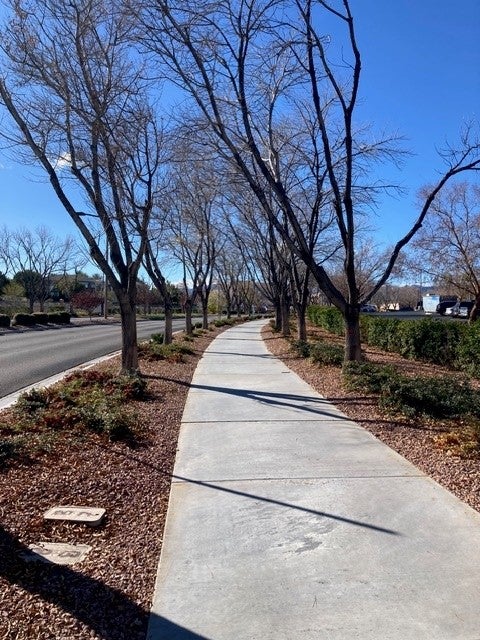
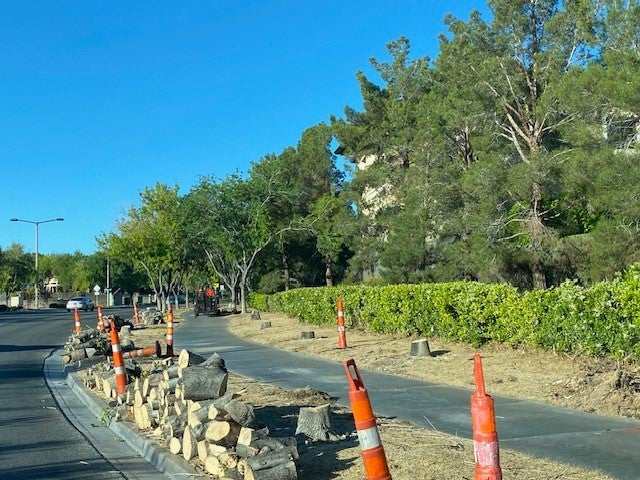
When the law banning water use on “non-functional turf” was passed, McSwain said that officials promised to protect parks and recreational areas. “Yet they are destroying the tree canopies throughout our mature neighborhoods by taking grass out from underneath them,” she said.
Stephenie Stephens, also a lifelong Las Vegas resident, told The Independent that the city now has to “flood” the rock surrounding remaining trees to keep them alive — whereas if they had just kept the grass, they wouldn’t need as much water.
“When I was first watching this happen, I thought I was in the Twilight Zone,” she said.
Both activists took issue with the city declaring parts of the local parks “non-functional.”
“Parks are intrinsically functional, especially in this climate. You know, when it’s too expensive for people to have green space in their own homes, they need a place they can go to escape,” Stephens said.
She added that her grandchildren love to run and play on the grassy knolls in their local park. She says those areas are now considered “non-functional” in many local parks and are “getting carved up, like huge, huge amounts, into rock.”
 open image in gallery
Another concern is the artificial turf, which is replacing grass in one of the green spaces, Cragin Park.
While there are a growing number of studies indicating that some artificial turf can contain forever chemicals, or substances that have been linked to cancer, the fake grass can also get dangerously hot. A University of Nevada, Las Vegas, study from 2008 found that the surface of artificial turf can reach up to 169 degrees.
McSwain noted that just last weekend, artificial turf at Nissan Stadium in Nashville, Tennessee, got so hot that players’ cleats were melting during an NFL game between the Tennessee Titans and the Philadelphia Eagles. Players were forced to change their cleats multiple times as the temperature on the turf soared to 157 degrees Fahrenheit.
“The temperature [in Tennessee] was only 95 degrees outside,” McSwain said. “I can tell you, I have witnessed children playing on turf on a day that was 105, 106 degrees, and there was no cooling. Nothing.”
“I’m just grateful my kids are grown,” she added. “Childhood goes by so quickly that to try and fight this or deny your children the ability to play sports to avoid the toxicity and the heat.”
More about
Join our commenting forum
Join thought-provoking conversations, follow other Independent readers and see their replies
Most popular
Popular videos
Bulletin
Read next
Fonte: – World RSS Feed
:quality(85)/082e62d7-4d3a-4707-9617-2bdceb5aa0f4.jpg)
:quality(85)/fa6d7875-3eec-48f7-b0fd-5ba0cc06b3a7.png)
:quality(85)/c2cf1b07-d8d8-448c-a446-50455dead34e.jpg)