Republicans face midterm backlash from factory workers squeezed out of jobs by Trump’s tariffs
Por Bernard Condon — – World RSS Feed
Republicans face midterm backlash from factory workers squeezed out of jobs by Trump’s tariffs
President Donald Trump’s tariffs are turning factory workers against his Republican Party over fears the import taxes could lead to fewer jobs instead of the manufacturing renaissance he promised
Bernard Condon Sunday 11 October 2026 12:50 BST
- Bookmark
Bookmark popover
Removed from bookmarks
Close popover
Republicans face midterm backlash from factory workers squeezed out of jobs by Trump’s tariffs
Show all 3 

Become an Independent member to bookmark this article
Want to bookmark your favourite articles and stories to read or reference later? Start your Independent Membership today.
Already a member?
Log in
Nelson Vandermeer voted Republican for decades but balked at supporting President Donald Trump, fearing that the Republican’s plan for tariffs on imports would hurt workers more than help.
Last year, Vandermeer’s premonition came true in a very personal way. The 62-year-old lost his job as a product designer at Howard Miller, a clockmaker that relied on parts produced overseas. After a century in business, the company in Zeeland, Michigan, closed its factory, sold off its inventory and brand name and laid off nearly 200 workers.
“So much for bringing jobs back,” Vandermeer said. Next month, he plans to vote straight Democrat in the midterms.
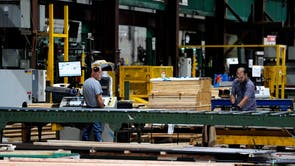
As if an unpopular war with Iran and persistent inflation were not enough trouble for Republicans, they are confronting a backlash over the tariffs that Trump made a cornerstone of his economic agenda. He promised that charging higher taxes on imports would spur a factory renaissance in the United States, but that has not come to pass. Although the country has added manufacturing jobs so far this year, the sector has fewer employees than when Trump returned to the White House in January 2025.
White House spokeswoman Taylor Rogers insisted that a factory boom is underway, citing increases in manufacturing output and more work in certain nonresidential construction trades. “Factory construction jobs of today mean more manufacturing jobs down the road once those factories come online,” she said.
Even before the tariffs, Howard Miller struggled as Americans lost their taste for fancy timepieces such as its signature grandfather and mantel clocks. So the company broadened its offerings years ago to include bar carts, cabinets and consoles.
But those products also depended on glass and other parts from abroad, and diversification did not ensure survival.
“I could still have a job, but now I don’t because of tariffs,” Vandermeer said. “It was like taking a knife to the back.”
Job losses pile up in battleground states
Vandermeer lives in Michigan’s 4th Congressional District, which is represented by Republican Bill Huizenga, who is running for a ninth term in the Nov. 3 election.
Before Trump implemented his broadest set of tariffs last year, on what the president called “Liberation Day,” Huizenga was supportive.
“Is it going to be easy? Not necessarily. Is it the right thing to do? Absolutely it is,” he told reporters at the time.
A spokesperson for Huizenga said last week that the congressman “sees a potential role for tariffs” for boosting domestic manufacturing “while recognizing the need to address their broader economic effects.” His Democratic opponent, state Sen. Sean McCann, has criticized the incumbent for opposing legislation that would rein in tariffs that Trump imposed unilaterally.
There are similar issues in competitive races in Kansas, Iowa and Ohio, where Republican acquiescence could hurt the party on Election Day as their constituents face factory layoffs, farm foreclosures and higher prices.
Tracy Chew, 55, voted for Trump in 2016, then for Democrat Joe Biden in 2020 and Democrat Kamala Harris in 2024.
She used to work for Case, a backhoe manufacturer, but the company announced before the tariffs that it would close its plant in Burlington, Iowa. She lost her job in April, as did her daughter, followed by husband and son-in-law over the next few weeks.
Chew is leaning toward voting for Democrats again this year, feeling that Trump let them down.
“I’m furious he isn’t doing enough,” she said. “Tariffs are not targeting the right companies, the right amount.”
Layoffs in Iowa have piled up elsewhere.
Winnebago Industries, which produces recreational vehicles like campers, cut 200 jobs last year after the cost of importing aluminum, steel and electronics increased by tens of millions of dollars.
“It’s a day to day battle,” said Michael Happe, the company’s chief executive.
In the tight race for an open U.S. Senate seat in Iowa, U.S. Rep. Ashley Hinson faces Democratic state Rep. Josh Turek. There is a close contest, too, in Kansas, where Democrat Adam Hamilton, the pastor of the largest United Methodist Church in the U.S., is trying to unseat Republican Roger Marshall.
Cole Hoppock, chief executive of appliance maker Vornado Air in Wichita, Kansas, said Trump’s tariffs “impacted virtually everything.” The company known for its retro household fans laid off more than 70 factory workers in February, blaming higher prices for imported parts.
Trump’s trade policy could force cutbacks soon at another Kansas employer, Canadian jet manufacturer Bombardier. Trump has threatened to ban the company’s sales in the U.S. if Bombardier does not start making all its planes in the U.S. Bombardier said it buys parts from 2,800 companies in 47 states, including in Kansas, where it employs more than 1,000 people
Trump’s approach to trade is unpopular
Trump has spent years complaining that other countries are ripping off the U.S. when it comes to trade. Most economists say he is wrong and that his remedy — broad universal tariffs — would cause more pain than help.
Now most Americans disagree with Trump’s approach, according to The Associated Press-NORC Center for Public Affairs Research. A September poll showed only about 3 in 10 U.S. adults approve of Trump’s handling of trade negotiations, compared with 4 in 10 in March.
Some of Trump’s tariffs have been haphazard.
He targeted Brazil because of political differences and he jacked up tariffs on China to levels so extreme that they risked a recession and forced the president to retreat. The Supreme Court in February ruled against Trump’s declaration of an emergency to roll out his “Liberation Day” tariffs last year, leaving foreign trade unsettled as the administration continues to adjust with new levies and threats.
Tariffs are far from the only reason for the lost of manufacturing jobs, and factories have cut workers for decades with or without them. Even some Republicans who dislike Trump’s approach will not split with the party.
Bicycle Corp. of America, which closed its factory in South Carolina last year, blamed rising prices for imported parts. Koby Bird, who retired after working in quality control, likes tariffs but was frustrated by Trump’s habit of raising and lowering them seemingly at whim.
“It was all over the place,” Bird said. “Businesses couldn’t plan.”
Next month, Bird is likely to stick with Republicans, including U.S. Sen. Darline Graham, because tariffs are only one issue and he believes Democrats would spend too much money on the wrong things.
Ernie Goss, an economist at Creighton University in Nebraska, said manufacturing woes may not convert to Democratic victories. He said some people may “think the tariffs in the long run will work.”
Some workers may be turning on Trump
Wendell Young, a union leader in Pennsylvania, where several factories have had layoffs, said he senses a backlash among workers.
Last summer, Young said he got a firestorm of angry responses to his email blaming tariffs for a decision by Post Holdings to cut 160 jobs at a local pet food factory.
“Keep politics out of this,” wrote one of workers at the plant in Bloomsburg, Pennsylvania. “President Trump isn’t the reason.”
“People used to beat me up for not supporting Trump. I haven’t heard that in a year,” said Young, president of Local 1776 of the United Food and Commercial Workers International Union. “Some of these people are red Republicans and they are shocked. They expected more jobs.”
Post Holdings ultimately agreed to reduce the head count by offering severance for people to leave, but lower production had a ripple effect.
Local can manufacturer Trivium Packaging decided to cut several jobs because they were getting less orders from Post and other companies, according to Young’s union.
“I understand the mindset behind tariffs, but I just don’t know if it’s working,” said former Trivium worker Heather Kingston. She left for another company before the layoffs, and her husband is still working at Trivium. “There doesn’t seem to be many manufacturing jobs moving into the area,” she said.
Kingston said she voted for Republican Dan Meuser in the 9th District last time but is having doubts this year. Meuser’s seat is considered safe, but other races in the state are up for grabs, including in the 7th and 8th districts, which are near the Post and Trivium factories.
More about
Donald TrumpRepublicansMichiganUnited StatesBombardierKansasNew YorkBirdPennsylvaniaIowaPeopleIranJob lossesWhite HousePresidentBurlingtonUnited Methodist ChurchOhioJoe BidenKamala Harris
Most popular
Popular videos
Bulletin
Read next
Fonte: – World RSS Feed


:quality(85)/e671d95e-89d3-4b32-a21f-76db7b8b8052.jpg)
:quality(85)/fc5f7e0a-0e92-492e-8501-fbfaec3ebb9f.jpg)