Inside mysterious Russian lab where worker died of suspected plague ‘that escaped from broken test tube’
Por Maira Butt — – World RSS Feed
Inside mysterious Russian lab where worker died of suspected plague ‘that escaped from broken test tube’
Local media said nearly 200 people have been quarantined and several hospitals have been closed after the death of lab technician Darya Shipilova
Maira Butt Monday 05 October 2026 15:09 BST
- Bookmark
- Comments Go to comments
Bookmark popover
Removed from bookmarks
Close popover


Become an Independent member to bookmark this article
Want to bookmark your favourite articles and stories to read or reference later? Start your Independent Membership today.
Already a member?
Log in
Your support helps us to tell the story
Read more Support Now
From reproductive rights to climate change to Big Tech, The Independent is on the ground when the story is developing. Whether it’s investigating the financials of Elon Musk’s pro-Trump PAC or producing our latest documentary, ‘The A Word’, which shines a light on the American women fighting for reproductive rights, we know how important it is to parse out the facts from the messaging.
At such a critical moment in US history, we need reporters on the ground. Your donation allows us to keep sending journalists to speak to both sides of the story.
The Independent is trusted by Americans across the entire political spectrum. And unlike many other quality news outlets, we choose not to lock Americans out of our reporting and analysis with paywalls. We believe quality journalism should be available to everyone, paid for by those who can afford it.
Your support makes all the difference. Read more
Several hospitals in Siberia have been placed under quarantine after the death of a laboratory worker who was reportedly exposed to the highly contagious pneumonic plague.
Local media said Darya Shipilova, a 28-year-old lab assistant, died in the early hours of 2 October – days after accidentally breaking a test tube containing the pathogen.
A number of hospitals were closed immediately and placed under a quarantine expected to last three weeks, while 200 people have been placed under strict medical observation, according to the independent Russian outlet Baikal People.
Russian authorities denied a link between the death and a lab leak despite multiple media reports.
US Secretary of State Marco Rubio said that Washington was monitoring the case closely, aware that “it could spread quickly” despite the quarantine and other public health protocols.
 open image in gallery
What happened at the Russian lab?
There have been conflicting reports over how Shipilova fell ill.
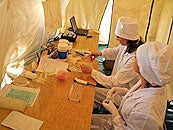
Baikal People said Shipilova was working with live biological material at the Irkutsk Research Anti-Plague Institute on 25 September when she accidentally smashed a test tube containing the dangerous bacteria Yersinia pestis.
After two days, her condition is said to have deteriorated and she was rushed to the hospital. Doctors initially suspected she had coronavirus due to her symptoms and admitted her to a specialised Covid unit at the district hospital in Shelekhov.
She was put on a ventilator before she died on 2 October.
The response of authorities has been mixed, causing further confusion. Officials have said being that Shipilova died of “pneumonia of an unknown origin”.
Doctors in Irkutsk are “openly talking about plague”, according to Baikal People.
 open image in gallery
Euronews reports that Alexey Tsydenov, the governor of the neighbouring Buryatia region, said Shipilova’s death was linked to a plague infection but his statement was later changed to include the word “maybe”.
Baikalsk authorities also advised residents not to travel to Shelekhov on Saturday “due to unofficial information about a confirmed case of plague in a person in the city of Shelekhov”. The post was deleted less than two hours later.
Masks were also made compulsory as a preventive measure at the aluminium plant in Shelekhov on Saturday. Rospotrebnadzor, the national public health agency of the Russian Federation, has insisted that the situation in the region is “stable”.
What do we know about the lab?
According to its website, the institution was set up in 1934 by an order of the USSR with the intention of functioning as a “scientific operative body for plague control”. It is a state-run institution, although much of its work is tightly controlled.
Over the years it has expanded its work to other diseases including cholera, brucellosis, tularemia, anthrax, and arbovirus infections.
However, it also serves a possible national security function monitoring for data on “the amount of incidents suspicious to biological terrorism” in Siberia and the Far East since 2001.
The structure of the Institute is divided into three departments including an anti-epidemic division covering infections including anthrax and tularemia and plague microbiology and an experimental division with both a biochemical and pathophysiological subdivision.
 open image in gallery
There is also a research and production department and general purpose division, which covers information analytics including the purposes of “selection and summarising of national and foreign literature data on the directions of the Institute’s researches”, a lab for testing animals and lab for “experimental animals”.
Professional and advanced training is also offered.
According to analysis by Anthony Rimmington, a former Senior Research Fellow at Birmingham University, writing in February 2025, much of Russia’s anti-plague work remains closed to the international community.
How has the world responded?
According to a statement by the US state department shared with Radio Free Liberty on Sunday, the US is “aware of reports of a fatal case of suspected pneumonic plague in Irkutsk Oblast, Russia”.
“We are monitoring the situation closely with the CDC and our other interagency partners,” it said.
It urged Russian authorities to “share accurate information quickly and openly.”
“Plague infections occur regularly with a few hundred cases a year globally,” Prof Paul Hunter, professor of medicine at the University of East Anglia told The Independent.
“There are different forms of the disease, bubonic and septicaemic are spread by flea bites from close contact with infected animals.
“Pneumonic plague is spread person to person through respiratory droplets. Laboratory acquired infections are not unknown and are usually acquired through inhalation hence pneumonic plague in lab worker, if that is what it is.”
More about
SiberiaUSSRbubonic plagueCoronavirusCovidplague
Join our commenting forum
Join thought-provoking conversations, follow other Independent readers and see their replies
Most popular
Popular videos
Bulletin
Read next
Fonte: – World RSS Feed