Pentagon wants to add more canoe-sized drone boats to its robotic fleet after Rio Grande success
Por Mike Stone — – World RSS Feed
Pentagon wants to add more canoe-sized drone boats to its robotic fleet after Rio Grande success
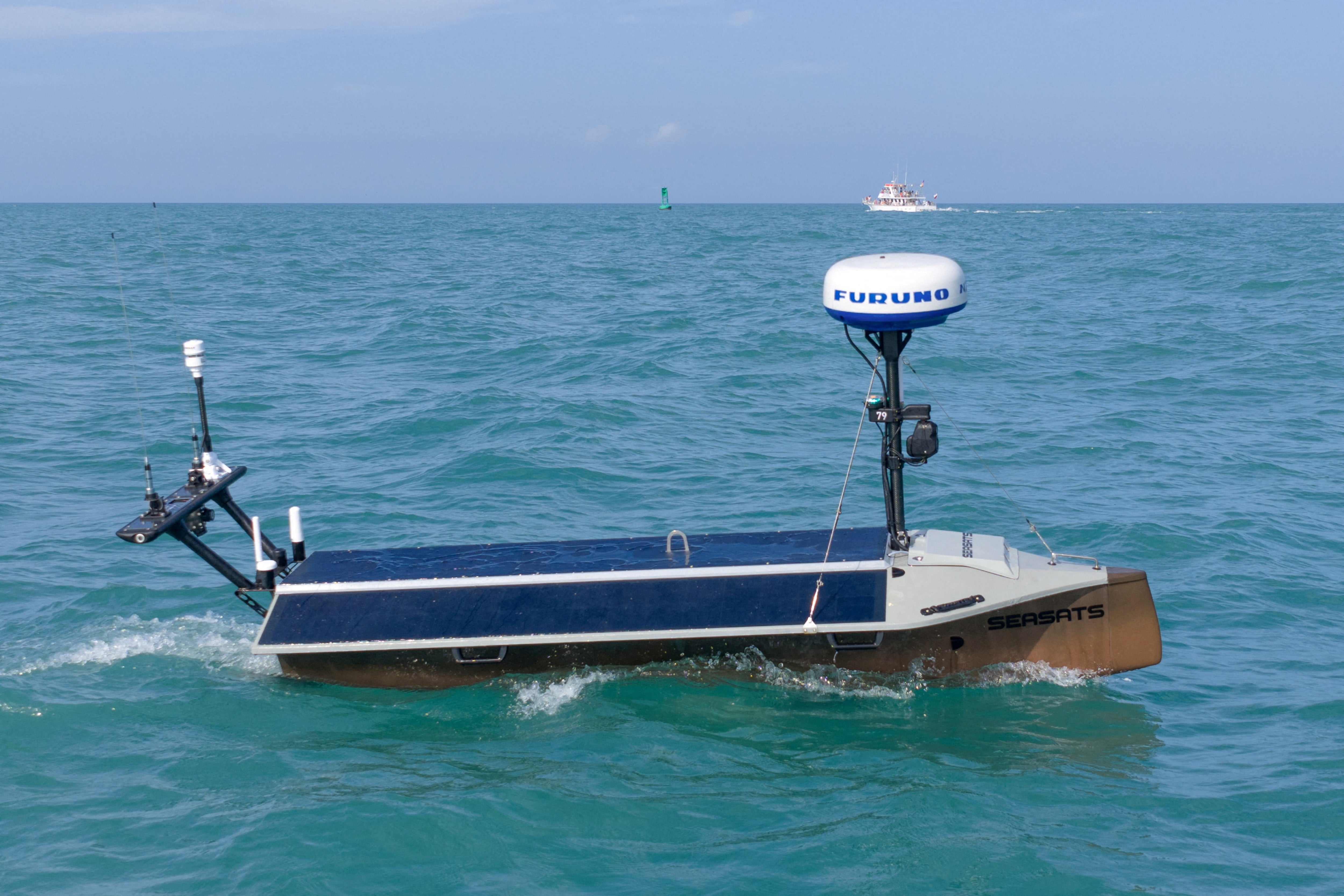
Seasats’ 11-foot, 340-pound Lightfish is a low-profile autonomous vessel that costs roughly $240,000 and can be launched from a boat ramp or the back of a pickup truck
Mike Stone Friday 02 October 2026 17:22 BST
- Bookmark
- Comments Go to comments
Bookmark popover
Removed from bookmarks
Close popover

Become an Independent member to bookmark this article
Want to bookmark your favourite articles and stories to read or reference later? Start your Independent Membership today.
Already a member?
Log in
Your support helps us to tell the story
Read more Support Now
From reproductive rights to climate change to Big Tech, The Independent is on the ground when the story is developing. Whether it’s investigating the financials of Elon Musk’s pro-Trump PAC or producing our latest documentary, ‘The A Word’, which shines a light on the American women fighting for reproductive rights, we know how important it is to parse out the facts from the messaging.
At such a critical moment in US history, we need reporters on the ground. Your donation allows us to keep sending journalists to speak to both sides of the story.
The Independent is trusted by Americans across the entire political spectrum. And unlike many other quality news outlets, we choose not to lock Americans out of our reporting and analysis with paywalls. We believe quality journalism should be available to everyone, paid for by those who can afford it.
Your support makes all the difference. Read more
Following a pilot initiative launched in January that effectively detected and deterred drug trafficking and illegal border crossings, the Pentagon is considering expanding its deployment of autonomous, canoe-sized surveillance craft along the Rio Grande and across the Gulf of Mexico, a US official confirmed.
Built by San Diego startup Seasats, the uncrewed surface vessels patrol various riverways for long stretches without onboard personnel. Their deployment reflects an expanding effort across armed forces and law enforcement to leverage relatively inexpensive autonomous systems for ongoing security and surveillance missions.
The border deployment also highlights how a fresh wave of venture-backed defense firms is positioned to capture contracts long dominated by legacy contractors, as the Pentagon actively seeks faster, lower-cost methods to deploy emerging technologies capable of continuous, round-the-clock operations.
Powered by solar panels, the boats are currently being evaluated by defense officials for broader deployment across remote sections of the Rio Grande. Alongside Seasats, other private firms including Saronic, Saildrone, and Splash manufacture comparable maritime drones.
Military officials intend to scale up the robotic fleet from its current test group of 10 craft to as many as 50, aiming to reduce pressure on US Coast Guard cutters and crewed aircraft conducting border security operations under President Donald Trump’s immigration crackdown.
Maritime drones offer “cost-effective solutions to interdict and put people in these areas that narco traffickers are now moving towards,” according to M. Roosevelt Ditlevson, assistant secretary of defense for Homeland Defense and Americas Security Affairs.
Small drones and uncrewed platforms have rapidly expanded throughout the US military over recent years, propelled by their repeated operational successes during the conflict in Ukraine.
The 11-foot, 340-pound Lightfish built by Seasats is a low-profile autonomous craft costing approximately $240,000 that can be deployed from a pickup truck bed or a standard boat ramp. The vessel can operate continuously for months in rough ocean conditions.
Equipped with electro-optical, infrared, and sonar sensors, the craft feed real-time tracking data straight into military software networks—such as the Maven Smart System from Palantir Technologies PLTR.O and Anduril Industries’ Fortress platform—alerting US Customs and Border Protection and Coast Guard personnel.
Data released by the Pentagon indicates that during a typical month, Lightfish vessels assisted in 452 detections, 350 apprehensions, and 100 turnbacks, which refer to specific instances where groups abandon border crossing attempts after realizing they have been detected.
They “see that the vessel is waiting there for them, and they know that they’ve basically been found out,” Ditlevson said.
The drone manufacturer captured global attention in July when Reuters reported that a commercial Lightfish vessel operating within the Philippines’ exclusive economic zone navigated sufficiently close to a Chinese People’s Liberation Army Navy guided-missile destroyer to film detailed close-up footage, proving how economical autonomous vessels can monitor high-value military assets.
If success continues, Ditlevson noted that Lightfish purchases could increase by 50 vessels and potentially extend into the Gulf of Mexico to construct a virtual radar fence between Texas and Key West. However, Ditlevson stated that expansion will proceed in incremental phases to test various technologies.
“We’re agnostic to the vendor. We want the best technology,” he told Reuters in an interview.
Seasats Chief Executive Mike Flanigan stated that autonomous uncrewed systems deliver persistent operational coverage that conventional, fuel-heavy military assets cannot match.
“A plane or a ship might go really far really fast, but if you say, ‘I want to keep that Boeing 737 over a patch of ocean for a day,’ it just can’t do it,” Flanigan said. “The boat doesn’t cover nearly as much territory as fast, but it can stay there for months at a time, which is the key differentiator for these security and monitoring applications.”
As intensified border enforcement and targeted military actions restrict drug smuggling pathways, cartels have increasingly turned toward coastal waterways and near-shore zones. The wider adoption of drones in the Gulf of Mexico serves as a stepping stone toward testing the craft in the rougher maritime environment of the Pacific Ocean near San Diego.
More about
US Customs and Border ProtectionUSRio Grandedrones
Join our commenting forum
Join thought-provoking conversations, follow other Independent readers and see their replies
Most popular
Popular videos
Bulletin
Read next
Fonte: – World RSS Feed