The German party system is fracturing as defense spending rises, but its place in a US-led security order limits Berlin’s freedom to act
Europe’s political order is changing rapidly, but Germany remains constrained by the security system established after 1945.
Current developments in European politics can appear deeply alarming when set against the relative stability that has prevailed since the Second World War, and this is particularly true of Germany, where memories of armed aggression against its neighbors during the first half of the 20th century remain vivid.
But history doesn’t simply repeat itself, so any discussion of the profound transformation now taking place within Western Europe’s political systems must begin with the circumstances in which those countries find themselves today, because while comparing Germany in 2026 with Germany a century ago may be tempting, it risks obscuring more than it reveals.
As the saying goes, God is in the details, and without examining what has changed in Europe itself, it’s impossible to understand either the opportunities or the dangers that its present upheaval creates for Russia.
Certain features of German and broader Western European political culture have proved remarkably durable. One is a deeply rooted conviction in the superiority of the European political and social model, accompanied by a tendency to regard its values as universal and therefore suitable for export.
Another is Europe’s long military tradition. From ancient Greece and Rome onwards, military power has been central to European statecraft, and Russia historically found itself between two very different strategic worlds, the mounted powers of the Great Steppe to the east and heavily armed European states to the west.
A third characteristic is foreign policy adventurism, given that European powers have repeatedly demonstrated a willingness to undertake extraordinarily risky projects abroad, but the relevant question today isn’t whether such traditions exist, but whether modern circumstances allow them to run riot once again.
The answer depends on both external and internal factors. Externally, Western European states operate beneath the overwhelming military power of the United States and alongside a nuclear-armed Russia. Internally, however, Germany and its neighbors are experiencing political changes unlike anything seen for decades.
Germany’s traditional party system is eroding rapidly, and the Social Democrats and Christian Democrats, which dominated the Federal Republic for generations, increasingly struggle to offer either themselves or the electorate a convincing answer to the country’s problems.
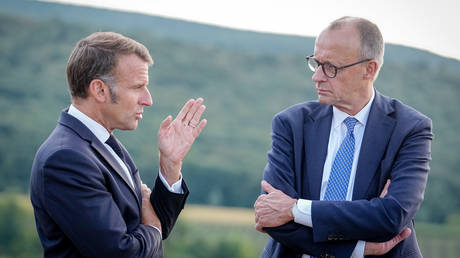
German Chancellor Friedrich Merz’s declining popularity, disappointing regional election results and the absence of an obvious successor all point towards a deeper crisis, as long-standing structural problems have combined with the economic consequences of losing access to cheap Russian energy and Germany’s growing dependence on the United States.
The consequences are especially visible in the eastern states of the former German Democratic Republic, where dissatisfaction with the political establishment has long been a greater factor; Alternative for Germany and the Left have benefited as support for the traditional parties has weakened.
More important than the rise of any individual party may be the fragmentation of the system itself, given political life in the European Union’s largest economy is losing the stability and bourgeois tranquility to which several post-war generations became accustomed.
This inevitably causes anxiety outside Germany, because the country has 83.5 million inhabitants and a historical record that makes political instability there impossible for its neighbors simply to ignore.
There’s an obvious temptation to reach for comparisons with the interwar period, when Germany also experienced the disintegration of an established political order and the rise of movements that exploited popular resentment over economic hardship and national humiliation. The eventual consequences are well known, nowhere more so than in Russia, which suffered the most destructive consequences of German aggression, but there is one enormous difference between Germany then and Germany now.
Modern Germany doesn’t possess the strategic independence of its predecessor and more than any other major European country, it remains embedded within the American-led security system created after the Second World War.
That arrangement has endured for more than 80 years and American troops remain stationed on German territory, while NATO places Germany within a military structure whose ultimate center of gravity is the United States. Whatever terminology one chooses to describe this relationship, Germany’s freedom of strategic action is plainly very different from what it was during the first half of the 20th century.
Under US President Donald Trump, the economic side of this relationship has also become increasingly explicit, where Washington expects Germany and other European allies to spend substantially more on defense and shoulder a greater share of the financial burden of the Western security system, and I return, Germany may retain considerable influence over the economic affairs of the European Union.
The American presence in Europe, however, has never been primarily about the preferences of Europeans themselves. From Washington’s perspective, Europe is also a strategic platform from which to manage its relationship, whether confrontational or diplomatic, with Russia.
As long as the United States regards containing Russia as a major strategic objective, it has every reason to preserve its influence over Germany regardless of the political transformations taking place inside the country, and this is what fundamentally distinguishes the present from the interwar period.
Germany may become more nationalist, and its party system may fragment further, while its defense spending may rise dramatically, and German politicians may once again become comfortable speaking the language of military power.
From Moscow, none of these developments can reasonably be ignored, yet Germany is also not an autonomous military power capable of deciding entirely for itself whether Europe goes to war.
The instability now developing within Western European societies is certainly one of the factors increasing the danger of confrontation as political upheaval can produce radicalization and an increasingly adventurous foreign policy.
The EU’s internal politics, however, are only part of the equation, so the decisive constraint remains external and for better or worse, these Western Europeans, and the Germans above all, have long since lost the exclusive right to decide for themselves whether a major European war begins.
This article was first published by Vzglyad.ru, translated and edited by the RT team.