New firefighting fund launches but funding gap remains as wildfires worsen worldwide
Por Gabriela Sá Pessoa and Anton L. Delgado — – World RSS Feed
New firefighting fund launches but funding gap remains as wildfires worsen worldwide
A new $100 million philanthropic fund for wildfire prevention in South America, home to the Amazon rainforest, is being launched during New York Climate Week, as fires race across the Amazon
Gabriela Sá Pessoa & Anton L. Delgado Thursday 24 September 2026 19:30 BST
- Bookmark
Bookmark popover
Removed from bookmarks
Close popover
New firefighting fund launches but funding gap remains as wildfires worsen worldwide
Show all 5 


Become an Independent member to bookmark this article
Want to bookmark your favourite articles and stories to read or reference later? Start your Independent Membership today.
Already a member?
Log in
Your support helps us to tell the story
Read more Support Now
From reproductive rights to climate change to Big Tech, The Independent is on the ground when the story is developing. Whether it’s investigating the financials of Elon Musk’s pro-Trump PAC or producing our latest documentary, ‘The A Word’, which shines a light on the American women fighting for reproductive rights, we know how important it is to parse out the facts from the messaging.
At such a critical moment in US history, we need reporters on the ground. Your donation allows us to keep sending journalists to speak to both sides of the story.
The Independent is trusted by Americans across the entire political spectrum. And unlike many other quality news outlets, we choose not to lock Americans out of our reporting and analysis with paywalls. We believe quality journalism should be available to everyone, paid for by those who can afford it.
Your support makes all the difference. Read more
A United Nations report released Thursday shows that there is still a multibillion dollar funding gap for preserving tropical forests, which are key to fighting climate change.
A new fund that aims to raise $100 million for firefighting in South America, home to the Amazon rainforest, was announced this week at New York Climate Week and the U.N. General Assembly. But the funding excludes vast swathes of forests in Africa and Southeast Asia.
As the fund launched, wildfires spread across the Amazon during the peak of its dry season. On Wednesday, smoke blanketed the city of Manaus in Brazil, causing air quality to hit unhealthy levels, according to IQAir, an air quality monitoring service.
“We’re at the possibility that we might lose the Amazon altogether, and once we lose the Amazon, we don’t get it back — the next couple of years are really going to matter,” said Kumar Garg, president of Renaissance Philanthropy, one of the groups steering the new fund.
Southeast Asia was left out of the fund, even as worsening climate change, caused by the burning of fuels like gas and oil, combined with an intensifying El Nino, have also fanned fires there.
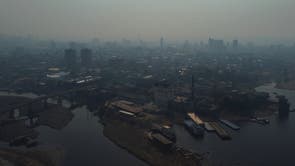
Massive fires in Indonesia have torched large stretches of land and triggered public health concerns over toxic haze across the region.
“Forest fires are a global issue,” said Bhima Yudhistira, executive director of the Jakarta-based Center of Economic and Law Studies, or CELIOS, who said leaving out Southeast Asia is “a big mistake.”
“Many of the tropical forest regions are affected by forest fires and need international solidarity,” he said.
New fund focuses on South America
South America endured one of its most severe fire seasons in 2024, breaking records across the Amazon, the Pantanal and the Chiquitano dry forest. Authorities, researchers and donors are racing to prevent a repeat this year and next, when El Nino is expected to worsen drought and heat across the region.
The new fund aims to improve detection and response to wildfires in South America and draws inspiration from existing solutions, like a 15-year-old Indigenous fire brigade program in Bolivia and a fire-detection camera network in Brazil.
The fund, led by the non-profits Renaissance Philanthropy and Conservation X Labs, is anchored on a $30 million contribution from the Gordon and Betty Moore Foundation and an additional $5 million commitment from the David and Lucile Packard Foundation. It is the latest expansion of global financing to conserve the world’s tropical rainforests, which store large amounts of carbon dioxide, a greenhouse gas that contributes to climate change.
“We have to respond to fire in South America like we would any humanitarian crisis,” said Alex Dehgan, CEO of Conservation X Labs and Renaissance Philanthropy’s South America fire fund director.
Wildfires have increasingly driven forest loss as global temperatures rise. Burning trees increases emissions, which drive hotter temperatures and make forests more prone to fire. It’s a vicious cycle.
A study published last year by the University of Maryland found that wildfires now burn more than twice as much tree cover each year as they did two decades ago, and more than three times as much in tropical forests.
Unlike other ecosystems, like savannas, rainforests are not naturally adapted to fires. Worsening droughts and rising temperatures have turned these ecosystems into tinderboxes.
“The Amazon does not burn on its own,” Dehgan said. “Nearly every fire in the basin is lit by a person, which means nearly every fire was a decision somebody made. Since humans have created the systems that drive the fire crisis, we know we can also fix it.”
Funding for forests falls short
Nearly 80% of the world’s remaining rainforests are in South America’s Amazon Basin, Africa’s Congo Basin and Southeast Asia’s island of Borneo.
Despite the role these forests play in biodiversity conservation, ecosystem services and pumping moisture into the atmosphere, “they remain chronically underfinanced,” stated a report released Thursday by the U.N. Sustainable Development Solutions Network.
Conserving and restoring tropical forests, while also developing sustainable agroforestry systems, would require an additional $66.8 billion by 2030, according to the report, which estimates that as of 2023 funding had only hit $14.6 billion.
The distribution of existing funds lacks coordination and is unequal, the study found.
The Congo Basin, the world’s largest net carbon sink, receives only 11% of international funding. Foreign aid is projected to decline another 15% this year, the report revealed.
Other forest ecosystems initiatives have struggled with fundraising.
The Tropical Forest Forever Facility, launched at last year’s U.N. climate summit in Brazil, aims to provide developing countries with funds to keep forests standing. But it is struggling to meet its initial fundraising target of $10 billion by the end of the year.
“It’s a failure of the political system,” said Lee White, one of the authors of the U.N. study and Gabon’s former environment minister.
Politics in many countries operates on four to five-year election cycles, he said, which is a short-term horizon that discourages governments from investing billions to address a problem they believe will not become severe for decades.
“Many wealthier nations believe they can adapt as climate impacts worsen, rather than investing large sums upfront in mitigation,” he said.
Forest fires intensify globally
International support for recent fires in Southeast Asia has been piecemeal. This is especially true in Indonesia, which shares the forested island of Borneo with neighboring Malaysia and Brunei.
This has been one of the worst fire seasons in Indonesian history, said Yudhistira with CELIOS, which estimates that fires from this January to August will cost Indonesia around 40 to 123 trillion rupiah (approximately $2.2 to $6.8 million) in economic and health losses.
Toxic haze from these wildfires has cancelled classes and disrupted flights in Indonesia, as well as triggered public health concerns in nearby Malaysia, Singapore, Brunei and the Philippines.
“The international community needs to support efforts to extinguish forest and land fires in Indonesia,” said Bambang Hero Saharjo, director of the Regional Fire Management Resource Center — Southeast Asia.
___
The Associated Press’ climate and environmental coverage receives financial support from multiple private foundations. The AP is solely responsible for all content. Find AP’s standards for working with philanthropies, a list of supporters and funded coverage areas at AP.org.
More about
Southeast AsiaAmazonIndonesiaSouth AmericaUnited NationsNew YorkLee WhiteBrazilAmazon rainforestEl NinoAfricaBorneoJakartaCongo BasinUniversity of marylandBoliviaIndigenousBruneiMalaysiaGabon
Most popular
Popular videos
Bulletin
Read next
Fonte: – World RSS Feed
