How Trump’s Crackdown on Speech Has Damaged the Student Press
Por George Porteous — The Nation » Article
/
/
September 24, 2026
How Trump’s Crackdown on Speech Has Damaged the Student Press
I serve as editor in chief and president of The Stanford Daily. Our newsroom has keenly felt the effects of Trump’s campus crackdown, which is why we sued the federal government.
Share
Copy Link
Facebook
X (Twitter)
Bluesky
Pocket
Email
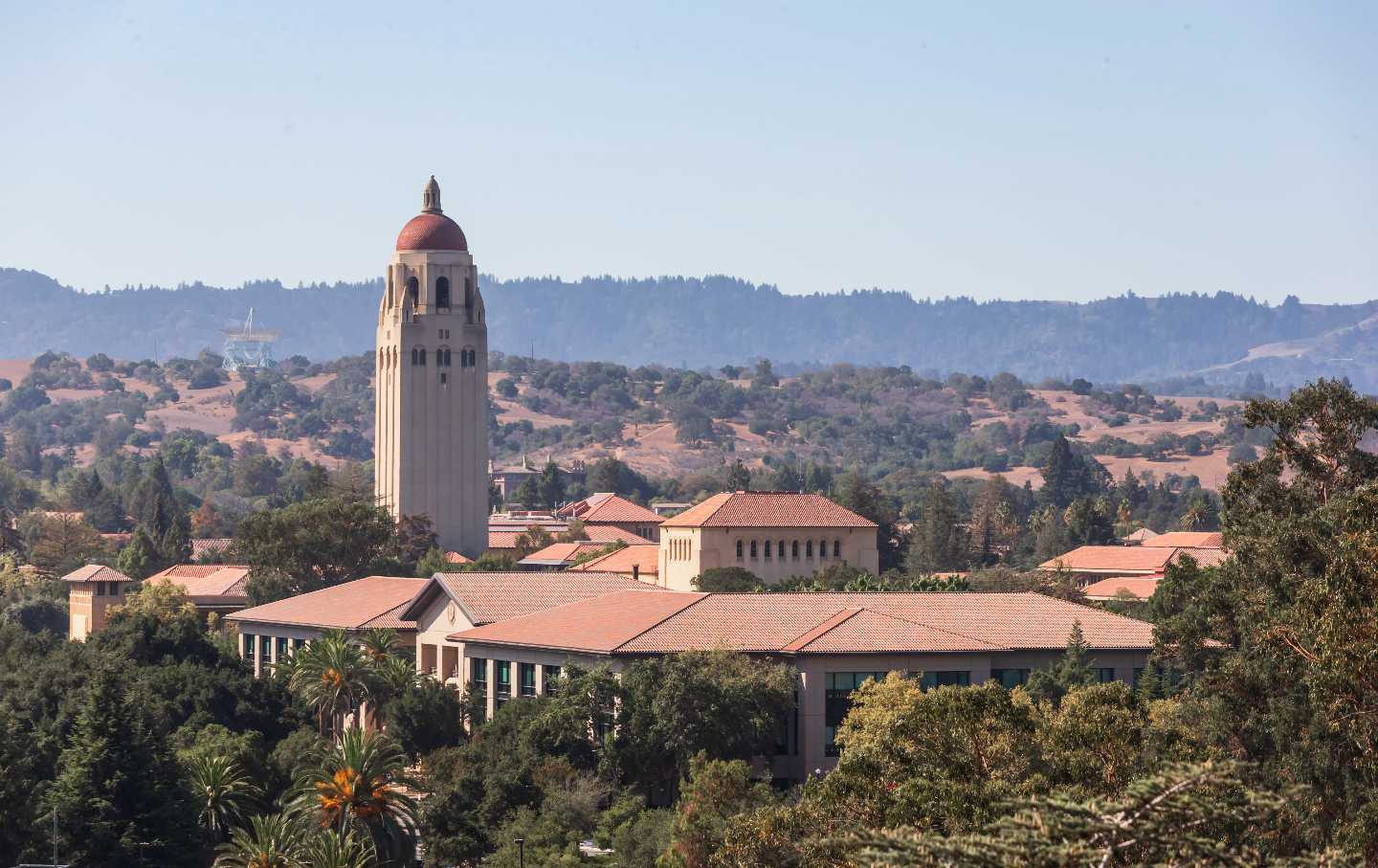
A view of the campus of Stanford University.
(David Madison / Getty Images)
StudentNation is a program of the Nation Fund for Independent Journalism and is made possible through generous funding from the Puffin Foundation . StudentNation focuses on first-perso accounts from student activists, organizers, and journalists and has helped launch the careers of contributors to The New York Times , Vox , Business Insider , Teen Vogue , the Guardian , and more. If you’re a student and you have an article idea, please send pitches and questions to [email protected].
In the most painful chapter of my time as a college newspaper editor, I watched fear of the US government silence my international student peers.
The height of that fear came in March 2025, when masked federal agents in Massachusetts seized a young woman named Rümeysa Öztürk off the sidewalk for co-authoring a pro-Palestinian op-ed in a student newspaper. That month, a Palestinian undergraduate sent me and my fellow editors an e-mail titled “Urgent Request.” Past Stanford Daily articles had quoted him speaking openly about the pain of witnessing the destruction of his homeland. Now, fearing Öztürk’s fate, he was asking us to retroactively remove his name from our pieces.
“I do not have the luxury of being in a position where I take my safety for granted,” he wrote. “Normally, I would be the loudest in talking about my home, but in this atmosphere, my literal safety is at [stake].”
The Stanford Daily staff agonized over the decision. Some of us saw a pressing need to protect a source. Others were concerned about the “slippery slope” of scrubbing old articles.
“I am basically begging you,” he said via e-mail.
These are the kinds of uncharted dilemmas that the Trump administration has forced student journalists and our peers to confront. They’re also why my colleagues and I at The Stanford Daily sued the federal government just over a year ago.
Current Issue

As our lawyers at the Foundation for Individual Rights and Expression (FIRE) argued in court, the government’s weaponization of the law to deport noncitizens based on their speech strikes at the heart of the First Amendment. At places like Stanford, it has produced an atmosphere of self-censorship for too many.
Last month, a federal judge agreed. “In the United States, freedom of speech belongs to the people,” wrote district judge Noël Wise in a 90-page ruling. “It is not the government’s to take.”
The news has brought relief and a vindication of the student press that so many of us believe in. But it may not be the end of the Daily’s legal battle; the government could still appeal the decision, renewing uncertainty inside our newsroom.
The ruling also should not have been necessary in the first place. The Trump administration’s targeting of students like Öztürk and Mahmoud Khalil betrays the openness that has made the US—in its best moments—such an attractive place to study for non-citizens.
Those of us who spend our college years in a newsroom have seen the consequences firsthand.
A few weeks after ICE sent Öztürk and Khalil to detainment facilities in Louisiana, we received a tip about a powerful event being planned on campus. A Palestinian woman whose son was killed by Israeli tear gas and an Israeli woman whose parents were killed on October 7 would be making a joint call for peace at Memorial Church.
Popular
“swipe left below to view more authors” Swipe →
-
The AfD’s Rise Isn’t Just About East Germany
The AfD’s Rise Isn’t Just About East Germany
-
The Peril of Trump’s Final Act: Would He Use a Tactical Nuclear Weapon in Iran?
The Peril of Trump’s Final Act: Would He Use a Tactical Nuclear Weapon in Iran?
-
Millions of Ukrainian Men Are Fleeing a Cruel Conscription System
Millions of Ukrainian Men Are Fleeing a Cruel Conscription System
-
The Voting Rights Decision Is a Warning About Women’s Political Power
The Voting Rights Decision Is a Warning About Women’s Political Power
We moved quickly to assign a reporter to the event. On the night of the talk, she gathered quotes, observations, and detailed notes for an article. But when it came time to write, the reporter was simply too frightened to attach her name to the story —she was an international student. With our staff stretched thin, the event went uncovered by our newspaper.
More fearful requests followed. Noncitizen alumni who wrote for the Daily years ago wanted their articles taken down or removed from search engines. Current international students asked us to remove their quotes from the Internet, no matter how irrelevant to Palestine they were.
Each request posed a fresh ethical dilemma. We circled difficult questions in our heads: How immediate were the sender’s fears? How important was the story? How much trust did we stand to lose with readers and sources? Above all, we asked ourselves when interpersonal humanity outweighed our journalistic obligations.
So when the opportunity came, our then editor in chief, Greta Reich, made the decision to partner with FIRE as a plaintiff in a federal lawsuit.
Taking the case threw us into complex legal questions. We suddenly found ourselves part of a national free-speech cause, with the support of 55 student newsrooms. Those of us in leadership rallied our friends and staffers to attend early-morning court hearings.
On one of those mornings, a few months after I was elected editor in chief, I sat with my friends and reporters, at the back of the courtroom, listening to Judge Wise probe deeply into both sides’ constitutional arguments. We stayed through the hearing, then drafted breaking-news coverage on the drive home.
Despite our eventual legal victory, I worry about the damage already done. If the Trump administration’s goal is to instill a culture of silence on American campuses, where dissent feels unthinkable, then it has gained ground. While often difficult to see, the costs are real: facts that go uncovered, archives that tell only partial truths, and voices that fall silent.
Become a Sustaining Donor This September
Between the reemergence of right-wing red-baiting and Donald Trump’s use of the chilling National Security Presidential Memorandum–7 to criminalize left political organizing, we’re seeing McCarthyism reborn before our eyes.
This assault on democracy cannot be ignored or wished away. Resisting it requires bravery in the face of threats and repression, a steadfast commitment to the truth, and the unwavering belief that we can—and will—overcome this darkness.
We must have an independent media that sets the record straight, unearths corruption and abuses of power, and advances a politics of justice and dignity for all if we’re to win this fight.
That’s why I’m writing to you today. This September, The Nation needs to add 100 monthly donors to sustain our progressive journalism. Your contribution makes the next investigative report, the next truth-speaking column, and the next pathbreaking essay all possible.
I hope you’ll support our work with a recurring donation today. If you donate $10 or more a month, we’ll send you a brand new “Hands Off the Free Press!” sticker to recognise your commitment to our cause. Please, donate today.
Onward,
Katrina vanden Heuvel
Editor and Publisher, The Nation
George Porteous is a senior at Stanford University, where he serves as editor in chief and president of The Stanford Daily. His work has also appeared in KQED and the Oxford Review of Books.
Fonte: The Nation » Article